Kenichi Kanatani – författare
Visar alla böcker från författaren Kenichi Kanatani. Handla med fri frakt och snabb leverans.
12 produkter
12 produkter
Del 37 - Oxford Engineering Science Series
Geometric Computation for Machine Vision
Inbunden, Engelska, 1993
4 549 kr
Skickas inom 7-10 vardagar
Machine vision is the study of how to build intelligent machines which can understand the environment by vision. Among many existing books on this subject, this book is unique in that the entire volume is devoted to computational problems, which most books do not deal with. One of the main subjects of this book is the mathematics underlying all vision problems - projective geometry, in particular. Since projective geometry has been developed by mathematicians without any regard to machine vision applications, our first attempt is to `tune' it into the form applicable to machine vision problems. The resulting formulation is termed computational projective geometry and applied to 3-D shape analysis, camera calibration, road scene analysis, 3-D motion analysis, optical flow analysis, and conic image analysis.A salient characteristic of machine vision problems is that data are not necessarily accurate. Hence, computational procedures defined by using exact relationships may break down if blindly applied to inaccurate data. In this book, special emphasis is put on robustness, which means that the computed result is not only exact when the data are accurate but also is expected to give a good approximation in the prescence of noise. The analysis of how the computation is affected by the inaccuracy of the data is also crucial. Statistical analysis of computations based on image data is also one of the main subjects of this book.
Inbunden, Engelska, 2020
1 279 kr
Skickas inom 10-15 vardagar
3D rotation analysis is widely encountered in everyday problems thanks to the development of computers. Sensing 3D using cameras and sensors, analyzing and modeling 3D for computer vision and computer graphics, and controlling and simulating robot motion all require 3D rotation computation. This book focuses on the computational analysis of 3D rotation, rather than classical motion analysis. It regards noise as random variables and models their probability distributions. It also pursues statistically optimal computation for maximizing the expected accuracy, as is typical of nonlinear optimization. All concepts are illustrated using computer vision applications as examples.Mathematically, the set of all 3D rotations forms a group denoted by SO(3). Exploiting this group property, we obtain an optimal solution analytical or numerically, depending on the problem. Our numerical scheme, which we call the "Lie algebra method," is based on the Lie group structure of SO(3).This book also proposes computing projects for readers who want to code the theories presented in this book, describing necessary 3D simulation setting as well as providing real GPS 3D measurement data. To help readers not very familiar with abstract mathematics, a brief overview of quaternion algebra, matrix analysis, Lie groups, and Lie algebras is provided as Appendix at the end of the volume.
Häftad, Engelska, 2022
719 kr
Skickas inom 10-15 vardagar
3D rotation analysis is widely encountered in everyday problems thanks to the development of computers. Sensing 3D using cameras and sensors, analyzing and modeling 3D for computer vision and computer graphics, and controlling and simulating robot motion all require 3D rotation computation. This book focuses on the computational analysis of 3D rotation, rather than classical motion analysis. It regards noise as random variables and models their probability distributions. It also pursues statistically optimal computation for maximizing the expected accuracy, as is typical of nonlinear optimization. All concepts are illustrated using computer vision applications as examples.Mathematically, the set of all 3D rotations forms a group denoted by SO(3). Exploiting this group property, we obtain an optimal solution analytical or numerically, depending on the problem. Our numerical scheme, which we call the "Lie algebra method," is based on the Lie group structure of SO(3).This book also proposes computing projects for readers who want to code the theories presented in this book, describing necessary 3D simulation setting as well as providing real GPS 3D measurement data. To help readers not very familiar with abstract mathematics, a brief overview of quaternion algebra, matrix analysis, Lie groups, and Lie algebras is provided as Appendix at the end of the volume.
Häftad, Engelska, 2020
740 kr
Skickas inom 10-15 vardagar
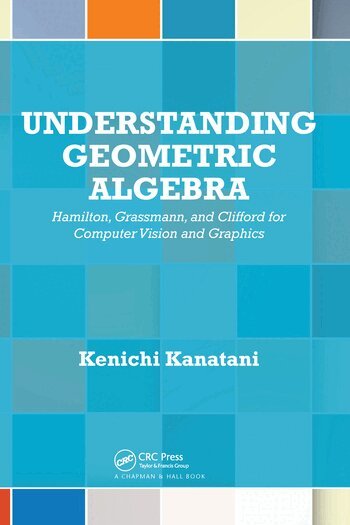
Understanding Geometric Algebra: Hamilton, Grassmann, and Clifford for Computer Vision and Graphics introduces geometric algebra with an emphasis on the background mathematics of Hamilton, Grassmann, and Clifford. It shows how to describe and compute geometry for 3D modeling applications in computer graphics and computer vision.Unlike similar texts, this book first gives separate descriptions of the various algebras and then explains how they are combined to define the field of geometric algebra. It starts with 3D Euclidean geometry along with discussions as to how the descriptions of geometry could be altered if using a non-orthogonal (oblique) coordinate system. The text focuses on Hamilton’s quaternion algebra, Grassmann’s outer product algebra, and Clifford algebra that underlies the mathematical structure of geometric algebra. It also presents points and lines in 3D as objects in 4D in the projective geometry framework; explores conformal geometry in 5D, which is the main ingredient of geometric algebra; and delves into the mathematical analysis of camera imaging geometry involving circles and spheres.With useful historical notes and exercises, this book gives readers insight into the mathematical theories behind complicated geometric computations. It helps readers understand the foundation of today’s geometric algebra.
Häftad, Engelska, 2005
303 kr
Skickas inom 3-6 vardagar
Inbunden, Engelska, 2015
1 155 kr
Skickas inom 10-15 vardagar
Understanding Geometric Algebra: Hamilton, Grassmann, and Clifford for Computer Vision and Graphics introduces geometric algebra with an emphasis on the background mathematics of Hamilton, Grassmann, and Clifford. It shows how to describe and compute geometry for 3D modeling applications in computer graphics and computer vision.Unlike similar texts, this book first gives separate descriptions of the various algebras and then explains how they are combined to define the field of geometric algebra. It starts with 3D Euclidean geometry along with discussions as to how the descriptions of geometry could be altered if using a non-orthogonal (oblique) coordinate system. The text focuses on Hamilton’s quaternion algebra, Grassmann’s outer product algebra, and Clifford algebra that underlies the mathematical structure of geometric algebra. It also presents points and lines in 3D as objects in 4D in the projective geometry framework; explores conformal geometry in 5D, which is the main ingredient of geometric algebra; and delves into the mathematical analysis of camera imaging geometry involving circles and spheres.With useful historical notes and exercises, this book gives readers insight into the mathematical theories behind complicated geometric computations. It helps readers understand the foundation of today’s geometric algebra.
Häftad, Engelska, 2016
561 kr
Skickas inom 10-15 vardagar
Computational methods discussed are broadly organized into ones forsimple keywords, ones going beyond keywords toward natural language, and ones considering sequential aspects of natural language.
Häftad, Engelska, 2016
671 kr
Skickas inom 10-15 vardagar
Because circular objects are projected to ellipses in images, ellipse fitting is a first step for 3-D analysis of circular objects in computer vision applications.
Häftad, Engelska, 2021
598 kr
Skickas inom 10-15 vardagar
Linear algebra is one of the most basic foundations of a wide range of scientific domains, and most textbooks of linear algebra are written by mathematicians.
Inbunden, Engelska, 2016
837 kr
Skickas inom 10-15 vardagar
This classroom-tested and easy-to-understand textbook/reference describes the state of the art in 3D reconstruction from multiple images, taking into consideration all aspects of programming and implementation. Unlike other computer vision textbooks, this guide takes a unique approach in which the initial focus is on practical application and the procedures necessary to actually build a computer vision system. The theoretical background is then briefly explained afterwards, highlighting how one can quickly and simply obtain the desired result without knowing the derivation of the mathematical detail. Features: reviews the fundamental algorithms underlying computer vision; describes the latest techniques for 3D reconstruction from multiple images; summarizes the mathematical theory behind statistical error analysis for general geometric estimation problems; presents derivations at the end of each chapter, with solutions supplied at the end of the book; provides additional material at anassociated website.
Häftad, Engelska, 2018
561 kr
Skickas inom 10-15 vardagar
Unlike other computer vision textbooks, this guide takes a unique approach in which the initial focus is on practical application and the procedures necessary to actually build a computer vision system.
Häftad, Engelska, 2004
561 kr
Skickas inom 10-15 vardagar
This book constitutes the thoroughly refereed post-proceedings of the Second International Workshop on Statistical Methods in Video Processing, SMVP 2004, held in Prague, Czech Republic in May 2004 as an ECCV 2004 workshop.The 17 revised full papers presented were carefully selected and improved during two rounds of reviewing and revision. The papers are organized in topical sections on 3D geometry, tracing, background modeling, and image and video analysis.