Kenneth E. Goodson - Böcker
Visar alla böcker från författaren Kenneth E. Goodson. Handla med fri frakt och snabb leverans.
4 produkter
4 produkter
Del 6 - Microsystems
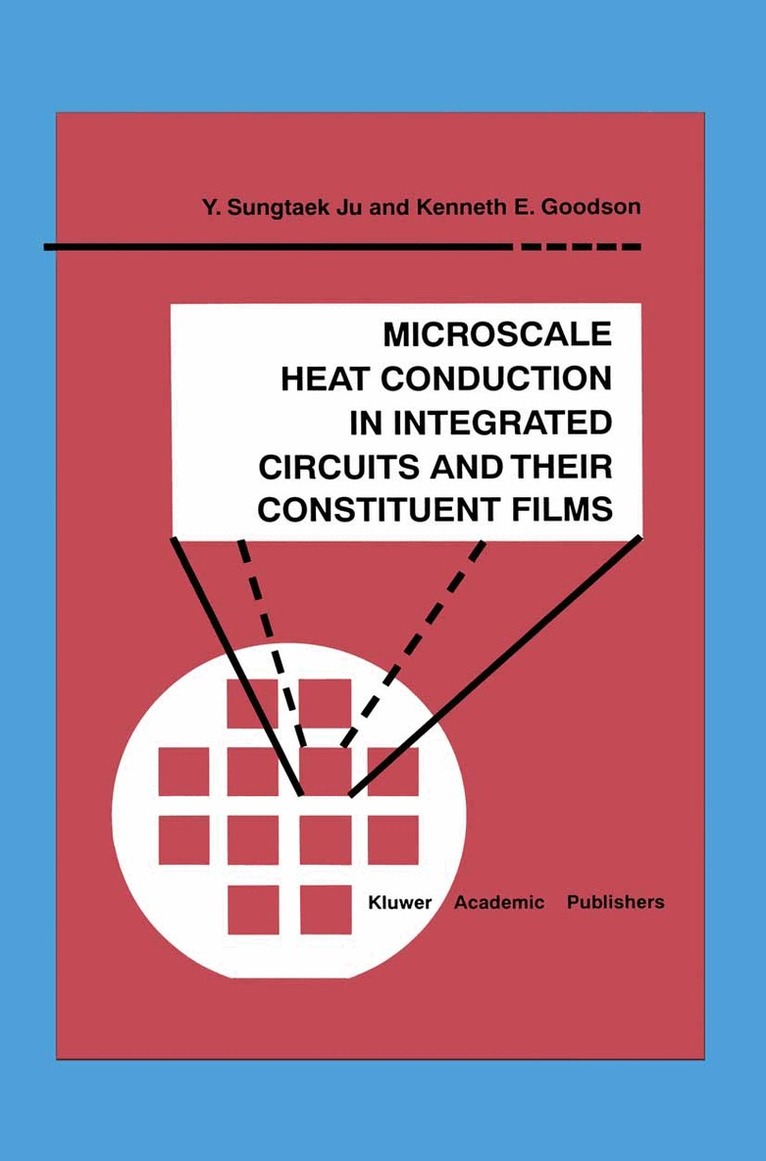
Microscale Heat Conduction in Integrated Circuits and Their Constituent Films
Inbunden, Engelska, 1999
1 064 kr
Skickas inom 10-15 vardagar
Advances in the semiconductor technology have enabled steady, exponential im- provement in the performance of integrated circuits. Miniaturization allows the integration of a larger number of transistors with enhanced switching speed. Novel transistor structures and passivation materials diminish circuit delay by minimizing parasitic electrical capacitance. These advances, however, pose several challenges for the thermal engineering of integrated circuits. The low thermal conductivities of passivation layers result in large temperature rises and temperature gradient magni- tudes, which degrade electrical characteristics of transistors and reduce lifetimes of interconnects. As dimensions of transistors and interconnects decrease, the result- ing changes in current density and thermal capacitance make these elements more susceptible to failure during brief electrical overstress. This work develops a set of high-resolution measurement techniques which de- termine temperature fields in transistors and interconnects, as well as the thermal properties of their constituent films.At the heart of these techniques is the thermore- flectance thermometry method, which is based on the temperature dependence of the reflectance of metals. Spatial resolution near 300 nm and temporal resolution near IOns are demonstrated by capturing transient temperature distributions in intercon- nects and silicon-on-insulator (SOl) high-voltage transistors. Analyses of transient temperature data obtained from interconnect structures yield thermal conductivities and volumetric heat capacities of thin films.
Del 6 - Microsystems
Microscale Heat Conduction in Integrated Circuits and Their Constituent Films
Häftad, Engelska, 2012
1 064 kr
Skickas inom 10-15 vardagar
Advances in the semiconductor technology have enabled steady, exponential im- provement in the performance of integrated circuits. Miniaturization allows the integration of a larger number of transistors with enhanced switching speed. Novel transistor structures and passivation materials diminish circuit delay by minimizing parasitic electrical capacitance. These advances, however, pose several challenges for the thermal engineering of integrated circuits. The low thermal conductivities of passivation layers result in large temperature rises and temperature gradient magni- tudes, which degrade electrical characteristics of transistors and reduce lifetimes of interconnects. As dimensions of transistors and interconnects decrease, the result- ing changes in current density and thermal capacitance make these elements more susceptible to failure during brief electrical overstress. This work develops a set of high-resolution measurement techniques which de- termine temperature fields in transistors and interconnects, as well as the thermal properties of their constituent films.At the heart of these techniques is the thermore- flectance thermometry method, which is based on the temperature dependence of the reflectance of metals. Spatial resolution near 300 nm and temporal resolution near IOns are demonstrated by capturing transient temperature distributions in intercon- nects and silicon-on-insulator (SOl) high-voltage transistors. Analyses of transient temperature data obtained from interconnect structures yield thermal conductivities and volumetric heat capacities of thin films.
1 064 kr
Skickas inom 10-15 vardagar
There is significant current interest in new technologies for IC (Integrated Circuit) cooling, driven by the rapid increase in power densities in ICs and the trend towards high-density electronic packaging for applications throughout civilian and military markets. In accordance with Moore's Law, the number of transistors on 6 Intel Pentium microprocessors has increased from 7.5 x10 in 1997 (Pentium II) to 6 55 x10 in 2002 (Pentium 4). Considering the rapid increase in the integration density, thermal management must be well designed to ensure proper functionality of these high-speed, high-power chips. Forced air convection has been traditionally used to remove the heat through a finned heat sink and fan module. 2 Currently, with 82 W power dissipation rate, approximately 62 W/cm heat flux, from a Pentium 4 processor with 3.06 GHz core frequency, the noise generated from high rotating speed fans is approaching the limit of acceptable level for humans. However, the power dissipation from a single cost-performance chip is 2 expected to exceed 100 W/cm by the year 2005, when the air cooling has to be replaced by new cooling technologies. Among alternative cooling methods, the two-phase microchannel heat sink is one of the most promising solutions. Understanding the boiling process and the two-phase flow behavior in microchannels is the key to successful implementation of such a device.
1 064 kr
Skickas inom 10-15 vardagar
There is significant current interest in new technologies for IC (Integrated Circuit) cooling, driven by the rapid increase in power densities in ICs and the trend towards high-density electronic packaging for applications throughout civilian and military markets. In accordance with Moore's Law, the number of transistors on 6 Intel Pentium microprocessors has increased from 7.5 x10 in 1997 (Pentium II) to 6 55 x10 in 2002 (Pentium 4). Considering the rapid increase in the integration density, thermal management must be well designed to ensure proper functionality of these high-speed, high-power chips. Forced air convection has been traditionally used to remove the heat through a finned heat sink and fan module. 2 Currently, with 82 W power dissipation rate, approximately 62 W/cm heat flux, from a Pentium 4 processor with 3.06 GHz core frequency, the noise generated from high rotating speed fans is approaching the limit of acceptable level for humans. However, the power dissipation from a single cost-performance chip is 2 expected to exceed 100 W/cm by the year 2005, when the air cooling has to be replaced by new cooling technologies. Among alternative cooling methods, the two-phase microchannel heat sink is one of the most promising solutions. Understanding the boiling process and the two-phase flow behavior in microchannels is the key to successful implementation of such a device.