Kevin Attell - Böcker
Visar alla böcker från författaren Kevin Attell. Handla med fri frakt och snabb leverans.
5 produkter
5 produkter
1 528 kr
Skickas inom 3-6 vardagar
Two months after the attacks of 9/11, the Bush administration, in the midst of what it perceived to be a state of emergency, authorized the indefinite detention of noncitizens suspected of terrorist activities and their subsequent trials by a military commission. Here, distinguished Italian philosopher Giorgio Agamben uses such circumstances to argue that this unusual extension of power, or "state of exception," has historically been an underexamined and powerful strategy that has the potential to transform democracies into totalitarian states.The sequel to Agamben's Homo Sacer: Sovereign Power and Bare Life, State of Exception is the first book to theorize the state of exception in historical and philosophical context. In Agamben's view, the majority of legal scholars and policymakers in Europe as well as the United States have wrongly rejected the necessity of such a theory, claiming instead that the state of exception is a pragmatic question. Agamben argues here that the state of exception, which was meant to be a provisional measure, became in the course of the twentieth century a normal paradigm of government. Writing nothing less than the history of the state of exception in its various national contexts throughout Western Europe and the United States, Agamben uses the work of Carl Schmitt as a foil for his reflections as well as that of Derrida, Benjamin, and Arendt.In this highly topical book, Agamben ultimately arrives at original ideas about the future of democracy and casts a new light on the hidden relationship that ties law to violence.
283 kr
Skickas inom 10-15 vardagar
Two months after the attacks of 9/11, the Bush administration, in the midst of what it perceived to be a state of emergency, authorized the indefinite detention of noncitizens suspected of terrorist activities and their subsequent trials by a military commission. Here, distinguished Italian philosopher Giorgio Agamben uses such circumstances to argue that this unusual extension of power, or "state of exception," has historically been an underexamined and powerful strategy that has the potential to transform democracies into totalitarian states.The sequel to Agamben's Homo Sacer: Sovereign Power and Bare Life, State of Exception is the first book to theorize the state of exception in historical and philosophical context. In Agamben's view, the majority of legal scholars and policymakers in Europe as well as the United States have wrongly rejected the necessity of such a theory, claiming instead that the state of exception is a pragmatic question. Agamben argues here that the state of exception, which was meant to be a provisional measure, became in the course of the twentieth century a normal paradigm of government. Writing nothing less than the history of the state of exception in its various national contexts throughout Western Europe and the United States, Agamben uses the work of Carl Schmitt as a foil for his reflections as well as that of Derrida, Benjamin, and Arendt.In this highly topical book, Agamben ultimately arrives at original ideas about the future of democracy and casts a new light on the hidden relationship that ties law to violence.
759 kr
Skickas inom 10-15 vardagar
Agamben's thought has been viewed as descending primarily from the work of Heidegger, Benjamin, and, more recently, Foucault. This book complicates and expands that constellation by showing how throughout his career Agamben has consistently and closely engaged (critically, sympathetically, polemically, and often implicitly) the work of Derrida as his chief contemporary interlocutor.The book begins by examining the development of Agamben's key concepts—infancy, Voice, potentiality—from the 1960s to approximately 1990 and shows how these concepts consistently draw on and respond to specific texts and concepts of Derrida. The second part examines the political turn in Agamben's and Derrida's thinking from about 1990 onward, beginning with their investigations of sovereignty and violence and moving through their parallel treatments of juridical power, the relation between humans and animals, and finally messianism and the politics to come.
289 kr
Skickas inom 10-15 vardagar
Agamben's thought has been viewed as descending primarily from the work of Heidegger, Benjamin, and, more recently, Foucault. This book complicates and expands that constellation by showing how throughout his career Agamben has consistently and closely engaged (critically, sympathetically, polemically, and often implicitly) the work of Derrida as his chief contemporary interlocutor.The book begins by examining the development of Agamben's key concepts—infancy, Voice, potentiality—from the 1960s to approximately 1990 and shows how these concepts consistently draw on and respond to specific texts and concepts of Derrida. The second part examines the political turn in Agamben's and Derrida's thinking from about 1990 onward, beginning with their investigations of sovereignty and violence and moving through their parallel treatments of juridical power, the relation between humans and animals, and finally messianism and the politics to come.
148 kr
Skickas inom 7-10 vardagar
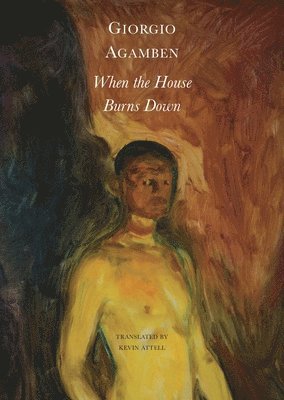
Giorgio Agamben tackles our crisis-ridden world in a series of powerful philosophical essays. “Which house is burning?” asks Giorgio Agamben. “The country where you live, or Europe, or the whole world? Perhaps the houses, the cities have already burnt down—who knows how long ago?—in a single immense blaze that we pretended not to see.” In this collection of four luminous, lyrical essays, Agamben brings his characteristic combination of philosophical acuity and poetic intensity to bear on a world in crisis. Whether surveying the burning house of our culture in the title essay, the architecture of pure exteriority in “Door and Threshold,” the language of prophecy in “Lessons in the Darkness,” or the word of the witness in “Testimony and Truth,” Agamben’s insights throw a revealing light on questions both timeless and topical. Written in dark times over the past year, and rich with the urgency of our moment, the essays in this volume also seek to show how what appears to be an impasse can, with care and attention, become the door leading to a way out.