Kevin J. Hastings - Böcker
Visar alla böcker från författaren Kevin J. Hastings. Handla med fri frakt och snabb leverans.
8 produkter
8 produkter
927 kr
Skickas inom 10-15 vardagar
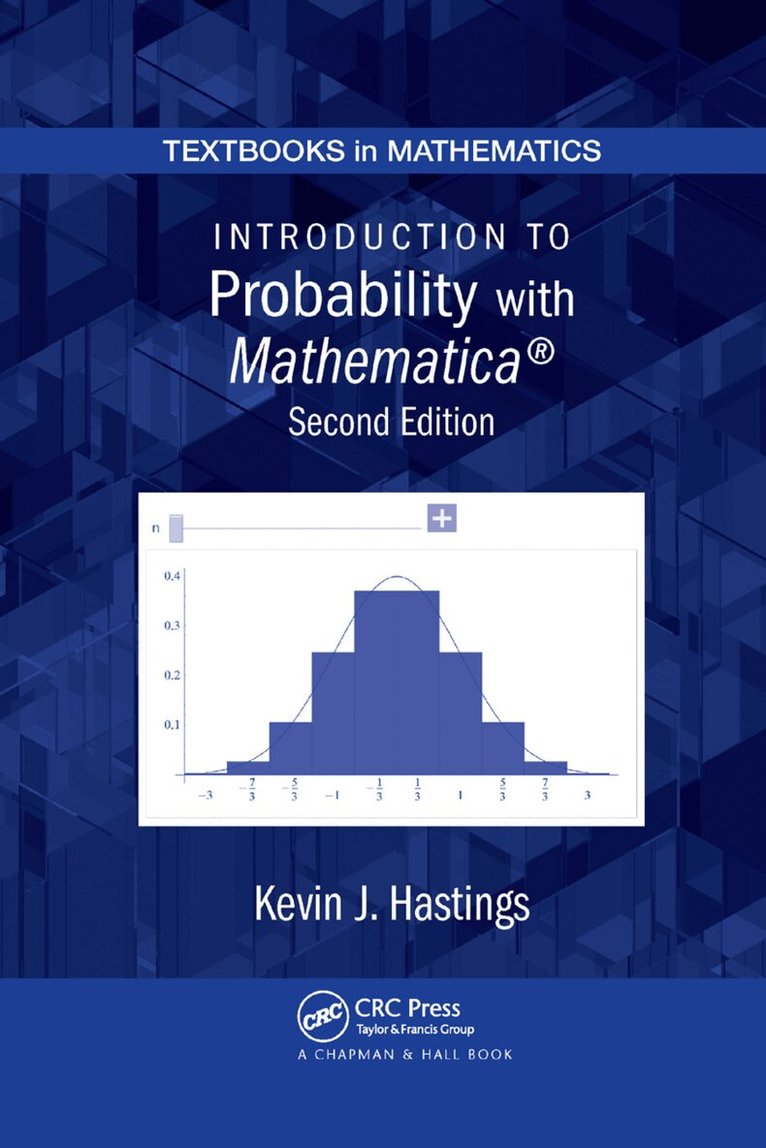
Updated to conform to Mathematica® 7.0, Introduction to Probability with Mathematica®, Second Edition continues to show students how to easily create simulations from templates and solve problems using Mathematica. It provides a real understanding of probabilistic modeling and the analysis of data and encourages the application of these ideas to practical problems. The accompanyingdownloadable resources offer instructors the option of creating class notes, demonstrations, and projects.New to the Second Edition Expanded section on Markov chains that includes a study of absorbing chainsNew sections on order statistics, transformations of multivariate normal random variables, and Brownian motionMore example data of the normal distribution More attention on conditional expectation, which has become significant in financial mathematicsAdditional problems from Actuarial Exam PNew appendix that gives a basic introduction to Mathematica New examples, exercises, and data sets, particularly on the bivariate normal distributionNew visualization and animation features from Mathematica 7.0Updated Mathematica notebooks on the downloadable resources. After covering topics in discrete probability, the text presents a fairly standard treatment of common discrete distributions. It then transitions to continuous probability and continuous distributions, including normal, bivariate normal, gamma, and chi-square distributions. The author goes on to examine the history of probability, the laws of large numbers, and the central limit theorem. The final chapter explores stochastic processes and applications, ideal for students in operations research and finance.
927 kr
Skickas inom 10-15 vardagar
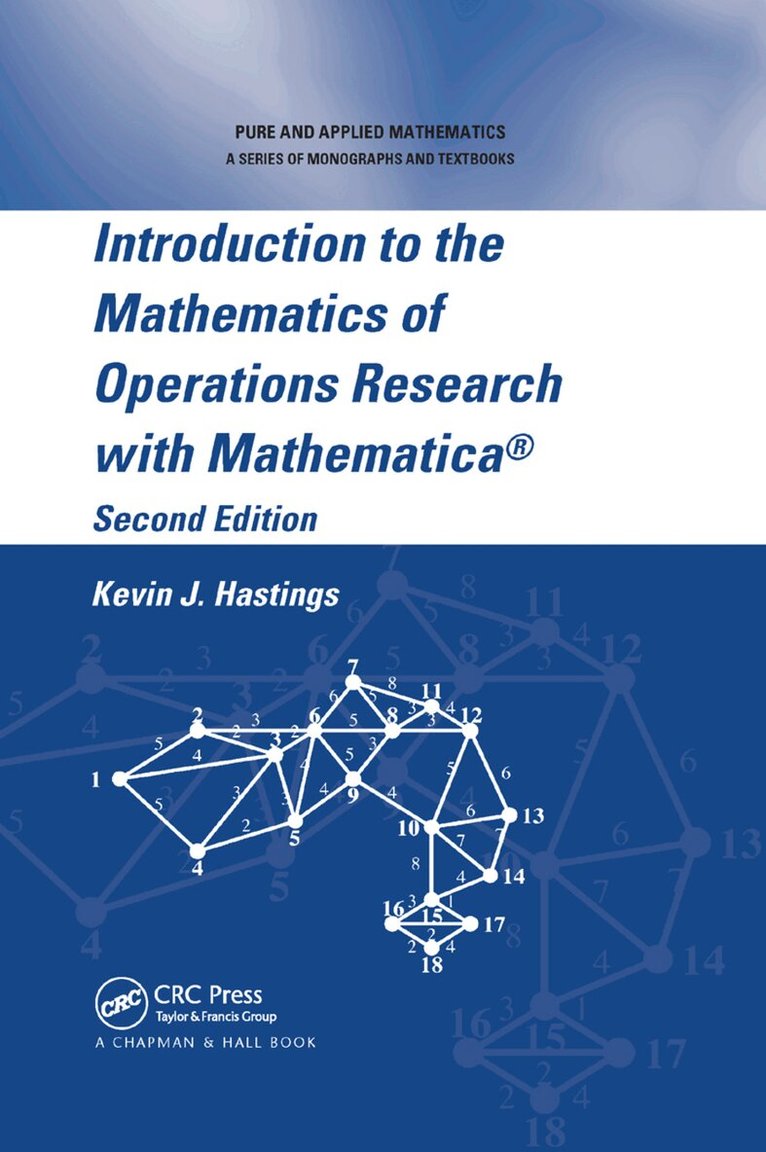
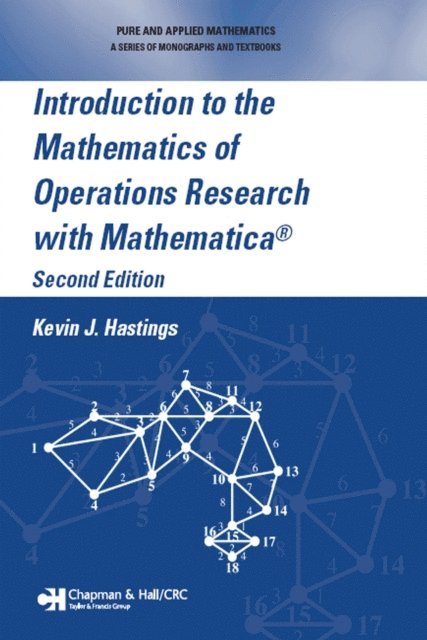
The breadth of information about operations research and the overwhelming size of previous sources on the subject make it a difficult topic for non-specialists to grasp. Fortunately, Introduction to the Mathematics of Operations Research with Mathematica®, Second Edition delivers a concise analysis that benefits professionals in operations research and related fields in statistics, management, applied mathematics, and finance.The second edition retains the character of the earlier version, while incorporating developments in the sphere of operations research, technology, and mathematics pedagogy. Covering the topics crucial to applied mathematics, it examines graph theory, linear programming, stochastic processes, and dynamic programming. This self-contained text includes an accompanying electronic version and a package of useful commands. The electronic version is in the form of Mathematica notebooks, enabling you to devise, edit, and execute/reexecute commands, increasing your level of comprehension and problem-solving.Mathematica sharpens the impact of this book by allowing you to conveniently carry out graph algorithms, experiment with large powers of adjacency matrices in order to check the path counting theorem and Markov chains, construct feasible regions of linear programming problems, and use the "dictionary" method to solve these problems. You can also create simulators for Markov chains, Poisson processes, and Brownian motions in Mathematica, increasing your understanding of the defining conditions of these processes. Among many other benefits, Mathematica also promotes recursive solutions for problems related to first passage times and absorption probabilities.
1 224 kr
Skickas inom 10-15 vardagar
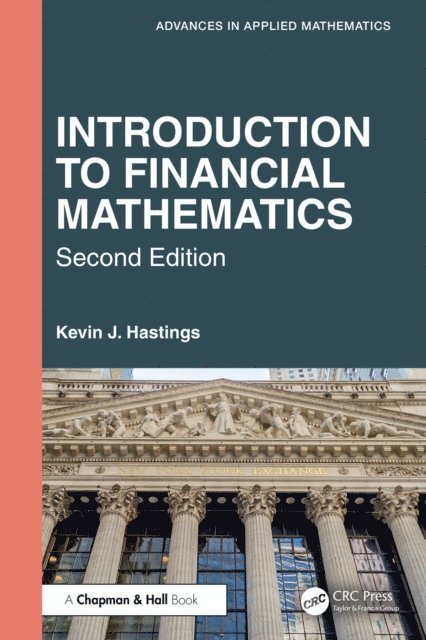
The second edition of this successful and widely recognized textbook again focuses on discrete topics. The author recognizes two distinct paths of study and careers of actuarial science and financial engineering. This text can be very useful as a common core for both. Therefore, there is substantial material in Introduction to Financial Mathematics, Second Edition on the theory of interest (the first half of the book), as well as the probabilistic background necessary for the study of portfolio optimization and derivative valuation (the second half). A course in multivariable calculus is not required.The material in the first two chapters should go a long way toward helping students prepare for the Financial Mathematics (FM) actuarial exam. Also, the discrete material will reveal how beneficial it is for the students to know more about loans in their personal financial lives.The notable changes and updates to this edition are itemized in the Preface, but overall, the presentation has been made more efficient. One example is the chapter on discrete probability, which is rather unique in its emphasis on giving the deterministic problems studied earlier a probabilistic context. The section on Markov chains, which is not essential to the development, has been scaled down. Sample spaces and probability measures, random variables and distributions, expectation, conditional probability, independence, and estimation all follow.Optimal portfolio selection coverage is reorganized and the section on the practicalities of stock transactions has been revised. Market portfolio and Capital Market Theory coverage is expanded. New sections on Swaps and Value-at-Risk have been added. This book, like the first edition, was written so that the print edition could stand alone. At times we simplify complicated algebraic expressions, or solve systems of linear equations, or numerically solve non-linear equations. Also, some attention is given to the use of computer simulation to approximate solutions to problems.
1 067 kr
Tillfälligt slut
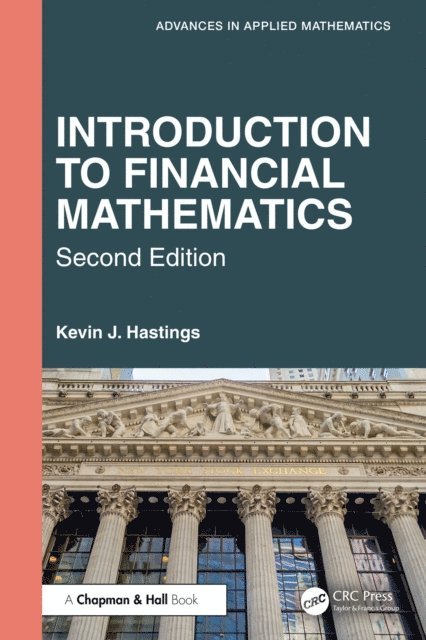
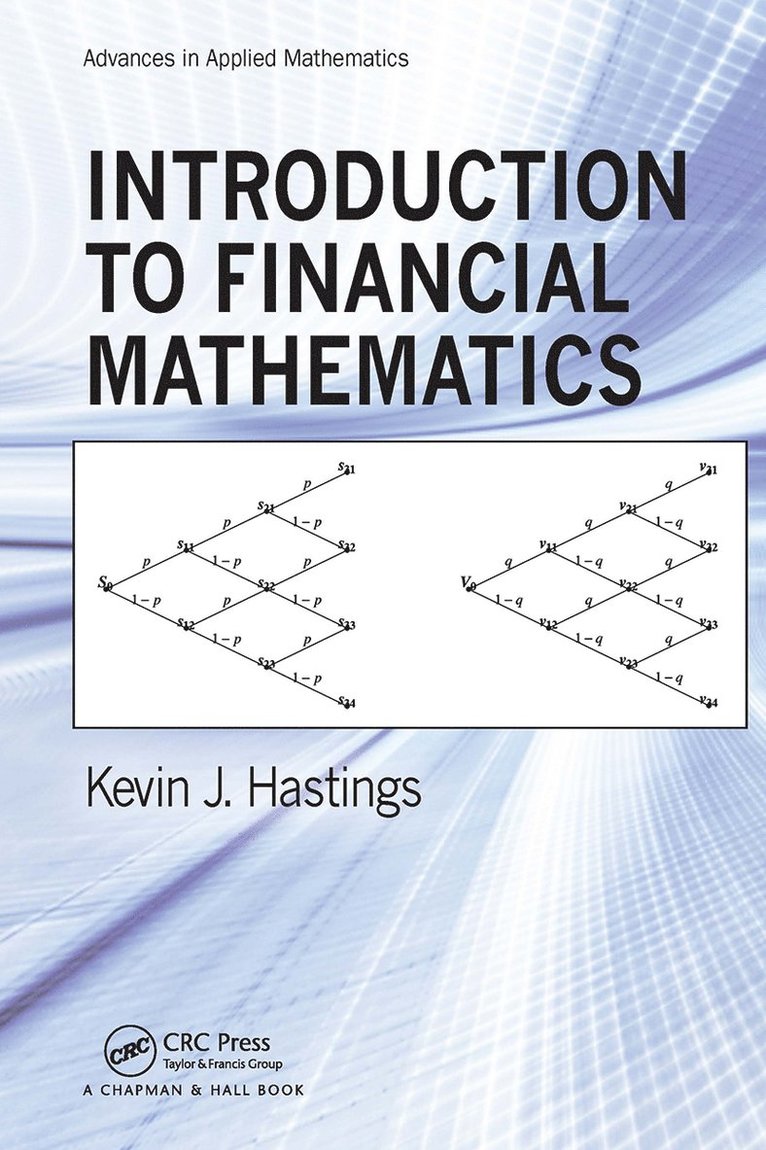
Introduction to Financial Mathematics is ideal for an introductory undergraduate course. Unlike most textbooks aimed at more advanced courses, the text motivates students through a discussion of personal finances and portfolio management. The author then goes on to cover valuation of financial derivatives in discrete time, using all of closed form, recursive, and simulation methods.The text covers nearly all of the syllabus topics of the Financial Mathematics Actuarial examination, providing students with the foundation they require for future studies and throughout their careers. It begins by covering standard material on the mathematics of interest, including compound interest, present value, annuities, loans, several versions of the rate of return on an investment, and interest in continuous time.The text explains how to value bonds at their issue dates, at coupon times, between coupon times, and in cases where the bonds are terminated early. Next, it supplies a rapid-fire overview of the main ideas and techniques of discrete probability, including sample spaces and probability measures, random variables and distributions, expectation, conditional probability, and independence.The author introduces the basic terminology of stocks and stock trading. He also explains how to derive the rate of return on a portfolio and how to use the idea of risk aversion to model the investor tradeoff between risk and return. The text also discusses the estimation of parameters of asset models from real data.The text closes with a detailed discussion of how to value financial derivatives using anti-arbitrage assumptions. The one-step and multi-step cases are covered, and exotic options such as barrier options are also introduced, to which simulation methods are applied.Many of the examples in the book involve numerical solution of complicated non-linear equations; others ask students to produce algorithms which beg to be implemented as programs. For maximum flexibility, the author has produced the text without adhering to any particular computational platform.A digital version of this text is also available in the form of Mathematica notebooks that contain additional content.
2 577 kr
Skickas inom 10-15 vardagar
Updated to conform to Mathematica® 7.0, Introduction to Probability with Mathematica®, Second Edition continues to show students how to easily create simulations from templates and solve problems using Mathematica. It provides a real understanding of probabilistic modeling and the analysis of data and encourages the application of these ideas to practical problems. The accompanyingdownloadable resources offer instructors the option of creating class notes, demonstrations, and projects.New to the Second Edition Expanded section on Markov chains that includes a study of absorbing chainsNew sections on order statistics, transformations of multivariate normal random variables, and Brownian motionMore example data of the normal distribution More attention on conditional expectation, which has become significant in financial mathematicsAdditional problems from Actuarial Exam PNew appendix that gives a basic introduction to Mathematica New examples, exercises, and data sets, particularly on the bivariate normal distributionNew visualization and animation features from Mathematica 7.0Updated Mathematica notebooks on the downloadable resources. After covering topics in discrete probability, the text presents a fairly standard treatment of common discrete distributions. It then transitions to continuous probability and continuous distributions, including normal, bivariate normal, gamma, and chi-square distributions. The author goes on to examine the history of probability, the laws of large numbers, and the central limit theorem. The final chapter explores stochastic processes and applications, ideal for students in operations research and finance.
1 725 kr
Tillfälligt slut
Introduction to Financial Mathematics is ideal for an introductory undergraduate course. Unlike most textbooks aimed at more advanced courses, the text motivates students through a discussion of personal finances and portfolio management. The author then goes on to cover valuation of financial derivatives in discrete time, using all of closed form, recursive, and simulation methods.The text covers nearly all of the syllabus topics of the Financial Mathematics Actuarial examination, providing students with the foundation they require for future studies and throughout their careers. It begins by covering standard material on the mathematics of interest, including compound interest, present value, annuities, loans, several versions of the rate of return on an investment, and interest in continuous time.The text explains how to value bonds at their issue dates, at coupon times, between coupon times, and in cases where the bonds are terminated early. Next, it supplies a rapid-fire overview of the main ideas and techniques of discrete probability, including sample spaces and probability measures, random variables and distributions, expectation, conditional probability, and independence.The author introduces the basic terminology of stocks and stock trading. He also explains how to derive the rate of return on a portfolio and how to use the idea of risk aversion to model the investor tradeoff between risk and return. The text also discusses the estimation of parameters of asset models from real data.The text closes with a detailed discussion of how to value financial derivatives using anti-arbitrage assumptions. The one-step and multi-step cases are covered, and exotic options such as barrier options are also introduced, to which simulation methods are applied.Many of the examples in the book involve numerical solution of complicated non-linear equations; others ask students to produce algorithms which beg to be implemented as programs. For maximum flexibility, the author has produced the text without adhering to any particular computational platform.A digital version of this text is also available in the form of Mathematica notebooks that contain additional content.
1 292 kr
Skickas inom 10-15 vardagar
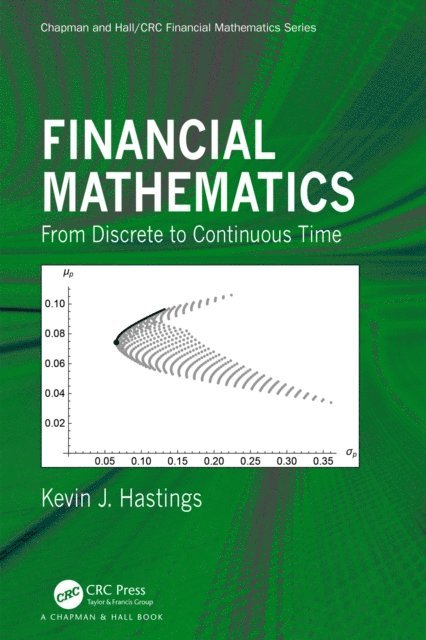
Financial Mathematics: From Discrete to Continuous Time is a study of the mathematical ideas and techniques that are important to the two main arms of the area of financial mathematics: portfolio optimization and derivative valuation. The text is authored for courses taken by advanced undergraduates, MBA, or other students in quantitative finance programs.The approach will be mathematically correct but informal, sometimes omitting proofs of the more difficult results and stressing practical results and interpretation. The text will not be dependent on any particular technology, but it will be laced with examples requiring the numerical and graphical power of the machine.The text illustrates simulation techniques to stand in for analytical techniques when the latter are impractical. There will be an electronic version of the text that integrates Mathematica functionality into the development, making full use of the computational and simulation tools that this program provides. Prerequisites are good courses in mathematical probability, acquaintance with statistical estimation, and a grounding in matrix algebra.The highlights of the text are:A thorough presentation of the problem of portfolio optimization, leading in a natural way to the Capital Market TheoryDynamic programming and the optimal portfolio selection-consumption problem through timeAn intuitive approach to Brownian motion and stochastic integral models for continuous time problemsThe Black-Scholes equation for simple European option values, derived in several different waysA chapter on several types of exotic optionsMaterial on the management of risk in several contexts
2 577 kr
Skickas inom 10-15 vardagar
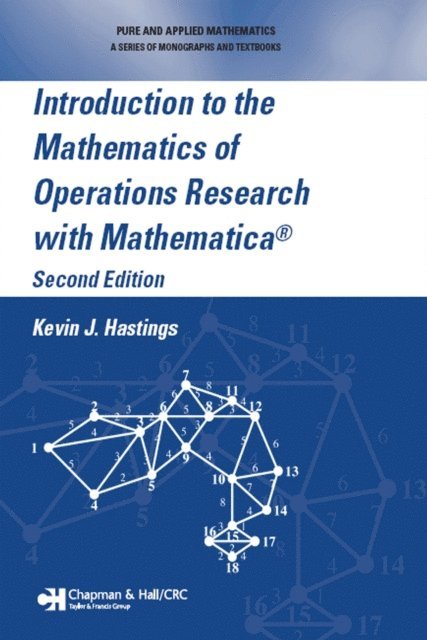
The breadth of information about operations research and the overwhelming size of previous sources on the subject make it a difficult topic for non-specialists to grasp. Fortunately, Introduction to the Mathematics of Operations Research with Mathematica®, Second Edition delivers a concise analysis that benefits professionals in operations research and related fields in statistics, management, applied mathematics, and finance.The second edition retains the character of the earlier version, while incorporating developments in the sphere of operations research, technology, and mathematics pedagogy. Covering the topics crucial to applied mathematics, it examines graph theory, linear programming, stochastic processes, and dynamic programming. This self-contained text includes an accompanying electronic version and a package of useful commands. The electronic version is in the form of Mathematica notebooks, enabling you to devise, edit, and execute/reexecute commands, increasing your level of comprehension and problem-solving.Mathematica sharpens the impact of this book by allowing you to conveniently carry out graph algorithms, experiment with large powers of adjacency matrices in order to check the path counting theorem and Markov chains, construct feasible regions of linear programming problems, and use the "dictionary" method to solve these problems. You can also create simulators for Markov chains, Poisson processes, and Brownian motions in Mathematica, increasing your understanding of the defining conditions of these processes. Among many other benefits, Mathematica also promotes recursive solutions for problems related to first passage times and absorption probabilities.