Kieran Quinlan - Böcker
Visar alla böcker från författaren Kieran Quinlan. Handla med fri frakt och snabb leverans.
2 produkter
2 produkter
299 kr
Skickas inom 10-15 vardagar
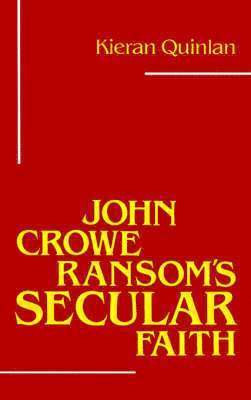
Recent interest in the life and works of John Crowe Ransom has brought to light the many apparent contradictions and discontinuities in the career of this important man of letters. A noted poet, Ransom chose to devote his energies primarily to the composition of prose. A southern agrarian in the 1930s, he later rejected the movement as nostalgic and unrealistic. But perhaps more central to his development as a man of letters, he came to renounce all traditional religious beliefs, even though he was descended from a line of Methodist ministers.In John Crowe Ransom's Secular Faith Keiran Quinlan examines these and other incongruities within the context of the writer's career and offers a substantially revisionist interpretation of his subject. Quinlan argues that the key to understanding Ransom's development lies in ""his early rejection of the tenets of Christian theology and in his consequent effort at articulating an alternative philosophy to live by."" Ransom's literary efforts are viewed as a philosophical project aimed at discovering an empirical validity for the world rather than a transcendental one.Quinlan examines Ransom's development against the background of the literary and philosophic movements that influenced the writer. He shows how thinkers like Kant, Hegel, Dewey, and the logical positivists, and poets like Arnold, Hardy, Stevens, Eliot, and Graves, all made significant contributions to Ransom's progress.Although Ransom has often been allied with T.S. Eliot, who turned to religion and a transcendental knowledge of the world, Quinlan contends that Ransom's real sympathies were with Wallace Stevens, who south a suitable substitute for religious faith in the celebration of a world he felt was emptied of its transcendental component.Ransom's difficulties are in many ways symptomatic of the struggles of our age, the supplanting of God and a supernatural world view by scientific advances, the loss of faith, and thus the need to find an alternative meaning in existence. Quinlan stresses that although the gradual emergence of Ransom's ""secular faith"" was a direct result of his lifelong dialogue with the Christian tradition, his final belief was that ""'this is the best of all possible worlds'; inasmuch as it is not possible for imagination to acquaint is with any other world."" Quinlan concludes, therefore, that Ransom belongs squarely in the American pragmatist tradition.
793 kr
Skickas inom 7-10 vardagar
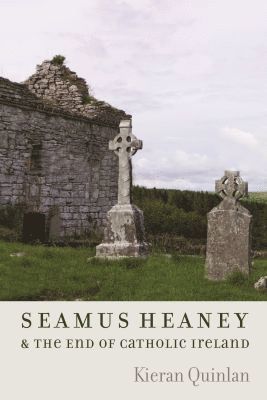
Seamus Heaney & the End of Catholic Ireland takes off from the poet’s growing awareness in the new millennium of “something far more important in my mental formation than cultural nationalism or the British presence or any of that stuff—namely, my early religious education.” It then pursues an examination of the full trajectory of Heaney’s religious beliefs as represented in his poetry, prose, and interviews, with a briefer account of the interactive religious histories of the Irish and international contexts in which he lived. Thus, in the 1940s and 50s, Heaney was inducted into the narrow, punitive, but also enabling Catholicism of the era. In the early 1960s he was witness to the lively religious debates from the Anglican Bishop of Woolwich’s Honest to God to the seismic disruptions of Vatican II. When the conflict in Northern Ireland between Catholics and Protestants broke out, Heaney was forced to dig deep for an imaginative understanding of its religious roots. From the 1980s on, Heaney more and more proclaimed his own religious loss while also recognizing the institution’s residual value in an Irish society of rising prosperity, weariness with the atrocities of a partly religion-inspired IRA, and beset by the scandals of sex abuse among the clergy. Kieran Quinlan sees Heaney as an exemplar of this period of major change in Ireland as he engaged the religious issue not only in major writers such as James Joyce, W. B. Yeats, T. S. Eliot, Wallace Stevens, Philip Larkin, and Czeslaw Mi?osz, but also in a diverse array of less familiar commentators lay and clerical, creative and academic, believers and unbelievers, Irish and international. Breaking new ground by expanding the scope of Heaney’s religious preoccupations and writing in an accessible, reflective, and sometimes provocative manner, Quinlan’s study places Heaney in his universe, and that universe in turn in its wider intellectual setting.