Kimiko Hahn - Böcker
Visar alla böcker från författaren Kimiko Hahn. Handla med fri frakt och snabb leverans.
10 produkter
10 produkter
243 kr
Skickas inom 5-8 vardagar
Mosquito and Ant refers to the style in which nu shu--a nearly extinct script used by Chinese women to correspond with one another--is written. Here in this exciting and totally original book of poems the narrator corresponds with L. about her hidden passions, her relationship with her husband and adolescent daughters, lost loves, and erotic fantasies. Kimiko Hahn's collection takes shape as a series of wide-ranging correspondences that are in turn precocious and wise, angry and wistful. Borrowing from both Japanese and Chinese traditions, Hahn offers us an authentic and complex narrator struggling with the sorrows and pleasures of being a woman against the backdrop of her Japanese-American roots.
243 kr
Skickas inom 5-8 vardagar
Kimiko Hahn's poetry explores the interplay—and tensions—among her various identities: mother, lover, wife, poet, and daughter of both the Midwest and Asia. However astonishing her subjects—from sideshow freaks to sadomasochistic fantasy—they ultimately emerge in this startling collection as moving images of the deepest levels of our shared humanity.
251 kr
Skickas inom 5-8 vardagar
Kimiko Hahn, "a welcome voice of experimentation and passion" (Bloomsbury Review), takes up the Japanese prose-poetry genre zuihitsu—literally "running brush," which utilizes tactics such as juxtaposition, contradiction, and broad topical variety—in exploring her various identities as mother and lover, wife and poet, daughter of varied traditions.
243 kr
Skickas inom 5-8 vardagar
For Kimiko Hahn, the language and imagery of science open up magical possibilities for the poet. In her haunting eighth collection inspired by articles from the weekly “Science” section of the New York Times, Hahn explores identity, extinction, and survival using exotic tropes drawn from the realms of astrophysics, mycology, paleobotany, and other rarefied fields. With warmth and generosity, Hahn mines the world of science in these elegant, ardent poems.from “On Deceit as Survival”Yet another species resemblesa female bumble bee,ending in frustrated trysts—or appears to be two fractious maleswhich also attracts—no surprise—a third curious enough to join the fray.What to make of highly evolved Beautybent on deception as survival—
208 kr
Skickas inom 7-10 vardagar
Acclaimed as "one of the most fascinating female poets of our time" (BOMB), Kimiko Hahn is a shape-shifter, a poet who seeks novel forms for her utterly original subject matter and "stands as a welcome voice of experimentation and passion" (Bloomsbury Review). In Brain Fever, Hahn integrates the recent findings of science, ancient Japanese aesthetics and observations from her life as a woman, wife, mother, daughter and artist.Rooted in meditations on contemporary neuroscience, Brain Fever takes as its subject the mysteries of the human mind—the nature of dreams and memories, the possibly illusory nature of linear time and the complexity of conveying love to a child. In one poem, "A Bowl of Spaghetti", she cites a comparison that researchers draw between unravelling "the millions of miles of wires in the [human] brain" and "untangling a bowl of spaghetti", and thus she untangles a memory of her own: "I have an old photo: Rei in her high chair intently / picking out each strand to mash in her mouth. // Was she two? Was that sailor dress from mother? / Did I cook that sauce from scratch? If so, there was a carrot in the pot."Equally inspired by Sei Shonagon's tenth-century Pillow Book and the latest findings of cognitive research, Brain Fever is a thrilling blend of the timely and the timeless.
183 kr
Skickas inom 7-10 vardagar
Inspired by her encounter with Dr Chevalier Jackson’s collection of ingested curiosities at Philadelphia’s Mütter Museum, Kimiko Hahn’s tenth collection investigates the grip that seemingly insignificant objects exert on our lives. Itself a cabinet of curiosities, the collection provokes the same surprise, wonder and pangs of recognition Hahn felt upon opening drawer after drawer of these swallowed and retrieved, objects—a radiator key, a child’s perfect attendance pin, a mother-of-pearl button. The speaker of these moving poems sees reflections of these items in the heartbreaking detritus of her family home and in her long-dead mother’s Japanese jewellery.As Hahn remakes the lyric sequence in chains reminiscent of the Japanese tanka, the foreign bodies of the title expand to include the immigrant woman’s trafficked body, fossilised remains, a grandmother’s Japanese body. She explores the relationship between our innermost selves and the relics of our vanished past, making room for meditation on grief and the ephemeral nature of the material world, for the account of a nineteenth-century female fossil hunter, and for a celebration of the nautilus. Foreign Bodies investigates the power of possession, replete with Hahn’s electric originality and thrilling mastery of ever-changing forms.
365 kr
Skickas inom 3-6 vardagar
Opening with forty-three new formally inventive poems and leading the reader back in time through selections from her ten previous volumes, The Ghost Forest offers a contemplative and haunting narrative of a writer’s artistic journey through craft and form while illuminating her personal history. Exploring the mysteries of science, nature, and the experiences of contemporary womanhood, Hahn both reinvents classic Japanese forms and experiments with traditional Western ones. Braided into the poems and narrative thread, a series of photos transforms the new-and-selected into a hybrid autobiography. This arresting collection derives new beauty from long-gone remnants.A Riotous DisorderShe mistakes one word for another—Something her brain naturally concocts.Her unruly gray matter and her heartMistake one word for an other—Razor for river, cistern for sister.Even cock for clock.She mistakes one word for a mother—A safe her brain naturally unlocks.—
225 kr
Kommande
Opening with forty-three new formally inventive poems and leading the reader back in time through selections from her ten previous volumes, The Ghost Forest offers a contemplative and haunting narrative of a writer’s artistic journey through craft and form while illuminating her personal history. Exploring the mysteries of science, nature and the experiences of contemporary womanhood, Hahn both reinvents classic Japanese forms and experiments with traditional Western ones. Braided into the poems and narrative thread, a series of photos transforms the new-and-selected into a hybrid autobiography. This arresting collection derives new beauty from long-gone remnants.A Riotous DisorderShe mistakes one word for another—Something her brain naturally concocts.Her unruly grey matter and her heartMistake one word for an other—Razor for river, cistern for sister.Even cock for clock.She mistakes one word for a mother—A safe her brain naturally unlocks.—
153 kr
Skickas
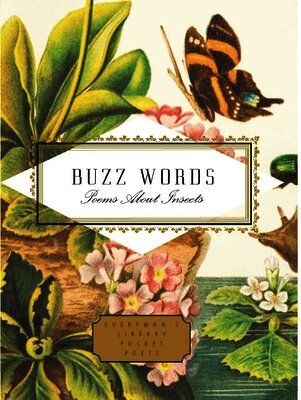
Given that insects vastly outnumber us (there are approximately 200 million insects for every human) it is no surprise that there is a rich body of verse on the creeping, scuttling, flitting, stinging things with which we share our planet. Many cultures have centuries-old traditions of insect poetry. In China,where noblewomen of the Tang dynasty kept crickets in gold cages-countless songs were written in praise of these 'insect musicians'. The haiku masters of Japan were similarly inspired, though spread their net wider to include less prepossessing bugs such as houseflies, fleas and mosquitoes. In the West, poems about insects date back to the ancient Greeks, and insects feature frequently in European literature from the 16th century onwards. The poets collected here range from Donne, Marvell, Keats and Wordsworth; Emily Dickinson, Gerard Manley Hopkins and Christina Rossetti, to Elizabeth Bishop, Mary Oliver, Ted Hughes, Paul Muldoon and Alice Oswald. In translation there is verse by - amongst others - Meleager and Tu Fu, Ivan Turgenev, Victor Hugo, Paul Valéry, Pablo Neruda, Antonio Machado and Xi Chuan. Bees, butterflies and beetles, cockroaches and caterpillars, fireflies and dragonflies, ladybirds and glowworms--the miniature creatures that adorn these pages are as varied as the poetic talents that celebrate them.
115 kr
Tillfälligt slut
In Brood, Kimiko Hahn trains her eye on the commonplace—clothespins, bees, papaya, perfume, poached eggs, a sponge, fire, sand dollars—and reveals their very essence in concise evocative language. Underlying these little gems is a sense of loss, a mother's death or a longing for childhood. "Brood" connotes the bundling of family or beasts, but also dark thinking, and both are at play here where the less said, the better.Kimiko Hahn is the author of ten books of poetry, including most recently, Brain Fever (Norton, 2014). She has received numerous honors, including the PSA's Shelley Memorial Prize, the PEN/Voelcker Award, and fellowships from the National Endowment for the Arts, Guggenheim Foundation, and New York Foundation for the Arts. She is a distinguished professor in creative writing at Queens College (CUNY) and lives in Forest Hills, New York.