Krishna Rajan – författare
1 750 kr
Skickas inom 10-15 vardagar
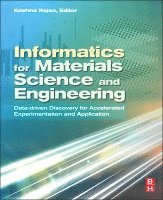
Materials informatics: a 'hot topic' area in materials science, aims to combine traditionally bio-led informatics with computational methodologies, supporting more efficient research by identifying strategies for time- and cost-effective analysis.
The discovery and maturation of new materials has been outpaced by the thicket of data created by new combinatorial and high throughput analytical techniques. The elaboration of this "quantitative avalanche"-and the resulting complex, multi-factor analyses required to understand it-means that interest, investment, and research are revisiting informatics approaches as a solution.
This work, from Krishna Rajan, the leading expert of the informatics approach to materials, seeks to break down the barriers between data management, quality standards, data mining, exchange, and storage and analysis, as a means of accelerating scientific research in materials science.
This solutions-based reference synthesizes foundational physical, statistical, and mathematical content with emerging experimental and real-world applications, for interdisciplinary researchers and those new to the field.
Identifies and analyzes interdisciplinary strategies (including combinatorial and high throughput approaches) that accelerate materials development cycle times and reduces associated costs Mathematical and computational analysis aids formulation of new structure-property correlations among large, heterogeneous, and distributed data sets Practical examples, computational tools, and software analysis benefits rapid identification of critical data and analysis of theoretical needs for future problems2 061 kr
Läs direkt efter köp
1 605 kr
Skickas inom 10-15 vardagar
1 619 kr
Skickas inom 10-15 vardagar
1 977 kr
Läs direkt efter köp
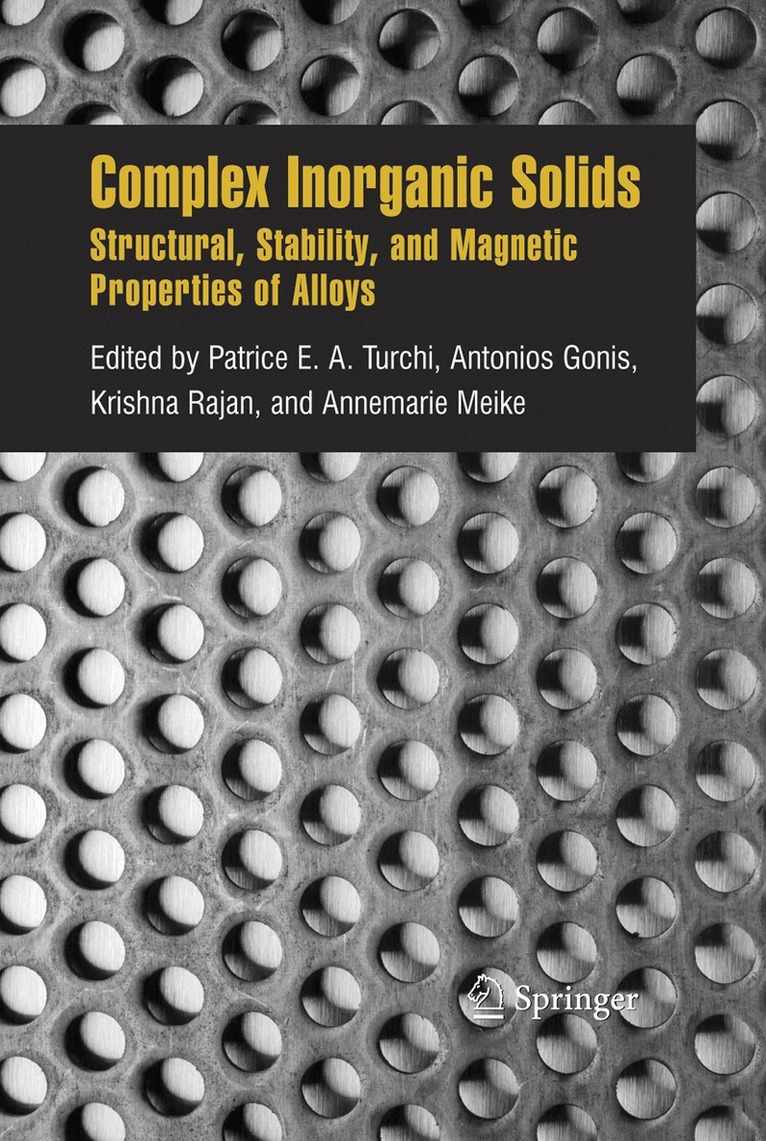
One of the key aspects of this volume is to cut across the traditional taxonomy of disciplines in the study of alloys. Hence there has been a deliberate attempt to integrate the different approaches taken towards alloys as a class of materials in different fields, ranging from geology to metallurgical engineering. The emphasis of this book is to highlight commonalities between different fields with respect to how alloys are studied. The topics in this book fall into several themes, which suggest a number of different classification schemes. We have chosen a scheme that classifies the papers in the volume into the categories Microstructural Considerations, Ordering, Kinetics and Diffusion, Magnetic Considerations and Elastic Considerations. The book has juxtaposed apparently disparate approaches to similar physical processes, in the hope of revealing a more dynamic character of the processes under consideration. This monograph will invigorate new kinds of discussion and reveal challenges and new avenues to the description and prediction of properties of materials in the solid state and the conditions that produce them.
2 051 kr
Kommande
Materials Informatics: Molecules, Crystals and Beyond discusses the role of information science in aiding the discovery and interpretation of multiscale relationships that are critical for materials discovery, design, and optimization. The book covers key challenges in applying information science methods to materials science, including the multidimensional nature of structure-property relationships, data sparsity, and the nature and sources of uncertainty, along with a brief overview of the algorithmic tools used for unsupervised and supervised learning.Building on these topics, chapters then cover the development of physics/chemistry informed data representations of structure and properties, the application of machine learning for structure and property prediction and screening for targeted properties, and the utilization of techniques such a graphics recognition, natural language processing, and statistically driven visualization tools in deciphering processing-structure-property-performance relationships in materials.
Explores the intersection of machine intelligence and robotics in experimental and computationally driven materials discovery and designHighlights experimental advances in materials synthesis, processing, and characterization to generate data that enables the harnessing of informatics methodsDiscusses the next generation of materials databases, built based on the paradigm of ‘FAIR’ principles (Findability, Accessibility, Interoperability, and Reusability)1 619 kr
Skickas inom 10-15 vardagar
1 619 kr
Skickas inom 10-15 vardagar
1 977 kr
Läs direkt efter köp
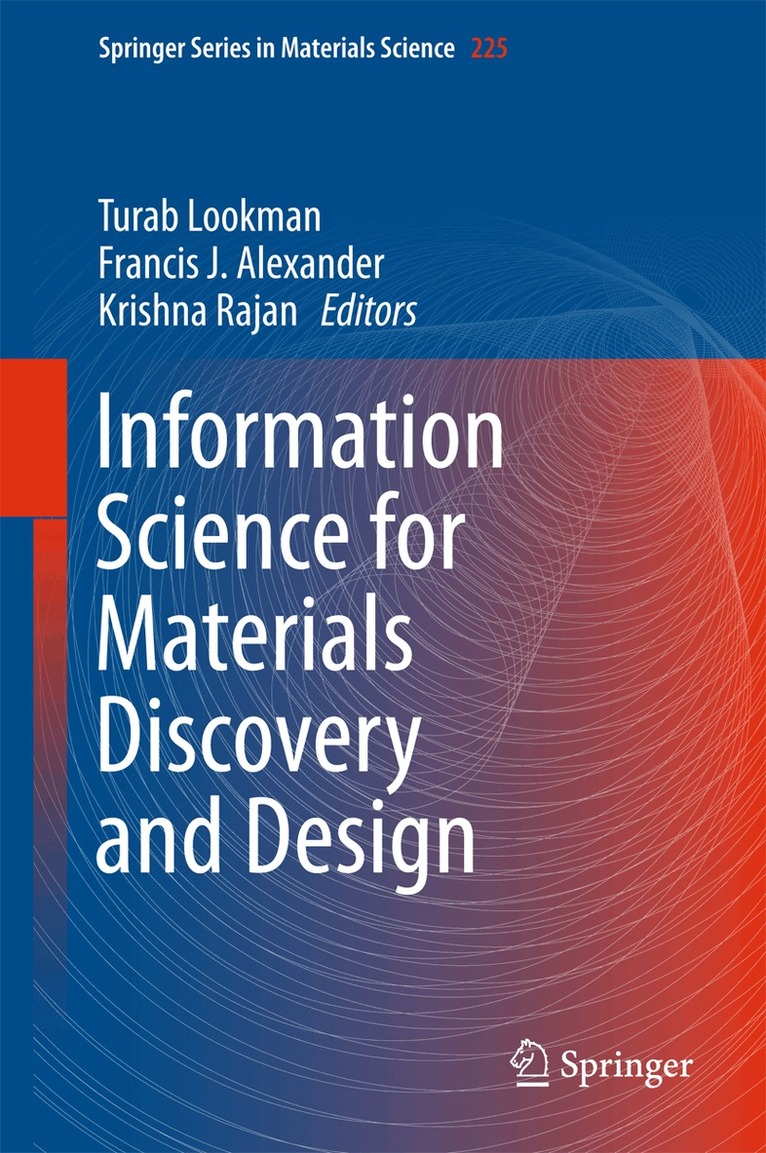
Information Science for Materials Discovery and Design
1 389 kr
Skickas inom 5-8 vardagar
3 046 kr
Läs direkt efter köp
This book deals with an information-driven approach to plan materials discovery and design, iterative learning. The authors present contrasting but complementary approaches, such as those based on high throughput calculations, combinatorial experiments or data driven discovery, together with machine-learning methods. Similarly, statistical methods successfully applied in other fields, such as biosciences, are presented. The content spans from materials science to information science to reflect the cross-disciplinary nature of the field. A perspective is presented that offers a paradigm (codesign loop for materials design) to involve iteratively learning from experiments and calculations to develop materials with optimum properties. Such a loop requires the elements of incorporating domain materials knowledge, a database of descriptors (the genes), a surrogate or statistical model developed to predict a given property with uncertainties, performing adaptive experimental design to guide the next experiment or calculation and aspects of high throughput calculations as well as experiments. The book is about manufacturing with the aim to halving the time to discover and design new materials. Accelerating discovery relies on using large databases, computation, and mathematics in the material sciences in a manner similar to the way used to in the Human Genome Initiative. Novel approaches are therefore called to explore the enormous phase space presented by complex materials and processes. To achieve the desired performance gains, a predictive capability is needed to guide experiments and computations in the most fruitful directions by reducing not successful trials. Despite advances in computation and experimental techniques, generating vast arrays of data; without a clear way of linkage to models, the full value of data driven discovery cannot be realized. Hence, along with experimental, theoretical and computational materials science, we need to add a “fourth leg’’ toour toolkit to make the “Materials Genome'''' a reality, the science of Materials Informatics.
Information Science for Materials Discovery and Design
1 389 kr
Skickas inom 5-8 vardagar