A. Gonis – författare
Visar alla böcker från författaren A. Gonis. Handla med fri frakt och snabb leverans.
22 produkter
Electron Correlations and Materials Properties
Av Antonios Gonis, Nicholis Kioussis m. fl.
Inbunden, 1999
2188 kr
Lägg i varukorg
Over the last thirty years or so, the attempts to identify the electronic origins of materials properties have proceeded along two distinct and apparently divergent methodologies. On the one-hand, so-called single-particle methods are based on the study of a single electron moving in an effective …
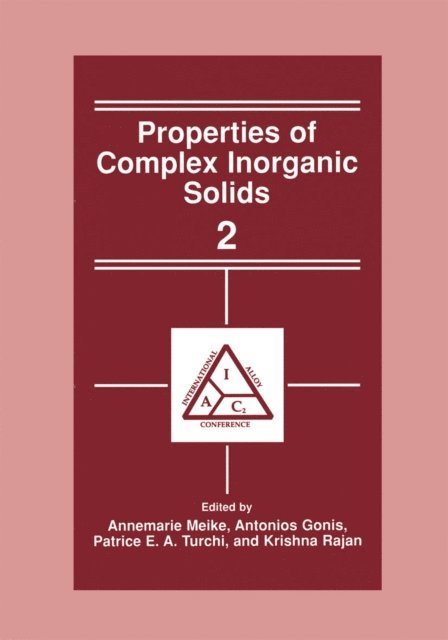
Properties of Complex Inorganic Solids 2
Av Annemarie Meike, A. Gonis m. fl.
Inbunden, 2001
1643 kr
Lägg i varukorg
The triennial International Alloy Conferences (lACs) aim at the identification and promotion of the common elements developed in the study, either experimental, phenomenological, or theoretical and computational, of materials properties across materials types, from metals to minerals. To accomplish …
Electron Correlations and Materials Properties 2
Av Antonios Gonis, Nicholis Kioussis m. fl.
Inbunden, 2003
1643 kr
Lägg i varukorg
This is the second in a series of "International Workshops on Electron Correlations and Materials Properties. " The aim of this series of workshops is to provide a periodic (triennial) and in-depth assessment of advances in the study and understanding of the effects that electron-electron …
Actinides and the Environment
Av P.A. Sterne, A. Gonis m. fl.
Inbunden, 1998
2188 kr
Lägg i varukorg
The handling of actinides and actinide-based materials provides significant technological challenges due to the toxicity and radioactivity associated with these materials. These challenges are particularly apparent in the nuclear power industry. Under normal operation, a reactor can produce a …
Electron Correlations and Materials Properties 2
Av A. Gonis, Nicholis Kioussis m. fl.
Häftad, 2010
1643 kr
Lägg i varukorg
This is the second in a series of "International Workshops on Electron Correlations and Materials Properties. " The aim of this series of workshops is to provide a periodic (triennial) and in-depth assessment of advances in the study and understanding of the effects that electron-electron …
Stability of Materials
Av Patrice E.A. Turchi, Josef Kudrnovsky m. fl.
E-bok, 2012
1427 kr
Lägg i varukorg
Engineering materials with desirable physical and technological properties requires understanding and predictive capability of materials behavior under varying external conditions, such as temperature and pressure. This immediately brings one face to face with the fundamental difficulty of …
Properties of Complex Inorganic Solids 2
Av Annemarie Meike, A. Gonis m. fl.
Häftad, 2012
1643 kr
Lägg i varukorg
The triennial International Alloy Conferences (lACs) aim at the identification and promotion of the common elements developed in the study, either experimental, phenomenological, or theoretical and computational, of materials properties across materials types, from metals to minerals. To accomplish …
Statics and Dynamics of Alloy Phase Transformations
Av Patrice E.A. Turchi, A. Gonis
Häftad, 2012
716 kr
Lägg i varukorg
The study of phase transformations in substitutional alloys, including order disorder phenomena and structural transformations, plays a crucial role in understanding the physical and mechanical properties of materials, and in designing alloys with desired technologically important characteristics. …
Equilibrium Structure and Properties of Surfaces and Interfaces
Av A. Gonis, G.M. Stocks
Häftad, 2012
552 kr
Lägg i varukorg
It is almost self-evident that surface and interface science, coupled with the electronic structure of bulk materials, playa fundamental role in the understanding of materials properties. If one is to have any hope of understanding such properties as catalysis, microelectronic devices and contacts, …
Electron Correlations and Materials Properties
Av A. Gonis, Nicholis Kioussis m. fl.
Häftad, 2013
2188 kr
Lägg i varukorg
Over the last thirty years or so, the attempts to identify the electronic origins of materials properties have proceeded along two distinct and apparently divergent methodologies. On the one-hand, so-called single-particle methods are based on the study of a single electron moving in an effective …
Properties of Complex Inorganic Solids
Av A. Gonis, Annemarie Meike m. fl.
Häftad, 2012
552 kr
Lägg i varukorg
It is common practice today to use the term "alloy" in connection with specific classes of materials, with prominence given to metals and semiconductors. However, there is good justification for considering alloys in a unified manner based on properties rather than types of materials because, after …
Stability of Materials
Av A. Gonis, Josef Kudrnovský m. fl.
Häftad, 2011
1098 kr
Lägg i varukorg
Engineering materials with desirable physical and technological properties requires understanding and predictive capability of materials behavior under varying external conditions, such as temperature and pressure. This immediately brings one face to face with the fundamental difficulty of …
Properties of Complex Inorganic Solids 2
Av Krishna Rajan, Patrice E.A. Turchi m. fl.
E-bok, 2012
2065 kr
Lägg i varukorg
The triennial International Alloy Conferences (lACs) aim at the identification and promotion of the common elements developed in the study, either experimental, phenomenological, or theoretical and computational, of materials properties across materials types, from metals to minerals. To accomplish …
Statics and Dynamics of Alloy Phase Transformations
Av A. Gonis, Patrice E.A. Turchi
E-bok, 2012
870 kr
Lägg i varukorg
The study of phase transformations in substitutional alloys, including order disorder phenomena and structural transformations, plays a crucial role in understanding the physical and mechanical properties of materials, and in designing alloys with desired technologically important characteristics. …
Equilibrium Structure and Properties of Surfaces and Interfaces
Av G.M. Stocks, A. Gonis
E-bok, 2012
734 kr
Lägg i varukorg
It is almost self-evident that surface and interface science, coupled with the electronic structure of bulk materials, playa fundamental role in the understanding of materials properties. If one is to have any hope of understanding such properties as catalysis, microelectronic devices and contacts, …
Electron Correlations and Materials Properties
Av Mikael Ciftan, Nicholis Kioussis m. fl.
E-bok, 2012
2862 kr
Lägg i varukorg
Over the last thirty years or so, the attempts to identify the electronic origins of materials properties have proceeded along two distinct and apparently divergent methodologies. On the one-hand, so-called single-particle methods are based on the study of a single electron moving in an effective …
Properties of Complex Inorganic Solids
Av Patrice E.A. Turchi, Annemarie Meike m. fl.
E-bok, 2012
734 kr
Lägg i varukorg
It is common practice today to use the term "alloy" in connection with specific classes of materials, with prominence given to metals and semiconductors. However, there is good justification for considering alloys in a unified manner based on properties rather than types of materials because, after …
Electron Correlations and Materials Properties 2
Av Mikael Ciftan, Nicholis Kioussis m. fl.
E-bok, 2013
2111 kr
Lägg i varukorg
This is the second in a series of "International Workshops on Electron Correlations and Materials Properties. " The aim of this series of workshops is to provide a periodic (triennial) and in-depth assessment of advances in the study and understanding of the effects that electron-electron …
Theoretical Materials Science
Tracing the Electronic Origins of Materials Behavior
Av A. Gonis
Inbunden, 2000
1938 kr
Lägg i varukorg
The primary goal of a materials scientist is a predictive understanding of materials properties and that requires a clear picture of the role played by electrons in determining the materials' behavior. Only then can one hope to design and build new materials with desired physical, chemical and …
Actinides and the Environment
Av P.A. Sterne, A. Gonis m. fl.
Häftad, 2010
2188 kr
Lägg i varukorg
The handling of actinides and actinide-based materials provides significant technological challenges due to the toxicity and radioactivity associated with these materials. These challenges are particularly apparent in the nuclear power industry. Under normal operation, a reactor can produce a …
Alloy Phase Stability
Av A. Gonis, G.M. Stocks
E-bok, 2012
734 kr
Lägg i varukorg
One of the ultimate goals of materials research is to develop a fun damental and predictive understanding of the physical and metallurgical properties of metals and alloys. Such an understanding can then be used in the design of materials having novel properties or combinations of proper ties …
Alloy Phase Stability
Av G.M. Stocks, A. Gonis
Häftad, 2011
551 kr
Lägg i varukorg
One of the ultimate goals of materials research is to develop a fun damental and predictive understanding of the physical and metallurgical properties of metals and alloys. Such an understanding can then be used in the design of materials having novel properties or combinations of proper ties …