Lars-Erik Cederman - Böcker
Visar alla böcker från författaren Lars-Erik Cederman. Handla med fri frakt och snabb leverans.
9 produkter
9 produkter
Nationalism and the Transformation of the State
Border Change and Political Violence in the Modern World
Häftad, Engelska, 2025
370 kr
Skickas inom 7-10 vardagar
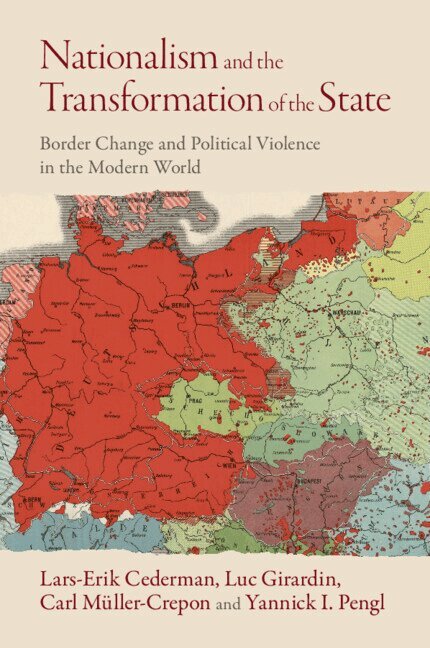
Following Russia's annexation of Crimea in 2014, the recent conflicts in Ukraine and the Middle East signals the return of geopolitics. This book challenges conventional approaches that ignore border change, arguing that geopolitics is driven by nationalism and focusing on how nationalism transforms the state. Using geocoded historical maps covering state borders and ethnic groups in Europe, the authors' spatial approach shows how, since the French Revolution, nationalism has caused increasing congruence between state and national borders and how a lack of congruence increased the risk of armed conflict. This macroprocess is traced from early modern Europe and widens the geographic scope to the entire world in the mid-twentieth century. The analysis shows that the risk of conflict may be increased by how nationalists seeking to revive past golden ages and restore their nations' prestige respond to incongruent borders. This title is also available as Open Access on Cambridge Core.
463 kr
Skickas inom 7-10 vardagar
The disappearance and formation of states and nations after the end of the Cold War have proved puzzling to both theorists and policymakers. Lars-Erik Cederman argues that this lack of conceptual preparation stems from two tendencies in conventional theorizing. First, the dominant focus on cohesive nation-states as the only actors of world politics obscures crucial differences between the state and the nation. Second, traditional theory usually treats these units as fixed. Cederman offers a fresh way of analyzing world politics: complex adaptive systems modeling. He provides a new series of models--not ones that rely on rational-choice, but rather computerized thought-experiments--that separate the state from the nation and incorporate these as emergent rather than preconceived actors. This theory of the emergent actor shifts attention away from the exclusively behavioral focus of conventional international relations theory toward a truly dynamic perspective that treats the actors of world politics as dependent rather than independent variables.Cederman illustrates that while structural realist predictions about unit-level invariance hold up under certain circumstances, they are heavily dependent on fierce power competition, which can result in unipolarity instead of the balance of power. He provides a thorough examination of the processes of nationalist mobilization and coordination in multi-ethnic states. Cederman states that such states' efforts to instill loyalty in their ethnically diverse populations may backfire, and that, moreover, if the revolutionary movement is culturally split, its identity becomes more inclusive as the power gap in the imperial center's favor increases.
Nationalism and the Transformation of the State
Border Change and Political Violence in the Modern World
Inbunden, Engelska, 2025
1 228 kr
Skickas inom 7-10 vardagar
Following Russia's annexation of Crimea in 2014, the recent conflicts in Ukraine and the Middle East signals the return of geopolitics. This book challenges conventional approaches that ignore border change, arguing that geopolitics is driven by nationalism and focusing on how nationalism transforms the state. Using geocoded historical maps covering state borders and ethnic groups in Europe, the authors' spatial approach shows how, since the French Revolution, nationalism has caused increasing congruence between state and national borders and how a lack of congruence increased the risk of armed conflict. This macroprocess is traced from early modern Europe and widens the geographic scope to the entire world in the mid-twentieth century. The analysis shows that the risk of conflict may be increased by how nationalists seeking to revive past golden ages and restore their nations' prestige respond to incongruent borders. This title is also available as Open Access on Cambridge Core.
1 034 kr
Skickas inom 7-10 vardagar
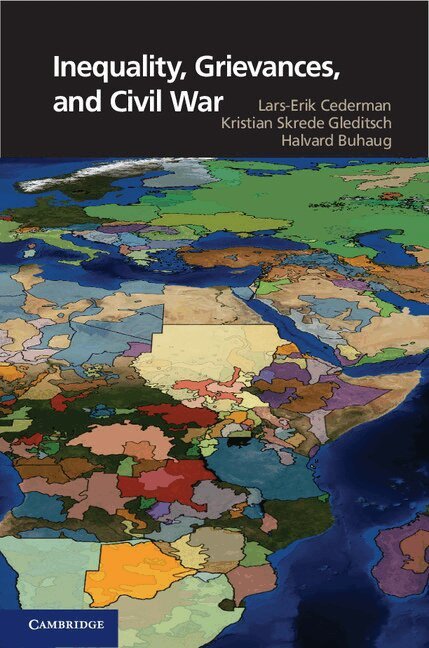
This book argues that political and economic inequalities following group lines generate grievances that in turn can motivate civil war. Lars-Erik Cederman, Kristian Skrede Gleditsch, and Halvard Buhaug offer a theoretical approach that highlights ethnonationalism and how the relationship between group identities and inequalities are fundamental for successful mobilization to resort to violence. Although previous research highlighted grievances as a key motivation for political violence, contemporary research on civil war has largely dismissed grievances as irrelevant, emphasizing instead the role of opportunities. This book shows that the alleged non-results for grievances in previous research stemmed primarily from atheoretical measures, typically based on individual data. The authors develop new indicators of political and economic exclusion at the group level, and show that these exert strong effects on the risk of civil war. They provide new analyses of the effects of transnational ethnic links and the duration of civil wars, and extended case discussions illustrating causal mechanisms.
309 kr
Skickas inom 7-10 vardagar
This book argues that political and economic inequalities following group lines generate grievances that in turn can motivate civil war. Lars-Erik Cederman, Kristian Skrede Gleditsch, and Halvard Buhaug offer a theoretical approach that highlights ethnonationalism and how the relationship between group identities and inequalities are fundamental for successful mobilization to resort to violence. Although previous research highlighted grievances as a key motivation for political violence, contemporary research on civil war has largely dismissed grievances as irrelevant, emphasizing instead the role of opportunities. This book shows that the alleged non-results for grievances in previous research stemmed primarily from atheoretical measures, typically based on individual data. The authors develop new indicators of political and economic exclusion at the group level, and show that these exert strong effects on the risk of civil war. They provide new analyses of the effects of transnational ethnic links and the duration of civil wars, and extended case discussions illustrating causal mechanisms.
334 kr
Skickas inom 7-10 vardagar
Does power sharing bring peace? Policymakers around the world seem to think so. Yet, while there are many successful examples of power sharing in multi-ethnic states, such as Switzerland, South Africa and Indonesia, other instances show that such arrangements offer no guarantee against violent conflict, including Rwanda, Yugoslavia, Zimbabwe and South Sudan. Given this mixed record, it is not surprising that scholars disagree as to whether power sharing actually reduces conflict. Based on systematic data and innovative methods, this book comes to a mostly positive conclusion by focusing on practices rather than merely formal institutions, studying power sharing's preventive effect, analyzing how power sharing is invoked in anticipation of conflict, and by showing that territorial power sharing can be effective if combined with inclusion at the center. The authors' findings demonstrate that power sharing is usually the best option to reduce and prevent civil conflict in divided states.
1 034 kr
Skickas inom 7-10 vardagar
Does power sharing bring peace? Policymakers around the world seem to think so. Yet, while there are many successful examples of power sharing in multi-ethnic states, such as Switzerland, South Africa and Indonesia, other instances show that such arrangements offer no guarantee against violent conflict, including Rwanda, Yugoslavia, Zimbabwe and South Sudan. Given this mixed record, it is not surprising that scholars disagree as to whether power sharing actually reduces conflict. Based on systematic data and innovative methods, this book comes to a mostly positive conclusion by focusing on practices rather than merely formal institutions, studying power sharing's preventive effect, analyzing how power sharing is invoked in anticipation of conflict, and by showing that territorial power sharing can be effective if combined with inclusion at the center. The authors' findings demonstrate that power sharing is usually the best option to reduce and prevent civil conflict in divided states.
1 458 kr
Skickas inom 10-15 vardagar
This edited volume explores the link between natural resources and civil conflict, focusing especially on protest and violence in the context of mining and the extraction of minerals.
1 458 kr
Skickas inom 10-15 vardagar
This edited volume explores the link between natural resources and civil conflict, focusing especially on protest and violence in the context of mining and the extraction of minerals.