Kristian Skrede Gleditsch – författare
Visar alla böcker från författaren Kristian Skrede Gleditsch. Handla med fri frakt och snabb leverans.
6 produkter
6 produkter
Inbunden, Engelska, 2013
1 071 kr
Skickas inom 7-10 vardagar
This book argues that political and economic inequalities following group lines generate grievances that in turn can motivate civil war. Lars-Erik Cederman, Kristian Skrede Gleditsch, and Halvard Buhaug offer a theoretical approach that highlights ethnonationalism and how the relationship between group identities and inequalities are fundamental for successful mobilization to resort to violence. Although previous research highlighted grievances as a key motivation for political violence, contemporary research on civil war has largely dismissed grievances as irrelevant, emphasizing instead the role of opportunities. This book shows that the alleged non-results for grievances in previous research stemmed primarily from atheoretical measures, typically based on individual data. The authors develop new indicators of political and economic exclusion at the group level, and show that these exert strong effects on the risk of civil war. They provide new analyses of the effects of transnational ethnic links and the duration of civil wars, and extended case discussions illustrating causal mechanisms.
E-bok
PDF, Engelska, 2013382 kr
Läs direkt efter köp
This book argues that political and economic inequalities following group lines generate grievances that in turn can motivate civil war. Lars-Erik Cederman, Kristian Skrede Gleditsch, and Halvard Buhaug offer a theoretical approach that highlights ethnonationalism and how the relationship between group identities and inequalities are fundamental for successful mobilization to resort to violence. Although previous research highlighted grievances as a key motivation for political violence, contemporary research on civil war has largely dismissed grievances as irrelevant, emphasizing instead the role of opportunities. This book shows that the alleged non-results for grievances in previous research stemmed primarily from atheoretical measures, typically based on individual data. The authors develop new indicators of political and economic exclusion at the group level, and show that these exert strong effects on the risk of civil war. They provide new analyses of the effects of transnational ethnic links and the duration of civil wars, and extended case discussions illustrating causal mechanisms.
E-bok
Engelska, 2013382 kr
Läs direkt efter köp
This book argues that political and economic inequalities following group lines generate grievances that in turn can motivate civil war. Lars-Erik Cederman, Kristian Skrede Gleditsch, and Halvard Buhaug offer a theoretical approach that highlights ethnonationalism and how the relationship between group identities and inequalities are fundamental for successful mobilization to resort to violence. Although previous research highlighted grievances as a key motivation for political violence, contemporary research on civil war has largely dismissed grievances as irrelevant, emphasizing instead the role of opportunities. This book shows that the alleged non-results for grievances in previous research stemmed primarily from atheoretical measures, typically based on individual data. The authors develop new indicators of political and economic exclusion at the group level, and show that these exert strong effects on the risk of civil war. They provide new analyses of the effects of transnational ethnic links and the duration of civil wars, and extended case discussions illustrating causal mechanisms.
Häftad, Engelska, 2013
317 kr
Skickas inom 7-10 vardagar
This book argues that political and economic inequalities following group lines generate grievances that in turn can motivate civil war. Lars-Erik Cederman, Kristian Skrede Gleditsch, and Halvard Buhaug offer a theoretical approach that highlights ethnonationalism and how the relationship between group identities and inequalities are fundamental for successful mobilization to resort to violence. Although previous research highlighted grievances as a key motivation for political violence, contemporary research on civil war has largely dismissed grievances as irrelevant, emphasizing instead the role of opportunities. This book shows that the alleged non-results for grievances in previous research stemmed primarily from atheoretical measures, typically based on individual data. The authors develop new indicators of political and economic exclusion at the group level, and show that these exert strong effects on the risk of civil war. They provide new analyses of the effects of transnational ethnic links and the duration of civil wars, and extended case discussions illustrating causal mechanisms.
E-bok
Engelska, 2018458 kr
Läs direkt efter köp
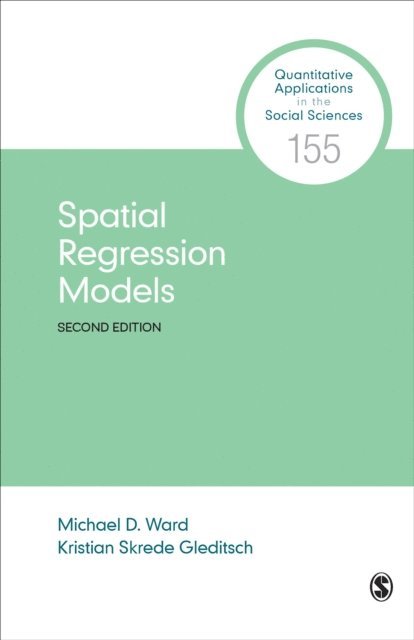
Spatial Regression Models illustrates the use of spatial analysis in the social sciences within a regression framework and is accessible to readers with no prior background in spatial analysis. The text covers different modeling-related topics for continuous dependent variables, including mapping data on spatial units, creating data from maps, analyzing exploratory spatial data, working with regression models that have spatially dependent regressors, and estimating regression models with spatially correlated error structures. Using social science examples based on real data, the authors illustrate the concepts discussed, and show how to obtain and interpret relevant results. The examples are presented along with the relevant code to replicate all the analysis using the R package for statistical computing. Users can download both the data and computer code to work through all the examples found in the text. New to the Second Edition is a chapter on mapping as data exploration and its role in the research process, updates to all chapters based on substantive and methodological work, as well as software updates, and information on estimation of time-series, cross-sectional spatial models.
Del 155 - Quantitative Applications in the Social Sciences
Spatial Regression Models
540 kr
Skickas
Spatial Regression Models illustrates the use of spatial analysis in the social sciences within a regression framework and is accessible to readers with no prior background in spatial analysis. The text covers different modeling-related topics for continuous dependent variables, including mapping data on spatial units, creating data from maps, analyzing exploratory spatial data, working with regression models that have spatially dependent regressors, and estimating regression models with spatially correlated error structures. Using social science examples based on real data, the authors illustrate the concepts discussed, and show how to obtain and interpret relevant results. The examples are presented along with the relevant code to replicate all the analysis using the R package for statistical computing. Users can download both the data and computer code to work through all the examples found in the text. New to the Second Edition is a chapter on mapping as data exploration and its role in the research process, updates to all chapters based on substantive and methodological work, as well as software updates, and information on estimation of time-series, cross-sectional spatial models.