Lars Jonung – författare
764 kr
Skickas
2 322 kr
Skickas inom 10-15 vardagar
2 467 kr
Skickas inom 10-15 vardagar
806 kr
Skickas inom 10-15 vardagar
589 kr
Skickas inom 7-10 vardagar
2 237 kr
Skickas inom 7-10 vardagar
797 kr
Skickas inom 7-10 vardagar
716 kr
Skickas inom 10-15 vardagar
797 kr
Läs direkt efter köp
797 kr
Läs direkt efter köp
925 kr
Läs direkt efter köp
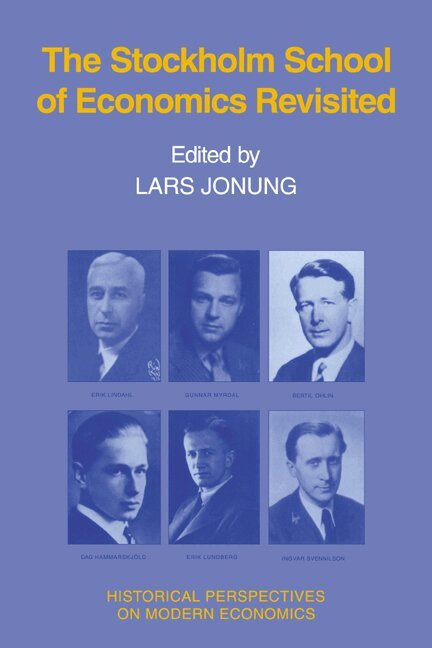
The impact of Swedish economists on the development of modern economic analysis has been profound. This volume contains twelve essays dealing with various aspects of the development of economics and economic thought from the mid 18th century to the middle of the 20th century. Most of the essays cover the golden age of Swedish economics, the early decades of the 20th century, and deal with such figures as Knut Wicksell, Gustav Cassel, Eli Heckscher, Bertil Ohlin, Erik Lindahl and Erik Lundberg.The book includes a chapter on an unpublished manuscript of Knut Wicksell''s which is reproduced in English for the first time
925 kr
Läs direkt efter köp
The impact of Swedish economists on the development of modern economic analysis has been profound. This volume contains twelve essays dealing with various aspects of the development of economics and economic thought from the mid 18th century to the middle of the 20th century. Most of the essays cover the golden age of Swedish economics, the early decades of the 20th century, and deal with such figures as Knut Wicksell, Gustav Cassel, Eli Heckscher, Bertil Ohlin, Erik Lindahl and Erik Lundberg.The book includes a chapter on an unpublished manuscript of Knut Wicksell''s which is reproduced in English for the first time
1 524 kr
Läs direkt efter köp
1 524 kr
Läs direkt efter köp
2 259 kr
Skickas inom 10-15 vardagar
849 kr
Läs direkt efter köp
The income velocity of money-an inverse measure of the demand for money balances-is the ratio of the money value of income to the average money stock that the public (excluding banks) holds in a given period. Why the magnitude of that ratio has changed over time is the subject of Michael D. Bordo and Lars Jonung''s classic study, originally published as The Long-Run Behavior of the Velocity of Circulation. Supported by statistical data, econometric estimation techniques, and meticulous historical analysis, this work describes, in an international setting, how slow-moving economic, social, and political forces interact with the decisions households and firms make about how much money to hold.
Annual time series of velocity for several countries from the late nineteenth century to the late twentieth century display a U-shaped pattern. Existing theories can explain each section of the velocity curve-the falling, flat, and rising parts-but the overall pattern is not consistent with any one theory. Here the authors put forth a comprehensive explanation for this behavior over time. Their theory is largely an extension of the approach of Knut Wicksell, the Swedish economist who stressed the role of substitution between monetary assets. This approach, which emphasizes institutional variables, is incorporated into the arguments for the traditional long-run money demand (velocity) function. Four types of empirical evidence strongly support the authors'' theory: econometric studies of the long-run velocity function for several countries; a cross section study of approximately eighty countries in the postwar period; a case study of the Swedish monetization process in the fifty years before World War I; and an examination of the time series properties of velocity.
Demand for Money suggests that institutional factors, as opposed to real income, play a greater role in velocity than previously thought. And these institutional factors have a major impact on monetary policy. This is a book that will prove of great value to economists, monetary strategists, and policymakers.
849 kr
Läs direkt efter köp
The income velocity of money-an inverse measure of the demand for money balances-is the ratio of the money value of income to the average money stock that the public (excluding banks) holds in a given period. Why the magnitude of that ratio has changed over time is the subject of Michael D. Bordo and Lars Jonung''s classic study, originally published as The Long-Run Behavior of the Velocity of Circulation. Supported by statistical data, econometric estimation techniques, and meticulous historical analysis, this work describes, in an international setting, how slow-moving economic, social, and political forces interact with the decisions households and firms make about how much money to hold.
Annual time series of velocity for several countries from the late nineteenth century to the late twentieth century display a U-shaped pattern. Existing theories can explain each section of the velocity curve-the falling, flat, and rising parts-but the overall pattern is not consistent with any one theory. Here the authors put forth a comprehensive explanation for this behavior over time. Their theory is largely an extension of the approach of Knut Wicksell, the Swedish economist who stressed the role of substitution between monetary assets. This approach, which emphasizes institutional variables, is incorporated into the arguments for the traditional long-run money demand (velocity) function. Four types of empirical evidence strongly support the authors'' theory: econometric studies of the long-run velocity function for several countries; a cross section study of approximately eighty countries in the postwar period; a case study of the Swedish monetization process in the fifty years before World War I; and an examination of the time series properties of velocity.
Demand for Money suggests that institutional factors, as opposed to real income, play a greater role in velocity than previously thought. And these institutional factors have a major impact on monetary policy. This is a book that will prove of great value to economists, monetary strategists, and policymakers.
Economic Development of Sweden since 1870�
6 626 kr
Skickas inom 5-8 vardagar
1 535 kr
Skickas
393 kr
Skickas inom 5-8 vardagar
EU mellan federalism och flexibel integration
233 kr
Skickas
Ska EU utvecklas i en federal riktning eller ska flexibla lösningar på konkreta problem tillämpas? Detta är ödesfrågan som EU återigen står inför i en tid då nya hotbilder växer sig starka i omvärlden och flera inom-europeiska utmaningar kvarstår. En tydlig framtida färdriktning är ännu inte utstakad. Låter sig de mönster som kan skönjas i utvecklingen under de senaste åren tolkas som att EU har tagit avgörande kliv mot ett federalt system, eller handlar det snarare om en utveckling i flera hastigheter? I en tid då EU står inför stora utmaningar är handlingskraften i dess befogenheter och bärigheten i politiska strukturer avgörande för framtiden. Dessa utmaningar ställer viktiga frågor på sin spets: utgör planerna att upprätta en europeisk försvarsunion, jämte inrättandet av en europeisk åklagarmyndighet avgörande steg bort från statssuveräniteten? Innebär den nya utformningen av EU:s statsstödsregler ett hot mot demokratin? Hur påverkar rättsstatskrisen integrationen i EU? Hur ser möjligheterna och utmaningarna ut för en gemensam skatte- och finanspolitik inom EU? Vilken roll spelar graden av ekonomisk jämlikhet för EU:s fortsatta utveckling? Finns det en fungerande parlamentarism i EU?
Dessa och andra frågor belyses i den tjugofemte årgången av Europaperspektiv. Boken är tvärvetenskaplig och innehåller nio kapitel skrivna av forskare inom juridik, statskunskap och ekonomiska ämnen, som ur olika perspektiv analyserar den europeiska integrationens färdriktning.
1 274 kr
Skickas inom 5-8 vardagar
Lessons for EMU from the History of Monetary Unions
160 kr
Tillfälligt slut
564 kr
Tillfälligt slut
1 460 kr
Tillfälligt slut