Laura Bradley - Böcker
Visar alla böcker från författaren Laura Bradley. Handla med fri frakt och snabb leverans.
6 produkter
6 produkter
1 380 kr
Skickas inom 5-8 vardagar
Bertolt Brecht's epic theatre sought to change how spectators watched performances, equipping them to critique and intervene in the world outside the theatre. Taking its cue from his call for theatre to develop 'the art of spectatorship', this major new study explores vision, observation, and spectatorship in twelve of his plays, spanning his career. It relates this analysis to Brecht's own formative experiences of spectatorship, to his poems and theories, and to productions directed by Brecht and his close collaborators. Finally, it investigates Brecht's attempts to transform the composition of the audience and cultivate critical spectatorship at the Berliner Ensemble, the theatre he founded with his wife, the actor Helene Weigel, in East Berlin after the Second World War. Brecht's plays foreground scenarios in which watching matters, as characters witness acts of injustice, watch trials or punishments, engage in surveillance, or observe scientific experiments. These instances of onstage spectatorship play a key role in Brecht's drive to transform the viewing practices of the theatre audience, showing the audience what characters notice, what they overlook, and how they use or ignore the knowledge that they have gained through spectatorship. Drawing on archival material and sources that have previously been rarely consulted, Laura Bradley shows how Brecht and his close collaborators - Erich Engel, Benno Besson, Peter Palitzsch, and Manfred Wekwerth - dealt with onstage spectatorship in performance, presenting characters as observers and spectators from whom the theatre audience should learn. By combining analysis of text, performance, and reception, Brecht and the Art of Spectatorship provides rich insights into Brecht's plays, rehearsal methods, and stagings, and the experiences of spectators at productions of his plays in the Weimar Republic, in exile, and in the GDR.
2 622 kr
Skickas inom 5-8 vardagar
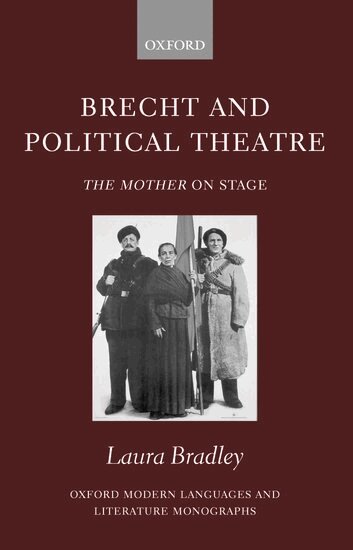
This production history of The Mother provides substantial new insights into Bertolt Brecht's theatre and drama, his impact on political theatre, and the relationship between text, performance, and politico-cultural context. As the only play which Brecht staged in the Weimar Republic, during his exile, and in the GDR, The Mother offers a unique opportunity to compare his theatrical practice in contrasting settings and at different points in his career. Through detailed analysis of original archival evidence, Bradley shows how Brecht became far more sensitive to his spectators' political views and cultural expectations, even making major tactical concessions in his 1951 production at the Berliner Ensemble. These compromises indicate that his 'mature' staging should not be regarded as definitive, for it was tailored to a unique and delicate situation.The Mother has appealed strongly to politically committed theatre practitioners both in and beyond Germany. By exploiting the text's generic hybridity and the interplay between Brecht's 'epic' and 'dramatic' elements, directors have interpreted it in radically different ways. So although Brecht's 1951 production stagnated into an affirmative GDR heritage piece, post-Brechtian directors have used The Mother to promote their own political and theatrical concerns, from anti-authoritarian theatre to reflections on the legacies of state Socialism. Their ideological and theatrical subversion have helped Brecht's text to outlive the political system that it came to uphold.
2 229 kr
Skickas inom 7-10 vardagar
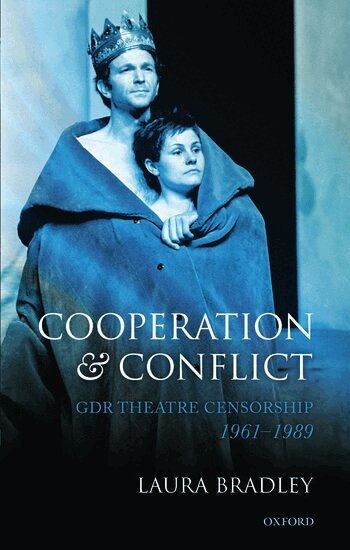
Despite all the evidence to the contrary, the authorities in the German Democratic Republic always denied that they practised censorship. In this fascinating new study, Laura Bradley explores how the authorities' denial affected the language and experience of theatre censorship. She shows that it left theatre practitioners doubly exposed: they remained officially responsible for their productions, even if the productions had passed pre-performance controls. In the absence of a fixed set of criteria, cultural functionaries had to make difficult judgements about which plays and productions to allow, and where to draw the line between constructive criticism and subversion. Drawing on a wealth of new archive material, the study explores how theatre practitioners and functionaries negotiated these challenges between 1961 and 1989. The chapters in Part I explore theatre censorship in East Berlin, asking how the controls affected different genres, and how theatre practitioners responded to the construction of the Berlin Wall, the Prague Spring, and the expatriation of Wolf Biermann. Part II broadens the focus to the regions, investigating why theatre practitioners complained of strong regional variations in theatre censorship, and how they responded to Mikhail Gorbachev's policies of glasnost and perestroika. By examining a range of case studies, from banned stagings to those that met with official approval, the book puts high-profile disputes back into context. It shows how censorship operated through human negotiation, illuminating the shifting patterns of cooperation and conflict that influenced the space available for theatrical experimentation.
119 kr
Tillfälligt slut
197 kr
Skickas inom 5-8 vardagar
Del 5 - Edinburgh German Yearbook
Edinburgh German Yearbook 5
Brecht and the GDR: Politics, Culture, Posterity
Inbunden, Engelska, 2011
1 212 kr
Skickas inom 10-15 vardagar
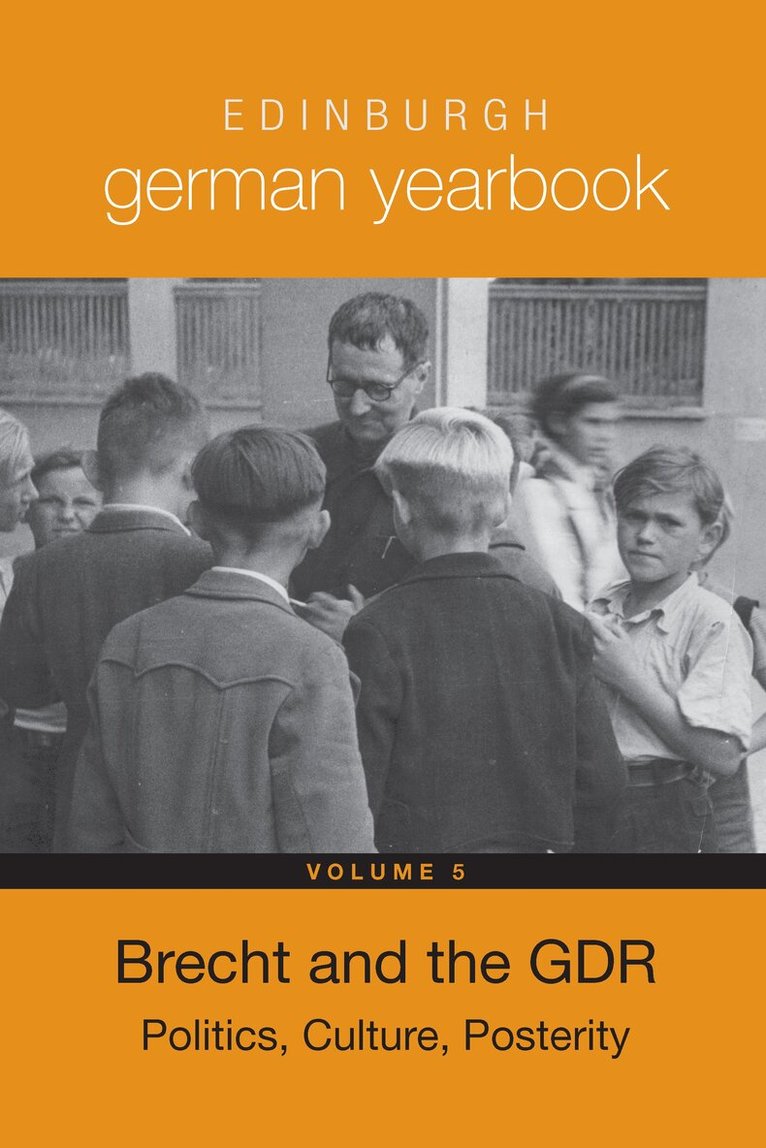
Brecht's activities in the GDR, the regime's marginalizing response and posthumous appropriation of his legacy, and creative responses in the GDR and after.The avant-garde writer and director Bertolt Brecht left the West for good in 1949, returning to East Berlin and founding the Berliner Ensemble. While he quickly became identified internationally as the cultural figurehead of the young socialist state, his relationship with the authorities was always complex, and he was increasingly marginalized by restrictive and authoritarian structures of power. It was only after his death that the regime sought to elevate him as a socialist classic - a shift that entailed the selective appropriation of his legacy and the development of authorized modes of interpretation and performance. Poets, theorists, dramatists, and directors soon reacted against what they saw as the stagnation of Brecht's critical impetus: they began to subject his work to his own treatment, using his texts as a source of material and taking his methods to more radical conclusions. EGYB 5 explores the multiple, contradictory impulses behind these broad paradigm shifts and behind Brecht's activities in the GDR. It investigates the tensions engendered by his co-option as a socialist classic, and the range of creative responses his works have inspired, both in the GDR itself and in reaction to its demise.Contributors: David Barnett, Laura Bradley, Joy Calico, Paula Hanssen, Patrick Harkin, Loren Kruger, Karen Leeder, Moray McGowan, Stephen Parker, David Robb, Erdmut Wizisla. Laura Bradley is Senior Lecturer in German at the University of Edinburgh. Karen Leeder is Professor of Modern German Literature and a Fellow of New College, University of Oxford.