Laurie M. Brown – författare
Visar alla böcker från författaren Laurie M. Brown. Handla med fri frakt och snabb leverans.
6 produkter
6 produkter
Häftad, Engelska, 1986
615 kr
Skickas inom 7-10 vardagar
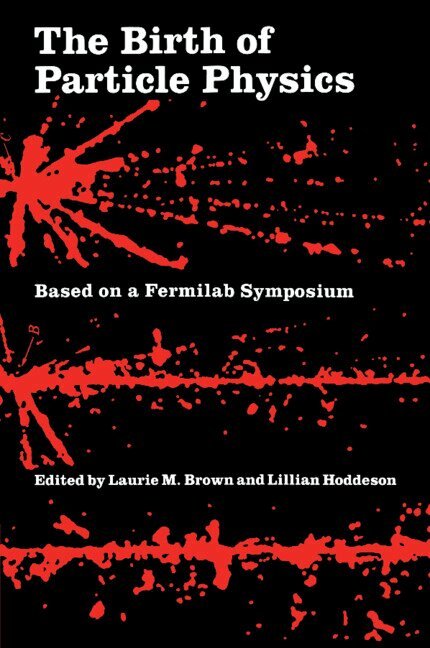
Editors Laurie Brown and Lillian Hoddeson have brought together a distinctive collection of essays, discussions, and personal descriptions of the evolution of particle physics based on the presentations and discussions at the May 1980 International Symposium on the History of Particle Physics, held at Fermi National Accelerator Laboratory in Batavia, Illinois. This collection focuses primarily on the development of cosmic-ray physics and quantum field theory in the 1930s and 1940s, before the advent of the great postwar accelerators, and draws on research conducted in the United States, Italy, Japan, Great Britain, Germany, France, and the USSR.
E-bok
PDF, Engelska, 20121 100 kr
Läs direkt efter köp
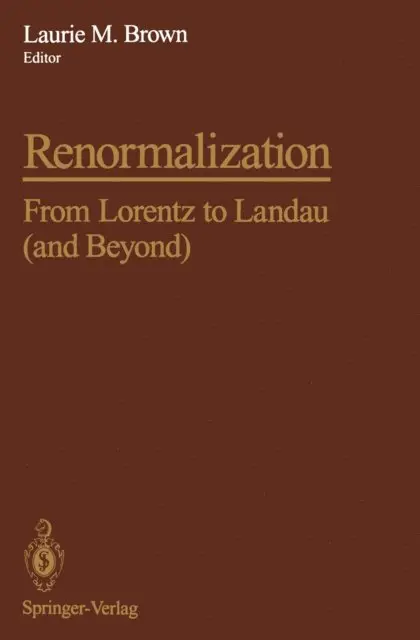
The purpose of this section is to give you a sketch of how quantum field theory works, where Feynman graphs come from and why they are so useful, where the infinities come from, and how we have learned to deal with them without compromising the physical principles involved. I am purposely treating the problem at the level of the 1940s and 1950s, so as to keep the basic ideas clear and avoid the more difficult problems and more sophisticated methods of recent years. I shall relate my discussion simply to quantum electrodynamics (QED) since that is the most familiar case and the case that was in the forefront from the beginning (though in fact I shall ignore many of the special complications that have to be dealt with when you quantize a gauge field). The methods I shall be describing are applicable to all sorts of quantized fields: the detailed factors are different but the structure of the logical development isjust the same. Not surprisingly, though, the renormalization procedure breaks down if the theory in question is nonrenormalizable. Whether nonrenormalizable theories are theories at all is a matter for debate; in any case, they hold no practical interest for physicists since they are essentially unusable. Quantum electrodynamics was devised in 1927 by Dirac, less than a year after the Schrodinger equation appeared and before the Dirac equa tion for the relativistic electron had been invented.
Häftad, Engelska, 2005
183 kr
Skickas inom 5-8 vardagar
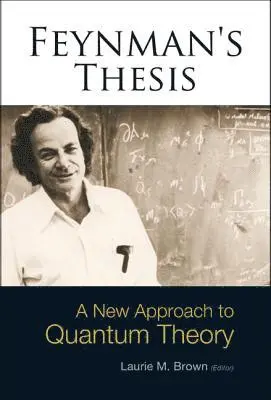
Richard Feynman's never previously published doctoral thesis formed the heart of much of his brilliant and profound work in theoretical physics. Entitled “The Principle of Least Action in Quantum Mechanics,' its original motive was to quantize the classical action-at-a-distance electrodynamics. Because that theory adopted an overall space-time viewpoint, the classical Hamiltonian approach used in the conventional formulations of quantum theory could not be used, so Feynman turned to the Lagrangian function and the principle of least action as his points of departure.The result was the path integral approach, which satisfied — and transcended — its original motivation, and has enjoyed great success in renormalized quantum field theory, including the derivation of the ubiquitous Feynman diagrams for elementary particles. Path integrals have many other applications, including atomic, molecular, and nuclear scattering, statistical mechanics, quantum liquids and solids, Brownian motion, and noise theory. It also sheds new light on fundamental issues like the interpretation of quantum theory because of its new overall space-time viewpoint.The present volume includes Feynman's Princeton thesis, the related review article “Space-Time Approach to Non-Relativistic Quantum Mechanics” [Reviews of Modern Physics 20 (1948), 367-387], Paul Dirac's seminal paper “The Lagrangian in Quantum Mechanics'' [Physikalische Zeitschrift der Sowjetunion, Band 3, Heft 1 (1933)], and an introduction by Laurie M Brown.
Del 27 - World Scientific Series In 20th Century Physics
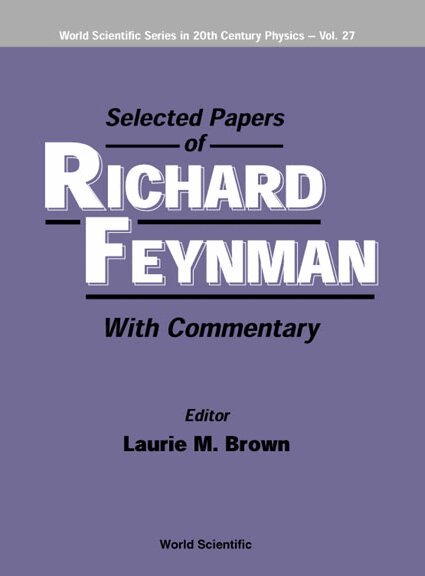
Selected Papers Of Richard Feynman (With Commentary)
Inbunden, Engelska, 2000
5 449 kr
Tillfälligt slut
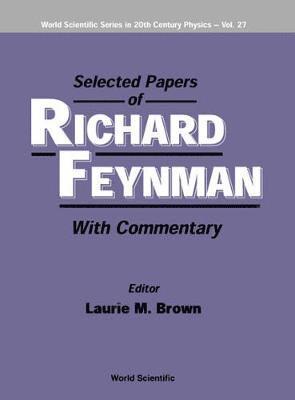
These scientific papers of Richard Feynman are renowned for their brilliant content and the author's striking original style. They are grouped by topic: path integral approach to the foundations of quantum mechanics and quantum field theory, renormalized quantum electrodynamics, theory of superfluid liquid helium, theory of the Fermi interaction, polarons, gravitation, partons, computer theory, etc. Comments on Feynman's topics are provided by the editor, together with biographical notes and a complete bibliography of Feynman's publications.
Del 27 - World Scientific Series In 20th Century Physics
Selected Papers Of Richard Feynman (With Commentary)
Häftad, Engelska, 2000
830 kr
Tillfälligt slut
These scientific papers of Richard Feynman are renowned for their brilliant content and the author's striking original style. They are grouped by topic: path integral approach to the foundations of quantum mechanics and quantum field theory, renormalized quantum electrodynamics, theory of superfluid liquid helium, theory of the Fermi interaction, polarons, gravitation, partons, computer theory, etc. Comments on Feynman's topics are provided by the editor, together with biographical notes and a complete bibliography of Feynman's publications.
Inbunden, Engelska, 2005
558 kr
Tillfälligt slut
Richard Feynman's never previously published doctoral thesis formed the heart of much of his brilliant and profound work in theoretical physics. Entitled “The Principle of Least Action in Quantum Mechanics,' its original motive was to quantize the classical action-at-a-distance electrodynamics. Because that theory adopted an overall space-time viewpoint, the classical Hamiltonian approach used in the conventional formulations of quantum theory could not be used, so Feynman turned to the Lagrangian function and the principle of least action as his points of departure.The result was the path integral approach, which satisfied — and transcended — its original motivation, and has enjoyed great success in renormalized quantum field theory, including the derivation of the ubiquitous Feynman diagrams for elementary particles. Path integrals have many other applications, including atomic, molecular, and nuclear scattering, statistical mechanics, quantum liquids and solids, Brownian motion, and noise theory. It also sheds new light on fundamental issues like the interpretation of quantum theory because of its new overall space-time viewpoint.The present volume includes Feynman's Princeton thesis, the related review article “Space-Time Approach to Non-Relativistic Quantum Mechanics” [Reviews of Modern Physics 20 (1948), 367-387], Paul Dirac's seminal paper “The Lagrangian in Quantum Mechanics'' [Physikalische Zeitschrift der Sowjetunion, Band 3, Heft 1 (1933)], and an introduction by Laurie M Brown.