• Fri frakt över 249 kr
  • •
  • Snabba leveranser
  • •
  • Billiga böcker
Kundservice

Du är på sajten för privatpersoner.

Företag, bibliotek eller offentlig verksamhet?

Du handlar på classic.bokus.com, där alla dina funktioner finns intakta.
Till classic.bokus.com
Bokus logotyp. Gå till startsidan.
  • Erbjudanden
  • Nyheter
  • Student
  • Topplistor
  • Barn & ungdom
  • Bokus Play
  • E-böcker
  • Pocketböcker
  • Spel & pussel

10% rabatt på allt med kod NYSTART10 →

Sidfot

Mina sidor

    Hjälp

    • Kundservice
    • Vanliga frågor och svar
    • Frakt och leverans
    • Retur vid ångerrätt
    • Reklamera vara
    • Betalning
    • Köpvillkor
    • Allmänna villkor
    • Information om webbplatsens tillgänglighet

    Om Bokus

    • Om oss
    • Pressrum
    • För studenter
    • För företag
    • För bibliotek och offentlig verksamhet
    • För leverantörer
    • Hållbarhet

    Populärt

    • Aktuella erbjudanden
    • Presentkort
    • Studentlitteratur
    • Nya böcker
    • Topplistor
    • Signerade böcker
    • Engelska böcker

    Inspiration

    • Boktips
    • BookTok
    • Populära bokserier
    • Barnbokskaraktärer
    • Populära författare
    Logotyp för Bokus
    Följ oss på Facebook (extern länk)Följ oss på Instagram (extern länk)Följ oss på YouTube (extern länk)Följ oss på TikTok (extern länk)
    bokus @ CookiesAnpassa cookiesIntegritetspolicyKöpvillkor
    Till Citymail hemsida (extern länk)Till Budbee hemsida (extern länk)Till Postnord hemsida (extern länk)Till Schenker hemsida (extern länk)Till Early Bird hemsida (extern länk)Till Walleys hemsida (extern länk)
    1. Naturvetenskap och teknik
    2. Matematik och naturvetenskap
    3. Fysik
    4. Matematisk fysik

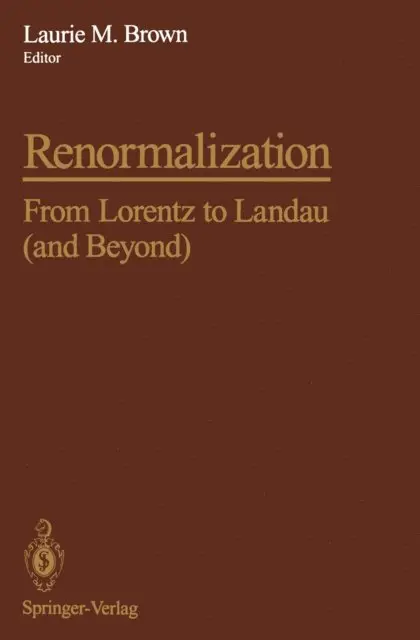
    Renormalization

    From Lorentz to Landau (and Beyond)

    AvLaurie M. Brown

    E-bok
    PDF, Engelska, 2012

    1 136 kr

    Läs direkt i Bokus Reader – eller ladda ned till din enhet (PDF kräver ofta zoom och scroll på små skärmar).

    Beskrivning

    The purpose of this section is to give you a sketch of how quantum field theory works, where Feynman graphs come from and why they are so useful, where the infinities come from, and how we have learned to deal with them without compromising the physical principles involved. I am purposely treating the problem at the level of the 1940s and 1950s, so as to keep the basic ideas clear and avoid the more difficult problems and more sophisticated methods of recent years. I shall relate my discussion simply to quantum electrodynamics (QED) since that is the most familiar case and the case that was in the forefront from the beginning (though in fact I shall ignore many of the special complications that have to be dealt with when you quantize a gauge field). The methods I shall be describing are applicable to all sorts of quantized fields: the detailed factors are different but the structure of the logical development isjust the same. Not surprisingly, though, the renormalization procedure breaks down if the theory in question is nonrenormalizable. Whether nonrenormalizable theories are theories at all is a matter for debate; in any case, they hold no practical interest for physicists since they are essentially unusable. Quantum electrodynamics was devised in 1927 by Dirac, less than a year after the Schrodinger equation appeared and before the Dirac equa­ tion for the relativistic electron had been invented.

    Produktinformation

    • Utgivningsdatum:2012-12-06
    • Språk:Engelska
    • Filformat:PDF
    • Kopieringsskydd:LCP
    • ISBN:9781461227205
    • Förlag:Springer New York

    Utforska kategorier

    • Matematisk fysik inom Naturvetenskap och teknik