Lawrence Kaplan - Böcker
Visar alla böcker från författaren Lawrence Kaplan. Handla med fri frakt och snabb leverans.
7 produkter
7 produkter
3 094 kr
Skickas inom 3-6 vardagar
Rockaway Beach was once a popular seaside resort in south Queens with a small permanent population. Shortly after World War II, large parts of this narrow peninsula between the ocean and the bay became some of New York City's worst slums. A historian who grew up in the community and his wife, a social worker, together present an illuminating account of this transformation, exploring issues of race, class, and social policy and offering a significant revision of the larger story of New York City's development. In particular, the authors qualify some of the negative assessments of Robert Moses, suggesting that the "Power Broker" attempted for many positive initiatives for Rockaway. Based on extensive archival research and hundreds of hours of interviews with residents, urban specialists, and government officials past and present, Between Ocean and City is a clear-eyed and harrowing story of this largely African American community's struggles and resiliency in the face of grinding poverty, urban renewal schemes gone wrong, and a forced ghettoization by the sea.
836 kr
Skickas inom 3-6 vardagar
Rockaway Beach was once a popular seaside resort in south Queens with a small permanent population. Shortly after World War II, large parts of this narrow peninsula between the ocean and the bay became some of New York City's worst slums. A historian who grew up in the community and his wife, a social worker, together present an illuminating account of this transformation, exploring issues of race, class, and social policy and offering a significant revision of the larger story of New York City's development. In particular, the authors qualify some of the negative assessments of Robert Moses, suggesting that the "Power Broker" attempted for many positive initiatives for Rockaway. Based on extensive archival research and hundreds of hours of interviews with residents, urban specialists, and government officials past and present, Between Ocean and City is a clear-eyed and harrowing story of this largely African American community's struggles and resiliency in the face of grinding poverty, urban renewal schemes gone wrong, and a forced ghettoization by the sea.
489 kr
Skickas inom 10-15 vardagar
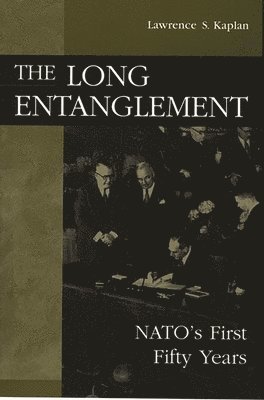
The fiftieth anniversary of the long entanglement between the United States and NATO is an appropriate occasion to reflect. One of the few NATO studies to concentrate on the history of the alliance, particularly the relationship between its senior partner and its European allies, this study examines critical issues in depth, to uncover the ability of the allies to surmount their internal divisions and to confront their Soviet adversary. While NATO archives are still not fully open, the use of declassified documents from the National Archives and the presidential libraries are of invaluable assistance in considering the historical role of America in the alliance, and the continuing relevance of the organization in U.S. foreign policy.The twelve chapters of this book, provide analyses of important issues in the organization's history, and are connected by brief contexual narratives. The resulting picture depicts a fifty-year history in which the difficulties in arriving at a consensus among the fifteen allies, each understandably concerned with its own national interests, rival those of the alliance in dealing with the Communist threat. The implosion of the Soviet empire in the early 1990s left the organization in search of new reasons for its own existence. While centrifugal forces are arguably greater today than they were during the Cold War, none of the allies seeks to terminate this long entanglement.
675 kr
Skickas inom 10-15 vardagar
This history of NATO concentrates on the differences within the alliance, particularly between the US and its European partners. NATO's war against terrorism began on September 11, 2001. Invoking Article 5 was a fitting response to the assault on the United States, but the spirit did not last long. Within a few weeks, old fissures within the alliance re-emerged, threatening once again to dissolve an entity that had survived over half a century. In the first two generations of NATO's existence, the Cold War with the Soviet Union had been the major purpose of its existence. But since the dissolution of the Warsaw Pact and of the Russian Empire itself, NATO has struggled to seek new raisons d'etre, and has succeeded to some degree in finding them in crisis management in Europe and in areas beyond the boundaries of the alliance.The absence of a traditional enemy to serve as a centripetal force, along with the recognition of the US as the lone superpower, has placed a focus on internal troubles of the alliance that had been obscured in the past by the presence of a common enemy. Too little attention has been paid to such West-West conflicts which arguably have been more frequent and more bitter, if not more dangerous, than the struggle with the Soviet Union. Differences among the allies began with the formation of the alliance itself. Some were resolved, others persisted. Many of them related to out of area issues in which the Soviet Union was not involved or only peripherally concerned. How the alliance managed the unequal relationship in the past may offer insights into the common ground the alliance partners can identify in the 21st century.
392 kr
Skickas inom 10-15 vardagar
This history of NATO concentrates on the differences within the alliance, particularly between the US and its European partners. NATO's war against terrorism began on September 11, 2001. Invoking Article 5 was a fitting response to the assault on the United States, but the spirit did not last long. Within a few weeks, old fissures within the alliance re-emerged, threatening once again to dissolve an entity that had survived over half a century. In the first two generations of NATO's existence, the Cold War with the Soviet Union had been the major purpose of its existence. But since the dissolution of the Warsaw Pact and of the Russian Empire itself, NATO has struggled to seek new raisons d'etre, and has succeeded to some degree in finding them in crisis management in Europe and in areas beyond the boundaries of the alliance.The absence of a traditional enemy to serve as a centripetal force, along with the recognition of the US as the lone superpower, has placed a focus on internal troubles of the alliance that had been obscured in the past by the presence of a common enemy. Too little attention has been paid to such West-West conflicts which arguably have been more frequent and more bitter, if not more dangerous, than the struggle with the Soviet Union. Differences among the allies began with the formation of the alliance itself. Some were resolved, others persisted. Many of them related to out of area issues in which the Soviet Union was not involved or only peripherally concerned. How the alliance managed the unequal relationship in the past may offer insights into the common ground the alliance partners can identify in the 21st century.
1 039 kr
Skickas inom 10-15 vardagar
611 kr
Tillfälligt slut