Leon Stover - Böcker
Visar alla böcker från författaren Leon Stover. Handla med fri frakt och snabb leverans.
6 produkter
6 produkter
462 kr
Skickas inom 5-8 vardagar
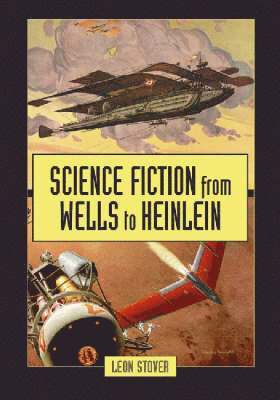
As a publisher's category, science fiction began in the American pulp magazine industry in 1926. But its origins lay in the British tradition of the scientific romance, whose mastery by H.G. Wells in his Victorian youth (1895-1901) makes him the "father of modern SF" (Jules Verne is a more distant ancestor). Wells's most self-conscious descendant is Robert Heinlein, whose rapid rise to fame during the magazine era made him "the dean of American SF." He so succeeded in winning literary recognition for the genre that it all but vanished into the mainstream, save for a lingering identity in classified paperbacks and in television programming (Michael Crichton's Jurassic Park, for example, was marketed as general fiction and not science fiction).The present work, by a man who taught the subject at the university level for decades, is a critical examination of the literary trajectory of science fiction from the scientific romances of H.G. Wells to the era of Robert Heinlein. Such luminaries as Isaac Asimov (I, Robot), Arthur C. Clarke (2001), A.E. van Vogt (Slan), L. Sprague de Camp (Lest Darkness Fall), Harry Harrison (Stars and Stripes Forever trilogy), Kurt Vonnegut (The Sirens of Titan), Brian Aldiss (Greybeard), Edgar Rice Burroughs (Barsoom series, Pellucidar series), Ray Bradbury (The Martian Chronicles), Fritz Leiber (The Wanderer), C.S. Lewis (Perelandra), and Arthur Conan Doyle (The Lost World) are discussed along the way. The roles of various magazines in establishing the genre, an area of the author's special expertise, are fully examined (Hugo Gernsback's Science and Invention, Amazing Stories, and Weird Tales, among others).

414 kr
Tillfälligt slut
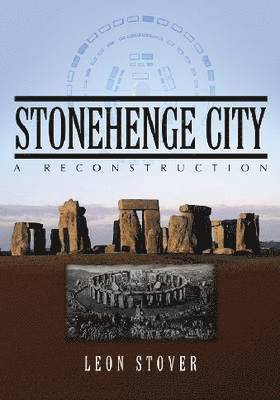
Stonehenge dates its Bronze Age phase to 2000 B.C. (but with a history stretching back yet another thousand years to Neolithic times). It attracts more than a million tourists a year, but is more than an array of great standing stones. Stonehenge was indeed its own city, the metropolitan center of a powerful kingdom heretofore unsuspected.That city is reconstructed by the author from the archaeological evidence--royal palace, banquet hall and tomb, among other buildings. Here (apart from Homer) begins European literature, derived from oral traditions. The entire book is richly illustrated.
549 kr
Tillfälligt slut
Initiated during the Former Han Dynasty in 136 BCE, the state cult of Confucius endured for more than 2000 years as the civil religion of a vast empire that ever-renewed itself despite periodic disunity and barbarian conquests. This was a weak agrarian state whose foundation was a Neolithic peasantry, whose archaic state-idea traces to the dawn of Chinese civilization, and whose ruling elite earned its credentials in civil service examinations based on classic Confucianism dating to pre-imperial times--all centered on the political thinking of a late Bronze Age philosopher.This work explores the political logic of old China's archaic civilization, where court protocol was the very essence of a liturgical government whose philosophical basis rested on the scriptural authority of Confucian teachings. Here is the historical paradox (vast empire, weak state) resolved in this book. By looking into the state cult of Confucius and its origins, the illogical begins to look reasonable for the pre-modern conditions of antiquity. Included are 128 photographs along with an appendix covering the Great Chinese Museum of New York and a bibliographic essay offering essential information on important works of Sinology.
Island of Doctor Moreau
A Critical Text of the 1896 London First Edition, with an Introduction and Appendices
Häftad, Engelska, 2012
409 kr
Skickas inom 5-8 vardagar
H.G. Wells (1866-1946) wrote some of the great classics of speculative fiction in English, including The Island of Doctor Moreau (1896), which might be said to be about unholy genetics. The work's biological and sociopolitical ideas are still current (such were the range and depth of Wells' ideas).Wells continued to work on Doctor Moreau for nearly thirty years after its initial publication in London (the New York first edition added a subtitle A Possibility), finally letting go of the work after the publication of the Atlantic Edition in 1924. Annotated by the premier Wellsian scholar, this is an exhaustive critical edition, examining the historical, medical, philosophical and literary contexts of the story.
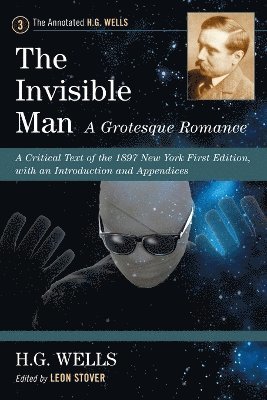
Invisible Man: A Grotesque Romance
A Critical Text of the 1897 New York First Edition, with an Introduction and Appendices
Häftad, Engelska, 2012
377 kr
Skickas inom 5-8 vardagar
H.G. Wells barely revised The Invisible Man once it was published, adding only an epilogue. But the opening statement of that epilogue--"So ends the strange and evil experiment of the Invisible Man"--has posed challenges to scholars. How to understand it? Does it speak strictly to the scientific elements of the novel? Or is it a part of the work's political underpinnings? The 1897 New York first edition (the first edition to incorporate the epilogue) is used here as the basis for the exhaustive annotations and other critical apparatus of the world's foremost Wellsian scholar. The introduction examines in great detail the novel's position in the Wellsian canon and sets the major themes in context with the literary conventions used in his other works, particularly the scientific romances.
Del 4 - Annotated H.G. Wells
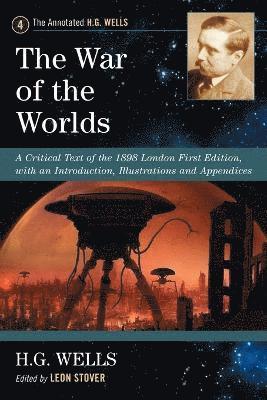
War of the Worlds
A Critical Text of the 1898 London First Edition, with an Introduction, Illustrations and Appendices
Häftad, Engelska, 2012
409 kr
Skickas inom 5-8 vardagar
Wells' novel, a "scientific romance," attained perhaps its greatest fame in another form, the infamous realistic 1939 radio broadcast "Invasion from Mars" by the redoubtable Orson Welles. It was also notably made into an early fifties science fiction adventure movie (and there have been other adaptations as well). So indelible is the association that the novel, like the panic inducing broadcast and the Hollywood flick, now is taken as little more than a light fantasy of outerspace terror and human heroism, far from the author's original vision. The War of the Worlds is a philosophical tale and as such, is profoundly ideological. The world of the Martians represents the progressive future of humanity in a cultural war with our world of tradition and reaction--these are the two worlds in question.The Mars from which the invaders come is united by a planet-wide system of irrigation canals; for Wells this indicates a socialist world-state. The red planet is red in more than one sense, pointing the direction of terrestrial progress. The Martians in the novel are octopoidal monsters, bodily anticipating the tentacular, all-controlling totalitarian regimes of the twentieth century.