Leonard F. Wheat - Böcker
Visar alla böcker från författaren Leonard F. Wheat. Handla med fri frakt och snabb leverans.
4 produkter
4 produkter
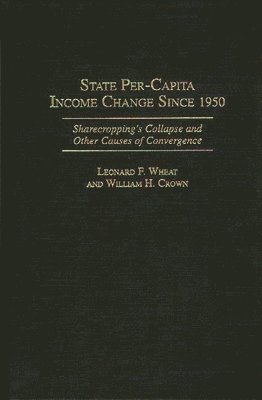
State Per-Capita Income Change Since 1950
Sharecropping's Collapse and Other Causes of Convergence
Inbunden, Engelska, 1995
1 039 kr
Skickas inom 10-15 vardagar
This book refutes prevailing theories that attribute post-1950 state per capita income convergence to (1) neo-classical adjustment mechanisms, (2) institutional sclerosis, and (3) southern industrialization. Wheat and Crown argue that southern income was low because of slavery's legacy—sharecropping, agricultural dependence, low urbanization, poor education, high Black population percentages, and low wage rates. The legacy's dominant feature was the sharecropper-tenant farmer system, which replaced slavery. Sharecropping was the foundation of southern poverty. Sharecropping's collapse, beginning around 1950, affected all of the other features of slavery's legacy. For example, millions of sharecroppers out-migrated from the South, shifting poverty to the North and lowering the South's Black percentage. This out-migration, white in-migration, and the civil rights movement jointly raised educational attainment in the South, further boosting southern income. Southern industrialization had only a marginally significant effect. In 1950's high income region, the West, the transport cost element in the price of manufactured goods shrank because of (1) transportation improvements and (2) rapid manufacturing growth, which reduced the need for long distance imports from the Manufacturing Belt. The resulting decline in the West's relative cost of living led to wage adjustments. Consequently, the West—despite having the highest manufacturing growth rates—had the nation's lowest per-capita income growth rates. Agricultural decline and educational gains stimulated income growth in the Plains. Nationally, per-capita employment gains were a strong influence.
929 kr
Skickas inom 10-15 vardagar
Acclaimed in an international critics poll as one of the ten best films ever made, Stanley Kubrick's 2001: A Space Odyssey has nonetheless baffled critics and filmgoers alike. Its reputation rests largely on its awesome special effects, yet the plot has been considered unfathomable. Critical consensus has been that Kubrick himself probably didn't know the answers.Leonard Wheat's Kubrick's 2001: A Triple Allegory reveals that Kubrick did know the answers. Far from being what it seems to be—a chilling story about space travel—2001 is actually an allegory, hidden by symbols. It is, in fact, a triple allegory, something unprecedented in film or literature. Three allegories—an Odysseus (Homer) allegory, a man-machine symbiosis (Arthur Clarke) allegory, and a Zarathustra (Nietzsche) allegory—are simultaneously concealed and revealed by well over 200 highly imaginative and sometimes devilishly clever symbols. Wheat "decodes" each allegory in rich detail, revealing the symbolism in numerous characters, sequences, and scenes. In bringing Kubrick's secrets to light, Wheat builds a powerful case for his assertion that 2001 is the "grandest motion picture ever filmed."
320 kr
Skickas inom 5-8 vardagar
"Philip Pullman's His Dark Materials" trilogy is one of the most popular fantasy works of our time. Both the trilogy and a new movie based on it are being marketed chiefly as YA (young adult) fare. But Leonard F Wheat shows in this fascinating analysis that "His Dark Materials" is far more than a YA tale. At a deeper level it is a complex triple allegory - a surface story that uses 231 symbols to tell three hidden stories. As such, it is among the most profound, intellectually challenging, and thoroughly adult works ever written. Wheat brings the hidden stories to light. He demonstrates how Pullman retells two prominent works of British literature - C S Lewis' "The Lion, the Witch and the Wardrobe" and John Milton's "Paradise Lost".Pullman's aim is to counter Lewis' pro-Christian allegory with his own anti-Christian allegory. Pullman does this in his second allegory by turning "Paradise Lost" upside down. Satan and his daughter, Sin, along with Adam's murderous son Cain, become heroes; God and Jesus become villains. This retold story depicts our society's warfare between knowledge (symbolised by Dust) and religious superstitions (symbolised by Spectres).Pullman adds an original third hidden story featuring Christian missionaries, Charles Darwin, agnostics, and atheists. Wheat's intriguing interpretation of Pullman's work is the first to point out the many allegorical features of "His Dark Materials" and to highlight the ingenious ways in which Pullman subtly attacks religious institutions and superstitions. Pullman fans as well as readers interested in fantasy or concerned about religious coercion will find Wheat's book not only stimulating but overflowing with surprises.
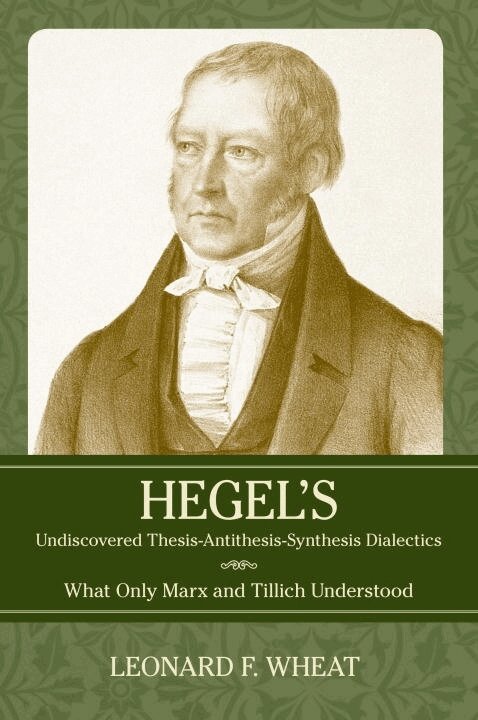
Hegel's Undiscovered Thesis-Antithesis-Synthesis Dialectics
What Only Marx and Tillich Understood
Inbunden, Engelska, 2012
349 kr
Tillfälligt slut
For over fifty years, Hegel interpreters have rejected the former belief that Hegel used thesis-antithesis-synthesis dialectics. In this incisive analysis of Hegel's philosophy, Leonard F. Wheat shows that the modern interpretation is false. Wheat rigorously demonstrates that there are in fact thirty-eight well-concealed dialectics in Hegel's two most important works--twenty-eight in Phenomenology of Spirit and ten in The Philosophy of History. Wheat also develops other major new insights:· Hegel's chief dialectical format consists of a two-concept thesis, a two-concept antithesis, and a two-concept synthesis that borrows one concept from the thesis and one from the antithesis.· All dialectics are analogically based on the Christian separation-and-return myth: the dialectic separates from and returns to a thesis concept.· Hegel's enigmatic Spirit is a four-faceted, deliberately fictitious, nonsupernatural entity that exists only as an atheistic redefinition of "God."· Spirit's "divine life" begins not with consciousness but with unconsciousness, in the prehuman state of nature-before Spirit acquires its human mind.· Hegel's concept of freedom is not a sociopolitical concept but release from bondage to religious superstition (belief in a supernatural God).· In Hegel's widely misinterpreted master-and-slave parable, the master is God, the slave is man, and the slave's gaining his freedom is man's becoming an atheist.· The standard non-Hegelian base-superstructure interpretation of Marx's dialectics is false. Marx's basic dialectic is actually this: thesis = communal ownership poverty, antithesis = private ownership wealth, synthesis = communal ownership wealth.Wheat also shows that Marx and Tillich, who subtly used Hegelian dialectics in their own works, are the only authors who have understood Hegelian dialectics.Thoroughly researched and exhaustive in detail, this radical reinterpretation of Hegel's philosophy should greatly interest Hegel scholars and students.