Leonidas Guibas – författare
Visar alla böcker från författaren Leonidas Guibas. Handla med fri frakt och snabb leverans.
10 produkter
10 produkter
E-bok
PDF, Engelska, 2004605 kr
Läs direkt efter köp
Information processing in sensor networks is a rapidly emerging area of computer science and electrical engineering research. Because of advances in micro-sensors, wireless networking and embedded processing, ad hoc networks of sensor are becoming increasingly available for commercial, military, and homeland security applications. Examples include monitoring (e.g., traffic, habitat, security), industrail sensing and diagnostics (e.g., factory, appliances), infrastructures (i.e., power grid, water distribution, waste disposal) and battle awareness (e.g., multi-target tracking). This book introduces practitioners to the fundamental issues and technology constraints concerning various aspects of sensor networks such as information organization, querying, routing, and self-organization using concrete examples and does so by using concrete examples from current research and implementation efforts.- Written for practitioners, researchers, and students and relevant to all application areas, including environmental monitoring, industrial sensing and diagnostics, automotive and transportation, security and surveillance, military and battlefield uses, and large-scale infrastructural maintenance- Skillfully integrates the many disciplines at work in wireless sensor network design: signal processing and estimation, communication theory and protocols, distributed algorithms and databases, probabilistic reasoning, energy-aware computing, design methodologies, evaluation metrics, and more- Demonstrates how querying, data routing, and network self-organization can support high-level information-processing tasks
Inbunden, Engelska, 2009
1 245 kr
Skickas inom 10-15 vardagar
A one-stop desk reference for R&D engineers involved in communications engineering, this book will not gather dust on the shelf. It brings together the essential professional reference content from leading international contributors in the field. Material covers a wide scope of topics, including voice, computer, facsimile, video, and multimedia data technologies. A hard-working desk reference, providing all the essential material needed by communications engineers on a day-to-day basis Fundamentals, key techniques, engineering best practice and rules-of-thumb together in one quick-reference sourcebook Definitive content by the leading authors in the field
E-bok
Engelska, 20091 298 kr
Läs direkt efter köp
A one-stop Desk Reference, for R&D engineers involved in communications engineering; this is a book that will not gather dust on the shelf. It brings together the essential professional reference content from leading international contributors in the field. Material covers a wide scope of topics including voice, computer, facsimile, video, and multimedia data technologies* A fully searchable Mega Reference Ebook, providing all the essential material needed by Communications Engineers on a day-to-day basis. * Fundamentals, key techniques, engineering best practice and rules-of-thumb together in one quick-reference.* Over 2,500 pages of reference material, including over 1,500 pages not included in the print edition
E-bok
PDF, Engelska, 20091 513 kr
Läs direkt efter köp
A one-stop desk reference for R&D engineers involved in communications engineering, this book will not gather dust on the shelf. It brings together the essential professional reference content from leading international contributors in the field. Material covers a wide scope of topics, including voice, computer, facsimile, video, and multimedia data technologies.- A hard-working desk reference, providing all the essential material needed by communications engineers on a day-to-day basis- Fundamentals, key techniques, engineering best practice and rules-of-thumb together in one quick-reference sourcebook- Definitive content by the leading authors in the field
Inbunden, Engelska, 2015
398 kr
Skickas inom 3-6 vardagar
Häftad, Engelska, 2018
246 kr
Skickas inom 3-6 vardagar
Häftad, Engelska, 2002
550 kr
Skickas inom 10-15 vardagar
In recent years, autonomous robots, including Xavier, Martha [1], Rhino [2,3], Minerva,and Remote Agent, have shown impressive performance in long-term demonstrations. In NASA’s Deep Space program, for example, an - tonomous spacecraft controller, called the Remote Agent [5], has autonomously performed a scienti?c experiment in space. At Carnegie Mellon University, Xavier [6], another autonomous mobile robot, navigated through an o?ce - vironment for more than a year, allowing people to issue navigation commands and monitor their execution via the Internet. In 1998, Minerva [7] acted for 13 days as a museum tourguide in the Smithsonian Museum, and led several thousand people through an exhibition. These autonomous robots have in common that they rely on plan-based c- trol in order to achieve better problem-solving competence. In the plan-based approach, robots generate control actions by maintaining and executing a plan that is e?ective and has a high expected utility with respect to the robots’ c- rent goals and beliefs. Plans are robot control programs that a robot can not only execute but also reason about and manipulate [4]. Thus, a plan-based c- troller is able to manage and adapt the robot’s intended course of action — the plan — while executing it and can thereby better achieve complex and changing tasks.
Häftad, Engelska, 2003
1 091 kr
Skickas inom 10-15 vardagar
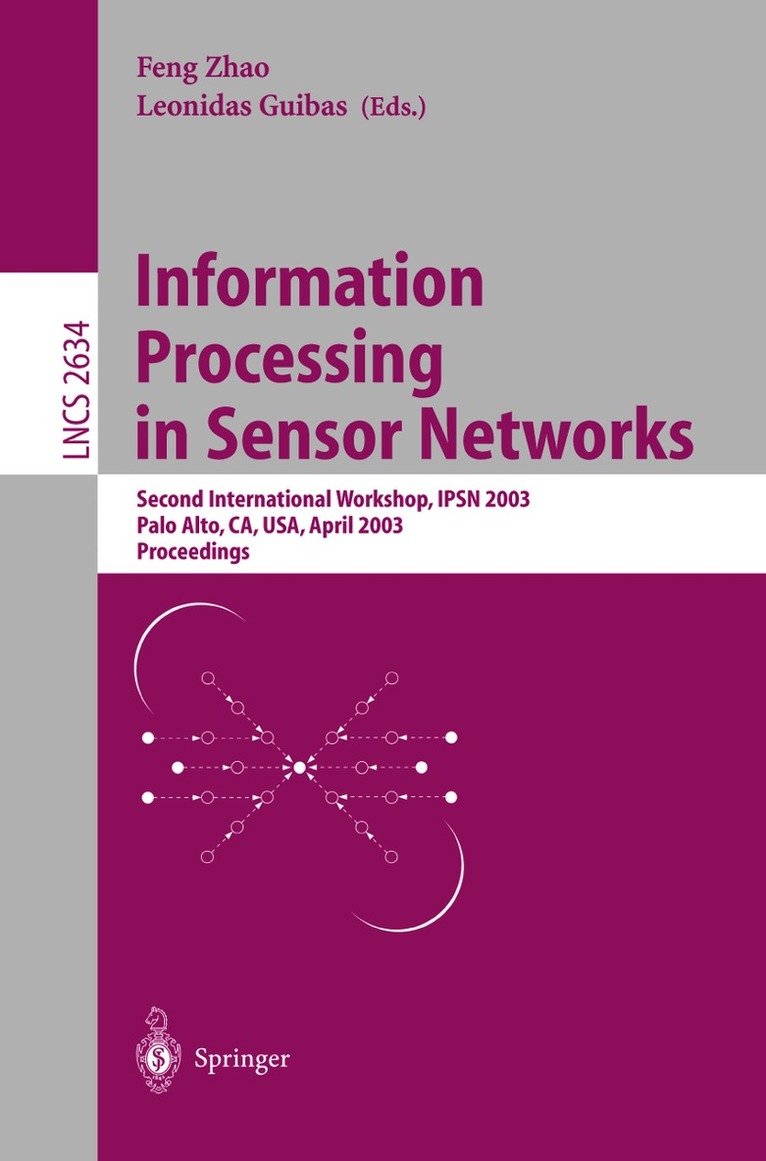
This volume contains the Proceedings of the 2nd International Workshop on Information Processing in Sensor Networks (IPSN 2003). The workshop was held at the Palo Alto Research Center (PARC), Palo Alto, California, on April 22–23, 2003. Informationprocessinginsensornetworksisaninterdisciplinaryresearcharea with deep connections to signal processing, networking and protocols, databases and information management, as well as distributed algorithms. Because of - vances in MEMS microsensors, wireless networking, and embedded processing, ad hoc networks of sensors are becoming increasingly available for commercial andmilitaryapplicationssuchasenvironmentalmonitoring(e.g.,tra?c,habitat, security), industrial sensing and diagnostics (e.g., factories, appliances), inf- structure maintenance (e.g., power grids, water distribution, waste disposal), and battle?eld awareness (e.g., multitarget tracking). From the engineering and computing point of view, sensor networks have become a rich source of problems in communication protocols, sensor tasking and control, sensor fusion, distributed databases and algorithms, probabilistic reasoning, system/software architecture, design methodologies, and evaluation metrics. This workshop took a systemic approach to address crosslayer issues, from the physical sensor layer to the sensor signal processing and networking levels and then all the way to the applications. Following the successful 1st Workshop on Collaborative Signal and Inf- mation Processing in Sensor Networks at PARC in 2001, this new workshop brought together researchers from academia, industry, and government to p- sent and discuss recent work concerning various aspects of sensor networks such as information organization, querying, routing, and self-organization, with anemphasis on the high-level information processing tasks that these networks are designed to perform.
E-bok
PDF, Engelska, 20031 408 kr
Läs direkt efter köp
This volume contains the Proceedings of the 2nd International Workshop on Information Processing in Sensor Networks (IPSN 2003). The workshop was held at the Palo Alto Research Center (PARC), Palo Alto, California, on April 22–23, 2003. Informationprocessinginsensornetworksisaninterdisciplinaryresearcharea with deep connections to signal processing, networking and protocols, databases and information management, as well as distributed algorithms. Because of - vances in MEMS microsensors, wireless networking, and embedded processing, ad hoc networks of sensors are becoming increasingly available for commercial andmilitaryapplicationssuchasenvironmentalmonitoring(e.g.,tra?c,habitat, security), industrial sensing and diagnostics (e.g., factories, appliances), inf- structure maintenance (e.g., power grids, water distribution, waste disposal), and battle?eld awareness (e.g., multitarget tracking). From the engineering and computing point of view, sensor networks have become a rich source of problems in communication protocols, sensor tasking and control, sensor fusion, distributed databases and algorithms, probabilistic reasoning, system/software architecture, design methodologies, and evaluation metrics. This workshop took a systemic approach to address crosslayer issues, from the physical sensor layer to the sensor signal processing and networking levels and then all the way to the applications. Following the successful 1st Workshop on Collaborative Signal and Inf- mation Processing in Sensor Networks at PARC in 2001, this new workshop brought together researchers from academia, industry, and government to p- sent and discuss recent work concerning various aspects of sensor networks such as information organization, querying, routing, and self-organization, with anemphasis on the high-level information processing tasks that these networks are designed to perform.
E-bok
PDF, Engelska, 2003712 kr
Läs direkt efter köp
In recent years, autonomous robots, including Xavier, Martha [1], Rhino [2,3], Minerva,and Remote Agent, have shown impressive performance in long-term demonstrations. In NASA’s Deep Space program, for example, an - tonomous spacecraft controller, called the Remote Agent [5], has autonomously performed a scienti?c experiment in space. At Carnegie Mellon University, Xavier [6], another autonomous mobile robot, navigated through an o?ce - vironment for more than a year, allowing people to issue navigation commands and monitor their execution via the Internet. In 1998, Minerva [7] acted for 13 days as a museum tourguide in the Smithsonian Museum, and led several thousand people through an exhibition. These autonomous robots have in common that they rely on plan-based c- trol in order to achieve better problem-solving competence. In the plan-based approach, robots generate control actions by maintaining and executing a plan that is e?ective and has a high expected utility with respect to the robots’ c- rent goals and beliefs. Plans are robot control programs that a robot can not only execute but also reason about and manipulate [4]. Thus, a plan-based c- troller is able to manage and adapt the robot’s intended course of action — the plan — while executing it and can thereby better achieve complex and changing tasks.