Leroy H. Pelton – författare
Visar alla böcker från författaren Leroy H. Pelton. Handla med fri frakt och snabb leverans.
3 produkter
3 produkter
1 026 kr
Tillfälligt slut
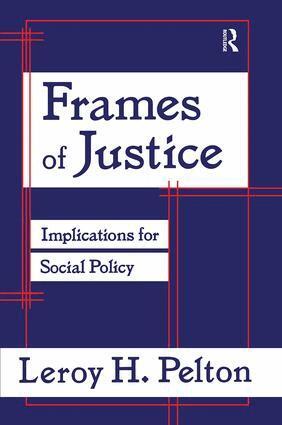
This work is devoted to analyzing three major frames of justice--group justice, individual desert, and life affirmation--and their implications for social policy as well as their reflections in contemporary social policies. Pelton finds that all three frames of justice are reflected in the Bible and, later, the Koran. He contends that there is no evidence in the Bible of a genesis or development from one frame of justice to another. Rather, a sense of justice has existed in the human mind from time immemorial, with the three frames coexisting and manifesting themselves in both inter- and intra-group relations. The prominence of one frame over another at any particular point in history or in a particular geographical location is influenced by a variety of factors, though it is ultimately open to human choice.Pelton compares and contrasts the philosophies of nonviolence and liberalism in regard to the frames, and explores the relationships between principle, sentiment, reason, justice, and policy. He discusses social science's problematic relationship to justice in policymaking--for instance, how scholars have focused more on the effectiveness of policies, largely in terms of statistical outcomes reflecting aggregate data analyses, than on their justice. He goes on to explore in depth how frames of justice give direction to social policies, including those of genocide.Frames of Justice is an outstanding work that analyzes the question of justice and social policy, while simultaneously exploring the notion of desert in religion, philosophy, and legislation--especially within the context of the moral question of the relationship between means and ends--and contrasting it with the principle of life affirmation.
350 kr
Tillfälligt slut
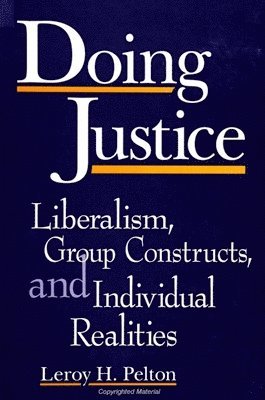
Offers a revised liberal political philosophy, arguing that group-based policies are discriminatory and proposing individual-oriented policies in their place.Offering a new way of thinking about liberalism and public policies, this book contends that group-based policies, predicated on all manner of group construction, pervade public policy. Such policies are grounded in group distinctions that include not only race, ethnicity, gender, and age, but current and past behavior, employment status, personal preferences, and numerous statistical and inferential factors. Although many of these policies are considered to be liberal, they are all discriminatory in essence. For example, the Social Security Act of 1935, although regarded as the foundation of modern liberalism, is riddled with group-based policies that are inconsistent with the principle of nondiscrimination. This book examines other examples of group-based discrimination in such diverse areas as public welfare and child welfare, drug and gambling laws, drunk driving laws, criminal justice, and foreign policy.Pelton argues that the true roots of liberalism are found in nondiscrimination and respect for the individual. Doing Justice proposes just that-nondiscriminatory, individual-oriented policies in place of each of the group-based policies that are analyzed. The book's innovative thesis points to a conceptual and political rebirth of liberalism.
409 kr
Skickas inom 10-15 vardagar
This work is devoted to analyzing three major frames of justice--group justice, individual desert, and life affirmation--and their implications for social policy as well as their reflections in contemporary social policies. Pelton finds that all three frames of justice are reflected in the Bible and, later, the Koran. He contends that there is no evidence in the Bible of a genesis or development from one frame of justice to another. Rather, a sense of justice has existed in the human mind from time immemorial, with the three frames coexisting and manifesting themselves in both inter- and intra-group relations. The prominence of one frame over another at any particular point in history or in a particular geographical location is influenced by a variety of factors, though it is ultimately open to human choice.Pelton compares and contrasts the philosophies of nonviolence and liberalism in regard to the frames, and explores the relationships between principle, sentiment, reason, justice, and policy. He discusses social science's problematic relationship to justice in policymaking--for instance, how scholars have focused more on the effectiveness of policies, largely in terms of statistical outcomes reflecting aggregate data analyses, than on their justice. He goes on to explore in depth how frames of justice give direction to social policies, including those of genocide.Frames of Justice is an outstanding work that analyzes the question of justice and social policy, while simultaneously exploring the notion of desert in religion, philosophy, and legislation--especially within the context of the moral question of the relationship between means and ends--and contrasting it with the principle of life affirmation.