Lesley Riddoch - Böcker
Visar alla böcker från författaren Lesley Riddoch. Handla med fri frakt och snabb leverans.
7 produkter
7 produkter
1 266 kr
Skickas inom 7-10 vardagar
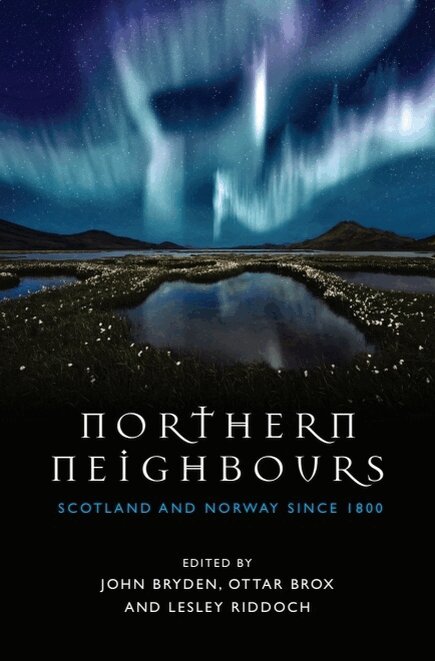
BCC approved (with endorsements)"How is it that two broadly similar countries, neighbours with roughly equal populations and similar natural conditions, can follow two very different development paths? The authors of Northern Neighbours claim that ‘politics matter’. In their comparative history of Scotland and Norway, key factors in each county’s development are thrown into relief. The result is a convincing explanation for their divergence and a significant contribution to development theory in general." Matthew Hoffman, Cornell University"In this important book we can read another exciting attempt to examine through the comparative lens the modern histories of Norway and Scotland. A team of interdisciplinary experts drawn from both countries and elsewhere in the UK have been assembled to consider the radically different historical paths of two small nations and the social, political and economic consequences." Professor Sir Tom M. Devine A topical, comparative study of the economic, social and political development of Norway and Scotland Northern Neighbours explores the reasons for, and outcomes of, the social, political and economic divergence between Scotland and Norway over a period encompassing 500 years, in an engaging and comprehensive way. This accessible comparative study takes a closer look at the links between suffrage, property ownership and the process of democratisation and distribution of political power, land use and reform, the relative movement of populations, the process of industrialization, and rights of access. It offers a thorough analysis of the history of religion, education and finance in both countries, and explores the exploitation of their rich natural resources, and the resulting contrast in their fortunes. The authors also pose timely questions about the future of both countries; whether the economic and social disparities between the two can be addressed, and if the Nordic model could provide a basis for a realistic and effective development strategy for Scotland, were it to become an independent nation.John Bryden is Emeritus Professor of Human Geography at the University of AberdeenOttar Brox is former research director of the Norwegian Institute for Urban and Regional ResearchLesley Riddoch is a freelance journalist, commentator and broadcaster
344 kr
Skickas inom 7-10 vardagar
A topical, comparative study of the economic, social and political development of Norway and Scotland since 1800Northern Neighbours explores the reasons for, and outcomes of, the social, political and economic divergence between Scotland and Norway over a period encompassing 500 years, in an engaging and comprehensive way. This accessible comparative study takes a closer look at the links between suffrage, property ownership and the process of democratisation and distribution of political power, land use and reform, the relative movement of populations, the process of industrialization, and rights of access. It offers a thorough analysis of the history of religion, education and finance in both countries, and explores the exploitation of their rich natural resources, and the resulting contrast in their fortunes. The authors also pose timely questions about the future of both countries; whether the economic and social disparities between the two can be addressed, and if the Nordic model could provide a basis for a realistic and effective development strategy for Scotland, were it to become an independent nation.ContributorsArne Bugge Amundsen, University of OsloEberhard ‘Paddy’ Bort, University of EdinburghNik. Brandal, University of OsloØivind Bratberg, University of OsloOttar Brox, Norwegian Institute for Regional ResearchJohn Bryden, Norwegian Agricultural Economics Research Institute in Oslo and Emeritus at the University of AberdeenBronwen Cohen, University of EdinburghKeith Hart, London School of EconomicsAgnar Hegrenes, Norwegian Agricultural Economics Research InstituteMary Hilson, University College LondonAndrew G. Newby, University of HelsinkiErik Opsahl, Norwegian University of Science and Technology (NTNU), TrondheimTore T. Petersen, Norwegian University of Science and Technology (NTNU), TrondheimKaren Refsgaard, University of Copenhagen and the University of Life Sciences at Ås, NorwayLesley Riddoch, journalist, author and broadcasterWenche Rønning, University of NordlandMichael Rosie, University of Edinburgh
148 kr
Skickas
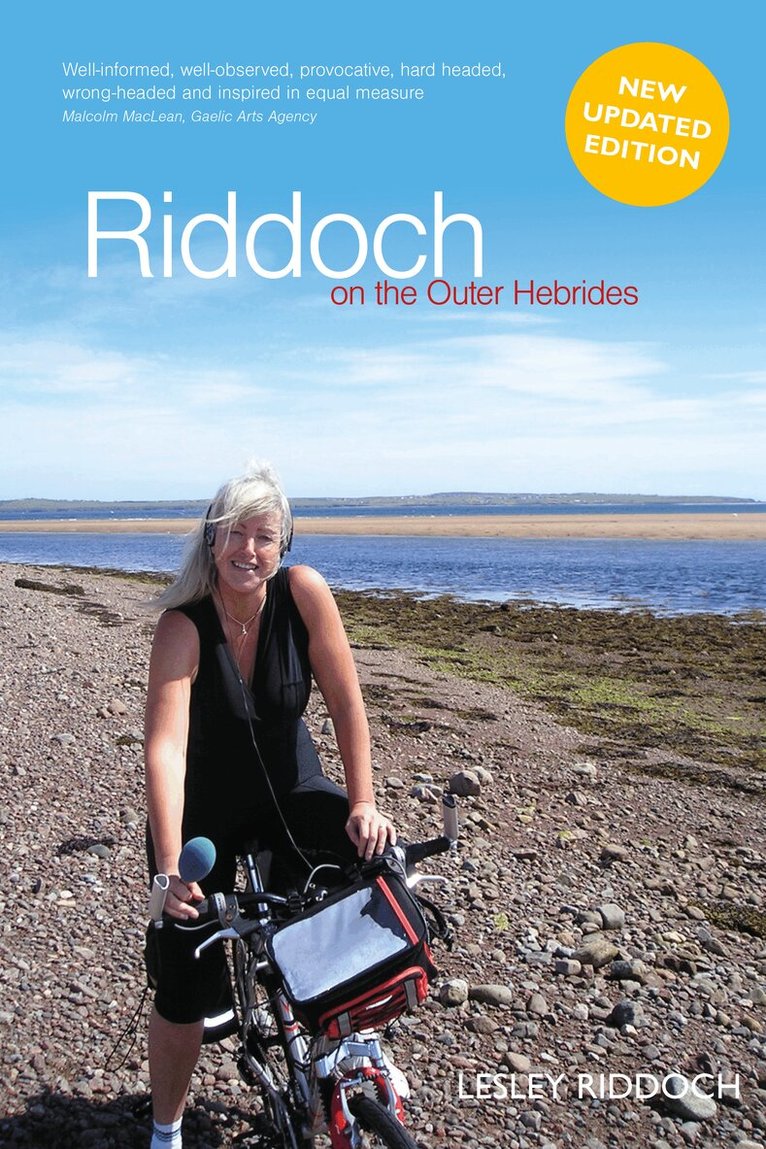
Riddoch on the Outer Hebrides is a thought-provoking commentary based on broadcaster Lesley Riddoch's cycle journey through a beautiful island chain facing seismic cultural and economic change. Her experience is described in a typically affectionate but hard-hitting style; with humour, anecdote and a growing sympathy for islanders tired of living at the margins but fearful of closer contact with mainland Scotland.
114 kr
Skickas
Why won’t Scots simmer down?Why batter on about independence when folk voted No a decade back?After all. Scotland’s not as populated as Yorkshire, nor as wealthy as London. But it’s also not as Conservative, as keen on Brexit, or as willing to flog public assets to Tory party pals.So does Nicola Sturgeon’s departure terminally damage the case for independence?The answer, with all respect to her legacy, is no.Scotland has bigger fish to fry.In this book, Lesley Riddoch makes an impassioned call to action, weaving academic evidence with story, international comparison and anecdote to explain why Scotland is ready to step forward as the world’s newest state.We need optimism. And contagious stories of inspiration. Told out loud. In the open. Repeatedly. So, folk can engage emotionally, dare to dream of better – and go get it. Scotland is a social democracy stuck in a Conservative state that’s preoccupied with its own lost imperial status. And stuck, Scotland cannae thrive.Let’s cast aside preconceptions. Whichever way you voted in 2014 – if you did – the world, Europe, the UK, Ireland and our Nordic neighbours have all changed. Scots need the freedom to change too – the freedom to flourish.
72 kr
Skickas inom 11-20 vardagar
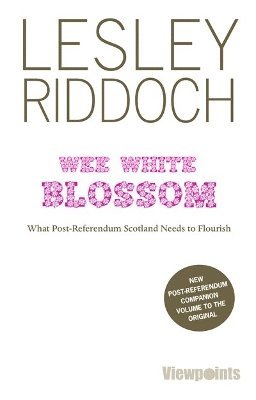
So stands Scotland where it did? Not on your nelly.The professional classes in Scotland may be busy with Commissions, vows, deals, submissions and General Election planning but the wider Yes Movement is busy with huge spontaneous meetings involving hundreds, even thousands of people – gatherings like birds flocking before winter or starlings swooping to throw shapes into darkening skies. Because they can.Wee White Blossom is a post-indyref, poppadom-sized version of Blossom for folk who’ve already sampled the full bhuna. It updates Blossom with a new chapter on Scotland’s Year of Living Dangerously. Lesley Riddoch shares her thoughts on the Smith Commission, the departure of Gordon Brown, the returnof Alex Salmond and the latest developments in land reform and local control. She considers the future of the SNP, the Radical Independence Campaign, Common Weal, Women for Independence and Scottish Labour in the aftermath of the referendum. This is a plain-speaking, incisive call to restore equality and control to local communities and let Scotland flourish.Wee White Blossom is the ideal companion volume to Blossom, whether you want an update on the first edition or an appetiser before delving into the pages of the original.
94 kr
Tillfälligt slut
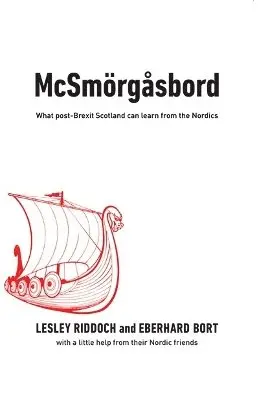
The Nordic countries have a veritable smörgåsbord of relationships with the European Union, from in to out to somewhere in between.So, what does that mean for Scotland?Well, somewhere in this incredible diversity of relationships with Europe is an arrangement that’s likely to be good for Scotland too – strangely enough, maybe more than one. Inside or outside the UK, Scotland wants to keep trade and cultural links with Europe – that much is clear. But is the EU really the best club in town for an independent Scotland?Or would Scots benefit from ‘doing a Norway’ – joining the halfway house of the EEA and keeping the Single Market but losing the troublesome Common Fisheries and Agriculture Policies?Would an independent Scotland need the support and shelter of another union – or could the nation stand alone like the tiny Faroes or Iceland?These tough questions have already been faced and resolved by five Nordic nations and their autonomous territories within the last 40 years. Perhaps there’s something for Scotland to learn?The unique combination of personal experience and experts’ insights give this book its hands-on character: pragmatic and thought-provoking, challenging and instructive, full of amazing stories and useful comparisons, enriching the debates about Scotland’s post-Brexit future as a Nordic neighbour.Scotland’s response to Britain’s divided Brexit vote has been positively Nordic – Scots expect diversity and empowerment to be entirely possible – whilst Westminster’s reaction has been decidedly British. One singer – one song. One deal for everyone – end of. Lesley RiddochOf course, the majority of Nordic nations are eu members. But perhaps the eea is a closer fit for Scotland? Perhaps, too, a viable halfway house option would boost support for Scottish independence? Especially since Holyrood may not automatically retrieve powers from Europe post Brexit. Paddy Bort
128 kr
Skickas
Blossom is an account of Scotland at the grassroots through the stories of people I’ve had the good fortune to know – the most stubborn, talented and resilient people on the planet. They’ve had to be. Some have transformed their parts of Scotland. Some have tried and failed. But all have something in common – they know what it takes for Scotland to blossom. We should too… /em>Weeding out vital components of Scottish identity from decades of political and social tangle is no mean task, but it’s one journalist Lesley Riddoch has undertaken.Dispensing with the tired, yo-yoing jousts over fiscal commissions, Devo Something and EU in-or-out, Blossom pinpoints both the buds of growth and the blight that’s holding Scotland back. Drawing from its people and history as well as the experience of the Nordic countries, and the author’s own passionate and outspoken perspective, this is a plain-speaking but incisive call to restore equality and control to local communities and let Scotland flourish.A brilliant, moving, well written, informative, important and valuable piece of work. ELAINE C SMITHNot so much an intervention in the independence debate as a heartfelt manifesto for a better democracy. ESTHER BREITENBACH, Scotsman