Linda Peake - Böcker
Visar alla böcker från författaren Linda Peake. Handla med fri frakt och snabb leverans.
14 produkter
14 produkter
896 kr
Skickas inom 5-8 vardagar
Urbanization in a Global Context is a contributed text that helps Canadian students understand the process of urbanization by examining cities outside Canada across the Global North and South. Truly international in its approach, it emphasizes the interconnectedness of urban places and fosters analysis that identifies the similarities and differences between cities in different world regions. Each chapter focuses on different contemporary urban issues - ranging from urban policy, climate change, and gender to transportation and water governance - and introduces current urban scholarly debates, grounding them in international case studies. How these issues resonate with the Canadian urban context is discussed in text boxes, which employ descriptive accounts, drawing on examples from a selection of small-, mid-, and large-sized Canadian cities. Activities and questions at the end of each chapter prompt students to collaborate with peers to further critically reflect upon how these urban issues could relate to their lived experience in Canadian cities.
2 091 kr
Skickas inom 10-15 vardagar
This book is concerned with the nature of the relationship between gender, ethnicity and poverty in the context of the external and internal dynamics of households in Guyana. Using detailed data collected from male and female respondents in three separate locations, two urban and one rural, and across two major ethnic groups, Afro-Guyanese and Indo-Guyanese, the authors discuss the links between gender and race, exploring development issues from a feminist perspective.
2 293 kr
Skickas inom 10-15 vardagar
In Rethinking Feminist Interventions into the Urban, Linda Peake and Martina Rieker embark on an ambitious project to explore the extent to which a feminist re-imagining of the twenty-first century city can form the core of a new emerging analytic of women and the neoliberal urban.In a world in which the majority of the population now live in urban centres, they take as their starting point the need to examine the production of knowledge about the city through the problematic divide of the global north and south, asking what might a feminist intervention, a position itself fraught with possibilities and problems, into this dominant geographical imaginary look like. Providing a meaningful discussion of the ways in which feminism, gender and women have been understood in relation to the city and urban studies, they ask probing and insightful questions that indicate new directions for theory and research, illustrating the necessity of a re-formulation of the north-south divide as a critical and urgent project for feminist urban studies.Working through platforms as diverse as policy formulations and telling stories, the contributors to the book come from a range of disciplinary backgrounds and geographic locations ranging through the Caribbean, North America, Western Europe, South, East and South East Asia, the Middle East and Latin America. They identify a range of issues (such as care, work, violence, the household, mobility, intimacy and poverty) that they analytically address to make sense of and reanimate resistance to the contemporary urban through articulations of new grammars of gendered geographies of justice.
726 kr
Skickas inom 10-15 vardagar
In Rethinking Feminist Interventions into the Urban, Linda Peake and Martina Rieker embark on an ambitious project to explore the extent to which a feminist re-imagining of the twenty-first century city can form the core of a new emerging analytic of women and the neoliberal urban.In a world in which the majority of the population now live in urban centres, they take as their starting point the need to examine the production of knowledge about the city through the problematic divide of the global north and south, asking what might a feminist intervention, a position itself fraught with possibilities and problems, into this dominant geographical imaginary look like. Providing a meaningful discussion of the ways in which feminism, gender and women have been understood in relation to the city and urban studies, they ask probing and insightful questions that indicate new directions for theory and research, illustrating the necessity of a re-formulation of the north-south divide as a critical and urgent project for feminist urban studies.Working through platforms as diverse as policy formulations and telling stories, the contributors to the book come from a range of disciplinary backgrounds and geographic locations ranging through the Caribbean, North America, Western Europe, South, East and South East Asia, the Middle East and Latin America. They identify a range of issues (such as care, work, violence, the household, mobility, intimacy and poverty) that they analytically address to make sense of and reanimate resistance to the contemporary urban through articulations of new grammars of gendered geographies of justice.
2 158 kr
Skickas inom 10-15 vardagar
Mapping Women, Making Politics demonstrates the multiple ways in which gender influences political processes and the politics of space. The book begins by addressing feminism's theoretical and conceptual challenges to traditional political geography and than applies these perspectives to a range of settings and topics including nationalism, migration, development, international relations, elections, social movements, governance and the environment in the Global North and South.
754 kr
Skickas inom 10-15 vardagar
Mapping Women, Making Politics demonstrates the multiple ways in which gender influences political processes and the politics of space. The book begins by addressing feminism's theoretical and conceptual challenges to traditional political geography and than applies these perspectives to a range of settings and topics including nationalism, migration, development, international relations, elections, social movements, governance and the environment in the Global North and South.
389 kr
Skickas inom 7-10 vardagar
Focusing on a series of pivotal issues confronting Canadian cities and city-dwellers today, this volume address key themes in urban studies:the interaction between social relations and urban landscape, the status of the city in the new world economy, and the sociocultural complexity of urban populations. The fifteen essays presented here reflect the current preoccupations and perspectives of critically oriented urban researchers in Canada. The essays in Part 1, 'People, Places, Cultures,' examine the nature of urban space and the links between this space and social relations, illustrating the fundamental principle that urban spaces are 'built values' and 'built politics' - physical expressions of social process. Part 2, 'The Economy of Cities,' explores recent fundamental shifts in the economic character of Canadian cities, whose effect on the social and physical landscapes has been as dramatic as the explosive onset of industrialism was in the last century. Part 3, 'Urban Social Movements,' focuses on the practices of social movements, including those oriented to gender, race, and the environment.Consisting largely of applied case studies, rather than broad thematic essays, City Lives and City Forms presents an overall argument for focused critical research in the urban field and suggests possible directions for the future.
2 091 kr
Skickas inom 10-15 vardagar
Doing Feminist Urban Research introduces the reader to the newly emerging 21st-century global landscape of feminist urban research. It showcases decolonising practices, partnerships and teamwork, new standards such as EDI, geo-ethnographic methodologies, software-enhanced qualitative data analysis, and knowledge mobilisation.This book delves into both the institutional and lived realities of the practice of feminist urban research for the 21st century via the insights of the GenUrb transnational research project. Through refection exercises based on real-life examples, it covers feminist methodologies and research techniques, critically examining the ‘feld’ through comparison and feminist geo-ethnographies. It guides readers through navigating the politics of decolonising research, working across diferences, and embracing feminist ethics and activism. The book also explores data through the practices of translation, data management, data analysis, and the use of NVivo. And it further introduces professional standards, including EDI, collaboration with partners, engagement in teamwork, the handling of crises, such as pandemics, and knowledge mobilisation, including utilising social media. Accompanying web resources will assist scholars and students with additional audio fles and documents.This book’s practical guidance will help those starting to contemplate and engage in qualitative feminist urban research as well as those teaching the practice and politics of research. It will appeal to practitioners in urban studies, geography, gender and women’s studies, sociology, anthropology, global studies, and development studies.The Open Access version of this book, available at www.taylorfrancis.com, has been made available under a Creative Commons Attribution-Non Commercial-No Derivatives (CC-BY-NC-ND) 4.0 license.
550 kr
Skickas inom 10-15 vardagar
Doing Feminist Urban Research introduces the reader to the newly emerging 21st-century global landscape of feminist urban research. It showcases decolonising practices, partnerships and teamwork, new standards such as EDI, geo-ethnographic methodologies, software-enhanced qualitative data analysis, and knowledge mobilisation.This book delves into both the institutional and lived realities of the practice of feminist urban research for the 21st century via the insights of the GenUrb transnational research project. Through refection exercises based on real-life examples, it covers feminist methodologies and research techniques, critically examining the ‘feld’ through comparison and feminist geo-ethnographies. It guides readers through navigating the politics of decolonising research, working across diferences, and embracing feminist ethics and activism. The book also explores data through the practices of translation, data management, data analysis, and the use of NVivo. And it further introduces professional standards, including EDI, collaboration with partners, engagement in teamwork, the handling of crises, such as pandemics, and knowledge mobilisation, including utilising social media. Accompanying web resources will assist scholars and students with additional audio fles and documents.This book’s practical guidance will help those starting to contemplate and engage in qualitative feminist urban research as well as those teaching the practice and politics of research. It will appeal to practitioners in urban studies, geography, gender and women’s studies, sociology, anthropology, global studies, and development studies.The Open Access version of this book, available at www.taylorfrancis.com, has been made available under a Creative Commons Attribution-Non Commercial-No Derivatives (CC-BY-NC-ND) 4.0 license.
2 091 kr
Skickas inom 10-15 vardagar
How do decolonial feminist urban imaginaries of urban futures begin to interrogate twenty-first century urban life? The urban futures signaled by the chapters in this book highlight overlapping dimensions of urban imaginaries—capitalism, temporality and the everyday. While the first dimension connects the privatisation and commodification of urban infrastructures to the realisation of state-based and capitalist discursive efforts to make the urban, the second dimension concerns temporal convergences of past, present and future in visions of the urban. It is in these convergences that the recursive logics of coloniality are reproduced in re-mappings of the landscapes of urban inequality and dispossession through which encounters between historical sedimentations of colonial relations and emergent (neo)colonial formations take place. Third, authors take up the everyday as a site of struggle through which women’s negotiations and placemaking practices offer alternative decolonial urban imaginaries.The book is based on papers given at the ‘Feminist Explorations of Urban Futures’ conference, held in September 2019, at York University in Toronto, Canada, organised by the transnational feminist research project ‘Urbanisation, Gender and the Global South: A Transformative Knowledge Network’ (GenUrb). It was originally published as a special issue of Urban Geography.
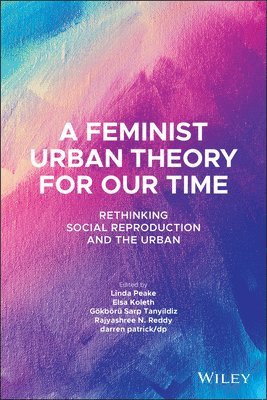
Feminist Urban Theory for Our Time
Rethinking Social Reproduction and the Urban
Inbunden, Engelska, 2021
797 kr
Skickas inom 7-10 vardagar
What does a feminist urban theory look like for the twenty first century? This book puts knowledges of feminist urban scholars, feminist scholars of social reproduction, and other urban theorists into conversation to propose an approach to the urban that recognises social reproduction both as foundational to urban transformations and as a methodological entry-point for urban studies. Offers an approach feminist urban theory that remains intentionally cautious of universal uses of social reproduction theory, instead focusing analytical attention on historical contingency and social differenceEleven chapters that collectively address distinct elements of the contemporary crisis in social reproduction and the urban through the lenses of infrastructure and subjectivity formation as well as through feminist efforts to decolonize urban knowledge productionDeepens understandings of how people shape and reshape the spatial forms of their everyday lives, furthering understandings of the 'infinite variety' of the urbanEssential reading for academics, researchers and scholars within urban studies, human geography, gender and sexuality studies, and sociology
Feminist Urban Theory for Our Time
Rethinking Social Reproduction and the Urban
Häftad, Engelska, 2021
270 kr
Skickas inom 7-10 vardagar
What does a feminist urban theory look like for the twenty first century? This book puts knowledges of feminist urban scholars, feminist scholars of social reproduction, and other urban theorists into conversation to propose an approach to the urban that recognises social reproduction both as foundational to urban transformations and as a methodological entry-point for urban studies. Offers an approach feminist urban theory that remains intentionally cautious of universal uses of social reproduction theory, instead focusing analytical attention on historical contingency and social differenceEleven chapters that collectively address distinct elements of the contemporary crisis in social reproduction and the urban through the lenses of infrastructure and subjectivity formation as well as through feminist efforts to decolonize urban knowledge productionDeepens understandings of how people shape and reshape the spatial forms of their everyday lives, furthering understandings of the 'infinite variety' of the urbanEssential reading for academics, researchers and scholars within urban studies, human geography, gender and sexuality studies, and sociology
672 kr
Skickas inom 10-15 vardagar
This book is concerned with the nature of the relationship between gender, ethnicity and poverty in the context of the external and internal dynamics of households in Guyana. Using detailed data collected from male and female respondents in three separate locations, two urban and one rural, and across two major ethnic groups, Afro-Guyanese and Indo-Guyanese, the authors discuss the links between gender and race, exploring development issues from a feminist perspective.
3 839 kr
Skickas inom 7-10 vardagar
This Handbook is a state-of-the-art exploration of the multidisciplinary field of gender and cities scholarship, providing in-depth assessments of the latest research within key areas of feminist urban academia. Editors Linda Peake, Anindita Datta and Grace Adeniyi-Ogunyankin have brought together over 60 feminist scholars to present cutting-edge insights into this important field of study.The Handbook on Gender and Cities presents a cross-section of contemporary feminist work, spanning a range of theories and practices associated with urban space. Contributing authors explore key issues including urban policy, planning and politics; the urban economic arena; the urban environment; the urban everyday; feminist imaginaries of urban spaces and places; and feminist and decolonial urban knowledge production. The editors trace numerous crucial themes across the Handbook’s chapters, namely patriarchy, social reproduction, gendered violence, and women’s agency and the arena of the everyday. Whilst the Handbook celebrates the continually developing field of feminist urban studies, it acknowledges the volume of work still to be done and encourages future research to better accept and understand its complex and multiplicitous nature.This forward-thinking Handbook is a vital resource for students, scholars and researchers in the fields of urban studies, geography, sociology, anthropology, women’s and gender studies and development studies. Its discussion of contemporary issues in urban settings will also appeal to professionals and practitioners working in public policy, urban design and planning.