Lindsay Schakenbach Regele - Böcker
Visar alla böcker från författaren Lindsay Schakenbach Regele. Handla med fri frakt och snabb leverans.
3 produkter
3 produkter
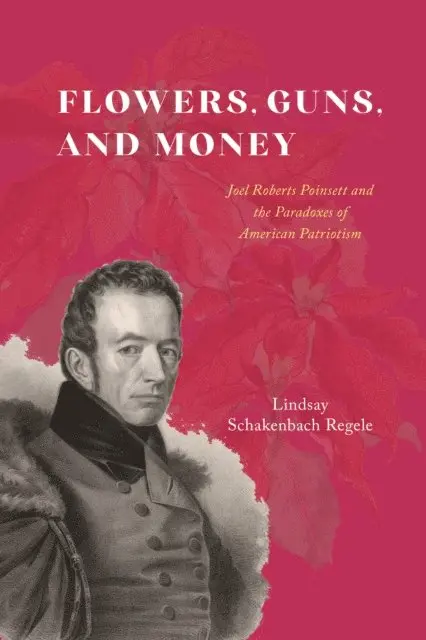
Flowers, Guns, and Money
Joel Roberts Poinsett and the Paradoxes of American Patriotism
Inbunden, Engelska, 2023
836 kr
Skickas inom 7-10 vardagar
A fascinating historical account of a largely forgotten statesman, who pioneered a form of patriotism that left an indelible mark on the early United States.Joel Roberts Poinsett’s (1779–1851) brand of self-interested patriotism illuminates the paradoxes of the antebellum United States. He was a South Carolina investor and enslaver, a confidant of Andrew Jackson, and a secret agent in South America who fought surreptitiously in Chile’s War for Independence. He was an ambitious Congressman and Secretary of War who oversaw the ignominy of the Trail of Tears and orchestrated America’s longest and costliest war against Native Americans, yet also helped found the Smithsonian. In addition, he was a naturalist, after whom the poinsettia—which he appropriated while he was serving as the first US ambassador to Mexico—is now named. As Lindsay Schakenbach Regele shows in Flowers, Guns, and Money, Poinsett personified a type of patriotism that emerged following the American Revolution, one in which statesmen served the nation by serving themselves, securing economic prosperity and military security while often prioritizing their own ambitions and financial interests. Whether waging war, opposing states’ rights yet supporting slavery, or pushing for agricultural and infrastructural improvements in his native South Carolina, Poinsett consistently acted in his own self-interest. By examining the man and his actions, Schakenbach Regele reveals an America defined by opportunity and violence, freedom and slavery, and nationalism and self-interest.
Flowers, Guns, and Money
Joel Roberts Poinsett and the Paradoxes of American Patriotism
Häftad, Engelska, 2023
233 kr
Skickas inom 7-10 vardagar
A fascinating historical account of a largely forgotten statesman, who pioneered a form of patriotism that left an indelible mark on the early United States.Joel Roberts Poinsett’s (1779–1851) brand of self-interested patriotism illuminates the paradoxes of the antebellum United States. He was a South Carolina investor and enslaver, a confidant of Andrew Jackson, and a secret agent in South America who fought surreptitiously in Chile’s War for Independence. He was an ambitious Congressman and Secretary of War who oversaw the ignominy of the Trail of Tears and orchestrated America’s longest and costliest war against Native Americans, yet also helped found the Smithsonian. In addition, he was a naturalist, after whom the poinsettia—which he appropriated while he was serving as the first US ambassador to Mexico—is now named. As Lindsay Schakenbach Regele shows in Flowers, Guns, and Money, Poinsett personified a type of patriotism that emerged following the American Revolution, one in which statesmen served the nation by serving themselves, securing economic prosperity and military security while often prioritizing their own ambitions and financial interests. Whether waging war, opposing states’ rights yet supporting slavery, or pushing for agricultural and infrastructural improvements in his native South Carolina, Poinsett consistently acted in his own self-interest. By examining the man and his actions, Schakenbach Regele reveals an America defined by opportunity and violence, freedom and slavery, and nationalism and self-interest.
Manufacturing Advantage
War, the State, and the Origins of American Industry, 1776–1848
Inbunden, Engelska, 2019
604 kr
Tillfälligt slut
How manufacturing textiles and guns transformed the United States from colonial dependent to military power.In 1783, the Revolutionary War drew to a close, but America was still threatened by enemies at home and abroad. The emerging nation faced tax rebellions, Indian warfare, and hostilities with France and England. Its arsenal—a collection of hand-me-down and beat-up firearms—was woefully inadequate, and its manufacturing sector was weak. In an era when armies literally froze in the field, military preparedness depended on blankets and jackets, the importation of which the British Empire had coordinated for over 200 years. Without a ready supply of guns, the new nation could not defend itself; without its own textiles, it was at the economic mercy of the British. Domestic industry offered the best solution for true economic and military independence. In Manufacturing Advantage, Lindsay Schakenbach Regele shows how the US government promoted the industrial development of textiles and weapons to defend the country from hostile armies—and hostile imports. Moving from the late 1700s through the Mexican-American War, Schakenbach Regele argues that both industries developed as a result of what she calls “national security capitalism”: a mixed enterprise system in which government agents and private producers brokered solutions to the problems of war and international economic disparities. War and State Department officials played particularly key roles in the emergence of American industry, facilitating arms makers and power loom weavers in the quest to develop industrial resources. And this defensive strategy, Schakenbach Regele reveals, eventually evolved to promote westward expansion, as well as America’s growing commercial and territorial empire. Examining these issues through the lens of geopolitics, Manufacturing Advantage places the rise of industry in the United States in the context of territorial expansion, diplomacy, and warfare. Ultimately, the book reveals the complex link between government intervention and private initiative in a country struggling to create a political economy that balanced military competence with commercial needs.