Luisa Arlotti - Böcker
Visar alla böcker från författaren Luisa Arlotti. Handla med fri frakt och snabb leverans.
3 produkter
3 produkter
536 kr
Skickas inom 10-15 vardagar
Perturbations of Positive Semigroups with Applications is a self-contained introduction to semigroup theory with emphasis on positive semigroups on Banach lattices and perturbation techniques. The first part of the book presents a survey of the results that are needed for the second, applied part of the book; worked examples are provided to help absorb the theoretical material. The second part then deals with the application of the developed theory to a variety of problems ranging from the classical birth-and-death type problems of population dynamics, through fragmentation models in both conservative and mass loss regimes, to kinetic models.The only prerequisites are a basic knowledge of functional analysis and measure theory. This is an essential one-stop reference for graduate and postgraduate students and researchers in applied analysis and mathematical physics who are interested in the application of functional analytic techniques to concrete problems arising in physics, biology and engineering.
536 kr
Skickas inom 7-10 vardagar
This book is devoted predominantly to one particular way of looking at the evolution of the system in which we describe time changes as transitions from one state to another. This leads in a natural way to the semigroup theory that has been developed in the last fifty years. There are many applications coming from kinetic theory, fragmentation theory, mathematical biology and many other fields, where the assumptions of standard perturbation theory are not satisfied. In this book the authors concentrate on perturbation results that take advantage of the fact that in many applications the operators involved are positive (as only nonnegative data and solutions make sense) and dissipative. The main part of the book is devoted to linking the properties of the generator with the properties of the semigroup, that are important in applications. In the final part of the book the authors discuss applications of the developed theory to a variety of problems ranging from the classical birth-and-death type problems of population dynamics, through fragmentation models in both conservative and mass loss regimes, to kinetic models.The authors also discuss a few miscellaneous applications that do not fit into their theory exactly but nevertheless their treatment draws substantially from it.
Del 64 - Series on Advances in Mathematics for Applied Sciences
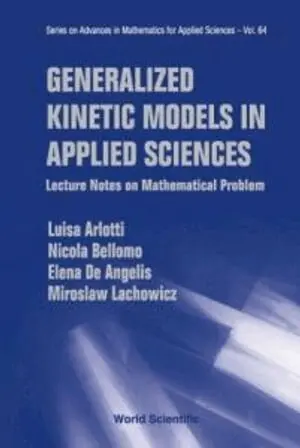
Generalized Kinetic Models In Applied Sciences: Lecture Notes On Mathematical Problems
Inbunden, Engelska, 2003
1 014 kr
Tillfälligt slut
This book deals with analytic problems related to some developments and generalizations of the Boltzmann equation toward the modeling and qualitative analysis of large systems that are of interest in applied sciences. These generalizations are documented in the various surveys edited by Bellomo and Pulvirenti with reference to models of granular media, traffic flow, mathematical biology, communication networks, and coagulation models.The above literature motivates applied mathematicians to study the Cauchy problem and to develop an asymptotic analysis for models regarded as developments of the Boltzmann equation. This book aims to initiate the research plan by the analyzing afore mentioned analysis problems.The first generalization dealt with refers to the averaged Boltzmann equation, which is obtained by suitable averaging of the distribution function of the field particles into the action domain of the test particle. This model is further developed to describe equations with dissipative collisions and a class of models that are of interest in mathematical biology. In this latter case the state of the particles is defined not only by a mechanical variable but also by a biological microscopic state.The book is essentially devoted to analytic aspects and deals with the analysis of the Cauchy problem and with the development of an asymptotic theory to obtain the macroscopic description from the mesoscopic one.