Lynda W. Powell - Böcker
Visar alla böcker från författaren Lynda W. Powell. Handla med fri frakt och snabb leverans.
3 produkter
3 produkter
Influence of Campaign Contributions in State Legislatures
The Effects of Institutions and Politics
Häftad, Engelska, 2012
490 kr
Skickas inom 7-10 vardagar
Campaign contributions are widely viewed as a corrupting influence but most scholarly research concludes that they have marginal impact on legislative behavior. Lynda W. Powell shows that contributions have considerable influence in some state legislatures but very little in others. Using a national survey of legislators, she develops an innovative measure of influence and delineates the factors that explain this great variation across the 99 U.S. state legislative chambers.Powell identifies the personal, institutional, and political factors that determine how much time a legislator devotes to personal fundraising and fundraising for the caucus. She shows that the extent of donors' legislative influence varies in ways corresponding to the same variations in the factors that determine fundraising time. She also confirms a link between fundraising and lobbying with evidence supporting the theory that contributors gain access to legislators based on donations, Powell's findings have important implications for the debate over the role of money in the legislative process.
348 kr
Skickas inom 7-10 vardagar
It has been predicted that term limits in state legislatures--soon to be in effect in eighteen states--will first affect the composition of the legislatures, next the behavior of legislators, and finally legislatures as institutions. The studies in Term Limits in State Legislatures demonstrate that term limits have had considerably less effect on state legislatures than proponents predicted.The term-limit movement--designed to limit the maximum time a legislator can serve in office--swept through the states like wildfire in the first half of the 1990s. By November 2000, state legislators will have been "term limited out" in eleven states.This book is based on a survey of nearly 3,000 legislators from all fifty states along with intensive interviews with twenty-two legislative leaders in four term-limited states. The data were collected as term limits were just beginning to take effect in order to capture anticipatory effects of the reform, which set in as soon as term limit laws were passed. In order to understand the effects of term limits on the broader electoral arena, the authors also examine data on advancement of legislators between houses of state legislatures and from the state legislatures to Congress.The results show that there are no systematic differences between term limit and non-term limit states in the composition of the legislature (e.g., professional backgrounds, demographics, ideology). Yet with respect to legislative behavior, term limits decrease the time legislators devote to securing pork and heighten the priority they place on the needs of the state and on the demands of conscience relative to district interests. At the same time, with respect to the legislature as an institution, term limits appear to be redistributing power away from majority party leaders and toward governors and possibly legislative staffers.This book will be of interest both to political scientists, policymakers, and activists involved in state politics.John M. Carey is Assistant Professor of Political Science, Washington University in St. Louis. Richard G. Niemi is Professor of Political Science, University of Rochester. Lynda W. Powell is Professor of Political Science, University of Rochester.
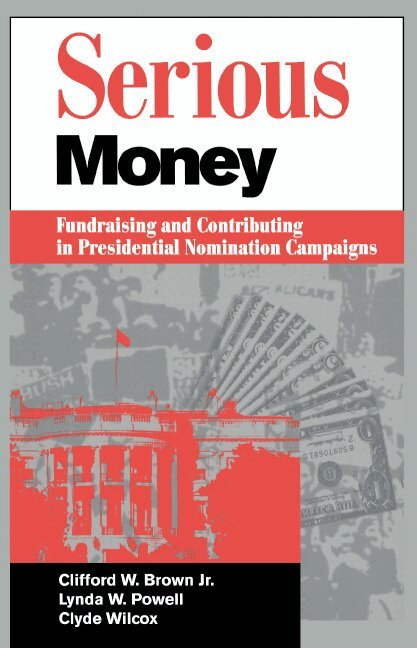
Serious Money
Fundraising and Contributing in Presidential Nomination Campaigns
Häftad, Engelska, 1995
428 kr
Skickas inom 7-10 vardagar
Serious Money offers detailed analysis of the relationship between fundraising methods and contributing decisions in presidential nomination campaigns, based largely upon newly conducted surveys of contributors to both the 1988 and 1992 campaigns. Brown, Powell and Wilcox explore the fundamental differences detween direct mail solicitation and personal-solicitation networks, and how candidate resources dictate the use of unique methods of solicitation. Candidate resources analysed include home state power bases, access to national party networks and the national legislative agenda, congressional office, social identity, and ideological proximity. With respect to contributing decisions, the book focuses on the three fundamental sources of the decision to contribute: the purposive, solidary, and material motives of contributors.