M. Mehring – författare
Visar alla böcker från författaren M. Mehring. Handla med fri frakt och snabb leverans.
8 produkter
Principles of High Resolution NMR in Solids
Av M. Mehring
E-bok, 2012
1141 kr
Lägg i varukorg
The field of Nuclear Magnetic Resonance (NMR) has developed at a fascinating pace during the last decade. It always has been an extremely valuable tool to the organic chemist by supplying molecular "finger print" spectra at the atomic level. Unfortunately the high resolution achievable in liquid …
Principles of High Resolution NMR in Solids
Av M. Mehring
Häftad, 2012
878 kr
Lägg i varukorg
The field of Nuclear Magnetic Resonance (NMR) has developed at a fascinating pace during the last decade. It always has been an extremely valuable tool to the organic chemist by supplying molecular "finger print" spectra at the atomic level. Unfortunately the high resolution achievable in liquid …
Electronic Properties of Polymers and Related Compounds
Proceedings of an International Winter School, Kirchberg, Tirol, February 23 – March 1, 1985
Av Siegmar Roth, M. Mehring m. fl.
E-bok, 2012
1459 kr
Lägg i varukorg
At the International Winter School on "Electronic Properties of Polymers and Related Compounds" particular attention was paid to a very new and special field in polymer research. It is concerned with the study of the electronic structure of polymers and with physical and chemical properties …
Electronic Properties of Polymers and Related Compounds
Proceedings of an International Winter School, Kirchberg, Tirol, February 23 – March 1, 1985
Av H. Kuzmany, M. Mehring m. fl.
Häftad, 2011
1095 kr
Lägg i varukorg
At the International Winter School on "Electronic Properties of Polymers and Related Compounds" particular attention was paid to a very new and special field in polymer research. It is concerned with the study of the electronic structure of polymers and with physical and chemical properties …
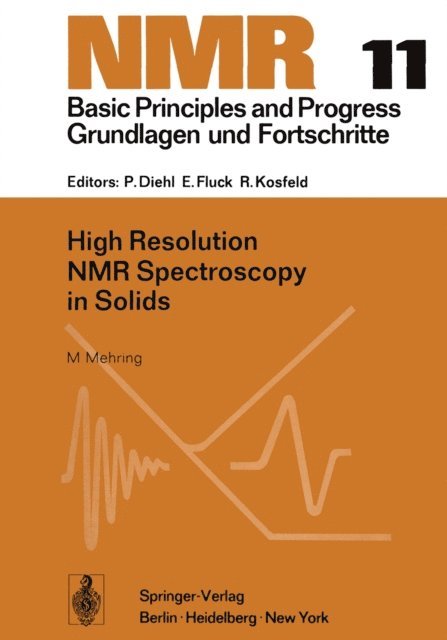
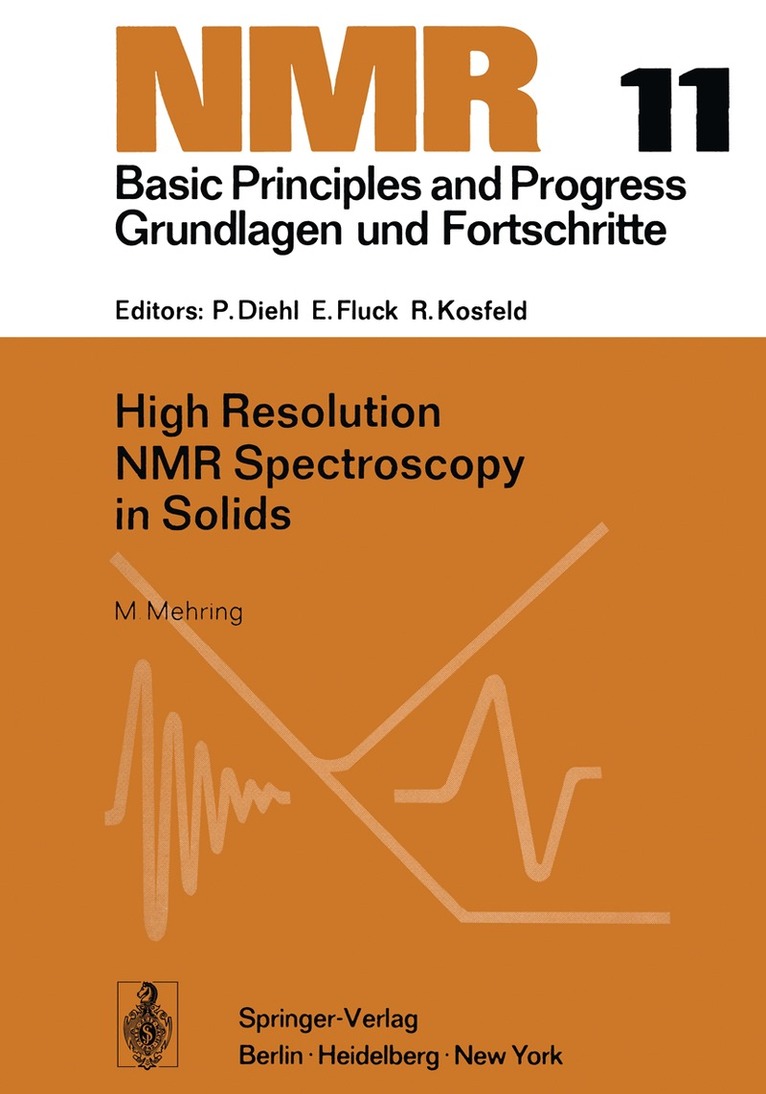
High Resolution NMR Spectroscopy in Solids
Av M. Mehring
E-bok, 2012
1427 kr
Lägg i varukorg
Manipulation and Dilution Tools for Ruling Abundant Species "NMR is dead" was the slogan heard in the late 1960s at least among physicists, until John S. Waugh and his co-workers initiated a series of new NMR experiments, which employed the coherent modulation of interactions by strong …
High Resolution NMR Spectroscopy in Solids
Av M. Mehring
Häftad, 2012
1450 kr
Tillfälligt slut
Manipulation and Dilution Tools for Ruling Abundant Species "NMR is dead" was the slogan heard in the late 1960s at least among physicists, until John S. Waugh and his co-workers initiated a series of new NMR experiments, which employed the coherent modulation of interactions by strong …
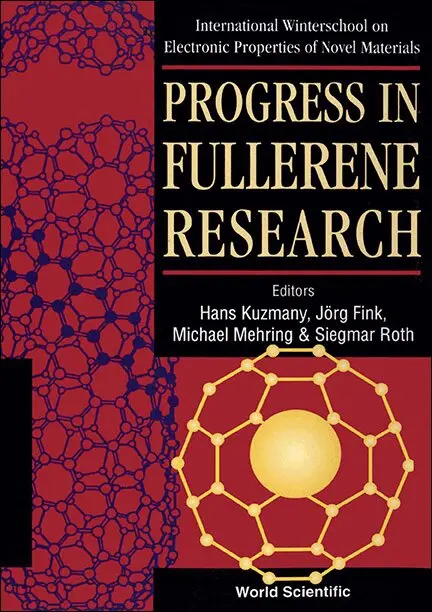
PROGRESS IN FULLERENE RESEARCH - PROCEEDINGS OF THE INTERNATIONAL WINTERSCHOOL ON ELECTRONIC PROPERTIES OF NOVEL MATERIALS
Av ROTH FINK MEHRING ROTH H KUZMANY, H Kuzmany m. fl.
Inbunden, 1994
3278 kr
Tillfälligt slut
The proceedings summarise the oral and poster presentations of the Winterschool on the above topic. The event was the sixth in a series aimed at describing and discussing recent advances in the understanding of the electronic properties of novel materials. The topic of the meeting, fullerenes and …
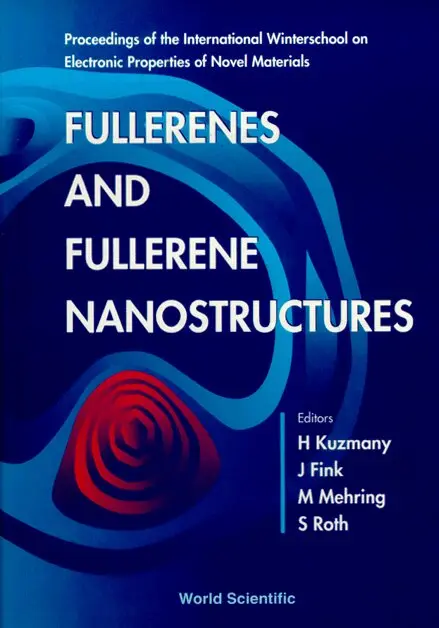
FULLERENES AND FULLERENE NANOSTRUCTURES: PROCEEDINGS OF THE INTERNATIONAL WINTER SCHOOL ON ELECTRONIC PROPERTIES OF NOVEL MATERIALS
Av ROTH FINK MEHRING ROTH H KUZMANY, H Kuzmany m. fl.
Inbunden, 1996
3822 kr
Tillfälligt slut
During the last ten years, the International Winterschools on Electronic Properties of New Materials (IWEPNM) have developed into a well-established institution and the alumni form a very active interdisciplinary community which spreads all over the world. Past schools of this series have treated …