Magnus Lindelow - Böcker
Visar alla böcker från författaren Magnus Lindelow. Handla med fri frakt och snabb leverans.
4 produkter
4 produkter
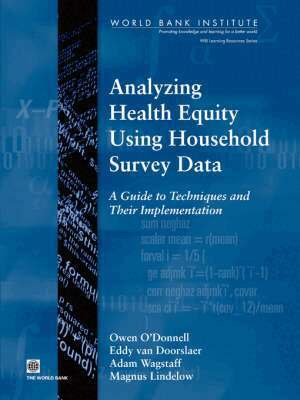
Analyzing Health Equity Using Household Survey Data
A Guide to Techniques and Their Implementation
Häftad, Engelska, 2007
310 kr
Skickas inom 10-15 vardagar
Have gaps in health outcomes between the poor and better off grown? Are they larger in one country than another? Are health sector subsidies more equally distributed in some countries than others? Are health care payments more progressive in one health care financing system than another? What are catastrophic payments and how can they be measured? How far do health care payments impoverish households? Answering questions such as these requires quantitative analysis. This in turn depends on a clear understanding of how to measure key variables in the analysis, such as health outcomes, health expenditures, need, and living standards. It also requires set quantitative methods for measuring inequality and inequity, progressivity, catastrophic expenditures, poverty impact, and so on. This book provides an overview of the key issues that arise in the measurement of health variables and living standards, outlines and explains essential tools and methods for distributional analysis, and, using worked examples, shows how these tools and methods can be applied in the health sector. The book seeks to provide the reader with both a solid grasp of the principles underpinning distributional analysis, while at the same time offering hands-on guidance on how to move from principles to practice.
392 kr
Skickas inom 10-15 vardagar
Discovering the Real World
Health Workers' Career Choices and Early Work Experience in Ethiopia
Häftad, Engelska, 2010
337 kr
Skickas inom 10-15 vardagar
Twenty Years of Health System Reform in Brazil
An Assessment of the Sistema Único De Saúde
Häftad, Engelska, 2013
337 kr
Skickas inom 10-15 vardagar
It has been over twenty years since the Brazilian Sistema Único de Saúde (Unified Health System or SUS) was formally established by the 1988 Constitution. The impetus for the SUS came in part from rising costs and a crisis in the social security system that preceded the reforms, but also from a broad-based political movement calling for democratisation and improved social rights. Building on reforms that started in the 1980s, the SUS was based on three overarching principles: (i) universal access to health services, with health defined as a citizen's right and an obligation of the state; (ii) equality of access to health care; and (iii) integrality (comprehensiveness) and continuity of care; along with several other guiding ideas, including decentralisation, increased participation, and evidence-based prioritisation. The SUS reform established health a fundamental right and duty of the state, and started a process of fundamentally transforming Brazil's health system to achieve this goal. So, what has been achieved since the SUS was established? And what challenges remain in achieving the goals that were established in 1988? These questions are the focus of this report. Specifically, it seeks to assess whether the SUS reforms have managed to transform the health system as envisaged more than 20 years ago, and whether the reforms have led to improved outcomes in terms of access to services, financial protection, and health status. Any effort to assess the performance of a health system runs into a host of challenges concerning the definition of boundaries of the 'health system', the outcomes that the assessment should focus on, data sources and quality, and the role of policies and reforms in understanding how the performance of the health system has changed over time. Building on an extensive literature on health system assessment, this report is based on a simple framework that specifies a set of health system 'building blocks', which affect a number of intermediate outcomes such as access, quality and efficiency, which, in turn, contribute to final outcomes, including health status, financial protection, and satisfaction. Based on this framework, the report starts by looking at how key building blocks of Brazil's health system have changed over time and then moves on to review performance in terms of intermediate and final outcomes.