Mai Zhou - Böcker
Visar alla böcker från författaren Mai Zhou. Handla med fri frakt och snabb leverans.
3 produkter
3 produkter
931 kr
Skickas inom 10-15 vardagar
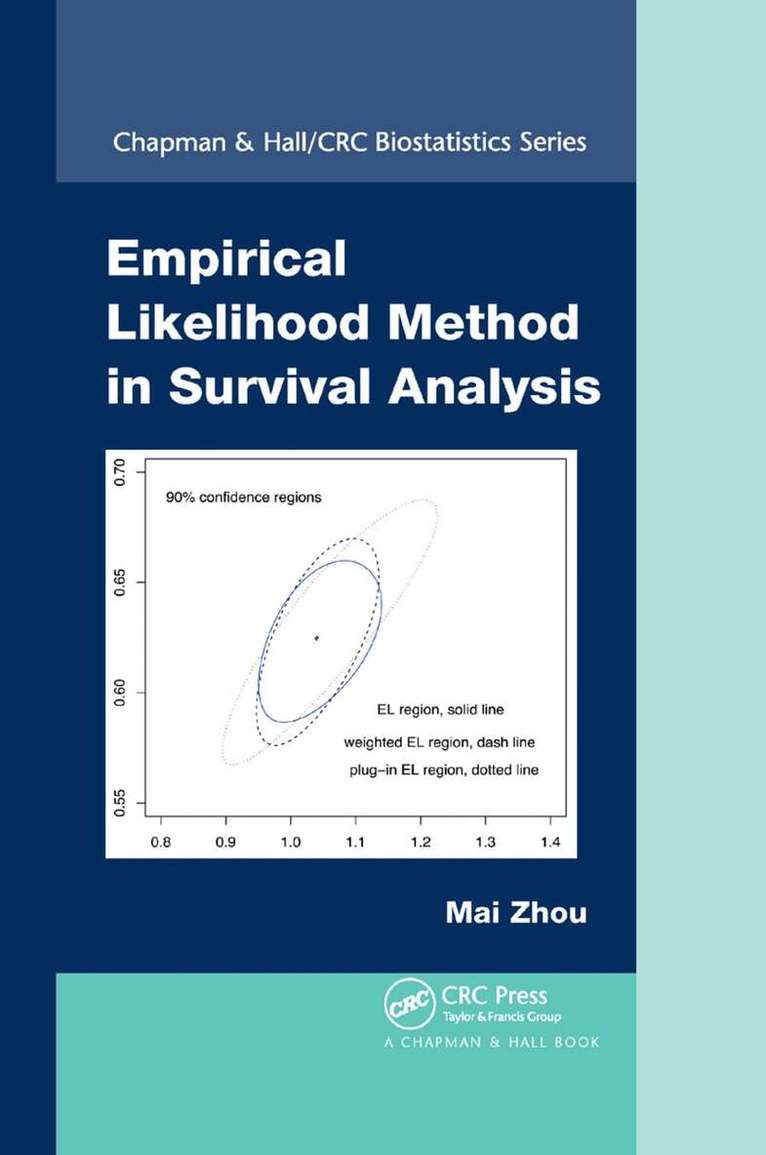
Add the Empirical Likelihood to Your Nonparametric ToolboxEmpirical Likelihood Method in Survival Analysis explains how to use the empirical likelihood method for right censored survival data. The author uses R for calculating empirical likelihood and includes many worked out examples with the associated R code. The datasets and code are available for download on his website and CRAN.The book focuses on all the standard survival analysis topics treated with empirical likelihood, including hazard functions, cumulative distribution functions, analysis of the Cox model, and computation of empirical likelihood for censored data. It also covers semi-parametric accelerated failure time models, the optimality of confidence regions derived from empirical likelihood or plug-in empirical likelihood ratio tests, and several empirical likelihood confidence band results.While survival analysis is a classic area of statistical study, the empirical likelihood methodology has only recently been developed. Until now, just one book was available on empirical likelihood and most statistical software did not include empirical likelihood procedures. Addressing this shortfall, this book provides the functions to calculate the empirical likelihood ratio in survival analysis as well as functions related to the empirical likelihood analysis of the Cox regression model and other hazard regression models.
Empirical Likelihood Method in Survival Analysis
With R Implementation, Second Edition
Inbunden, Engelska, 2026
1 877 kr
Kommande
This book systematically covers empirical likelihood methods in most important topics in survival analysis: the Kaplan–Meier and the Nelson–Aalen estimator, the log rank test, the Cox proportional hazards model and the accelerated failure time models. In addition, it also covers an extension of the Cox model–the short term/long term hazard ratio model of Yang and Prentice. Finally, empirical likelihood methods with current status data or type I interval censored data are investigated: estimation/test for the mean/hazard/probability and regression models are discussed.The author of this book is also the author of several R packages for empirical likelihood calculations with survival data. Every topic discussed gets immediately put into action with R code in examples that users can replicate and experiment with. Includes more than 70 examples illustrating the use of empirical likelihood, many with real data.Provides complete R computational codes that reader can replicate the results in the book.Includes over 80 exercise problems making it suitable to be adopted as a textbook.Newly added materials now cover more general types of censored survival data.The Open Access version of this book, available at www.taylorfrancis.com, has been made available under a Creative Commons Attribution-Non Commercial-No Derivatives (CC-BY-NC-ND) 4.0 International license.
1 336 kr
Skickas inom 10-15 vardagar
Add the Empirical Likelihood to Your Nonparametric ToolboxEmpirical Likelihood Method in Survival Analysis explains how to use the empirical likelihood method for right censored survival data. The author uses R for calculating empirical likelihood and includes many worked out examples with the associated R code. The datasets and code are available for download on his website and CRAN.The book focuses on all the standard survival analysis topics treated with empirical likelihood, including hazard functions, cumulative distribution functions, analysis of the Cox model, and computation of empirical likelihood for censored data. It also covers semi-parametric accelerated failure time models, the optimality of confidence regions derived from empirical likelihood or plug-in empirical likelihood ratio tests, and several empirical likelihood confidence band results.While survival analysis is a classic area of statistical study, the empirical likelihood methodology has only recently been developed. Until now, just one book was available on empirical likelihood and most statistical software did not include empirical likelihood procedures. Addressing this shortfall, this book provides the functions to calculate the empirical likelihood ratio in survival analysis as well as functions related to the empirical likelihood analysis of the Cox regression model and other hazard regression models.