Marc Goovaerts – författare
Visar alla böcker från författaren Marc Goovaerts. Handla med fri frakt och snabb leverans.
12 produkter
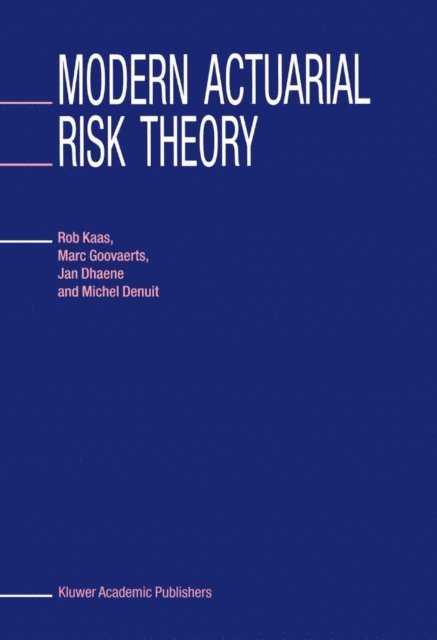
Modern Actuarial Risk Theory
Av Michel Denuit, Jan Dhaene m. fl.
E-bok, 2007
1209 kr
Lägg i varukorg
Apart from standard actuarial theory, Modern Actuarial Risk Theory contains methods that are relevant for actuarial practice, for instance the rating of automobile insurance policies, premium principles and IBNR models, as well as generalized linear models with an eye on actuarial applications. …
Actuarial Theory for Dependent Risks
Measures, Orders and Models
Av Michel Denuit, Jan Dhaene m. fl.
Inbunden, 2005
1571 kr
Lägg i varukorg
The increasing complexity of insurance and reinsurance products has seen a growing interest amongst actuaries in the modelling of dependent risks. For efficient risk management, actuaries need to be able to answer fundamental questions such as: Is the correlation structure dangerous? And, if yes, …
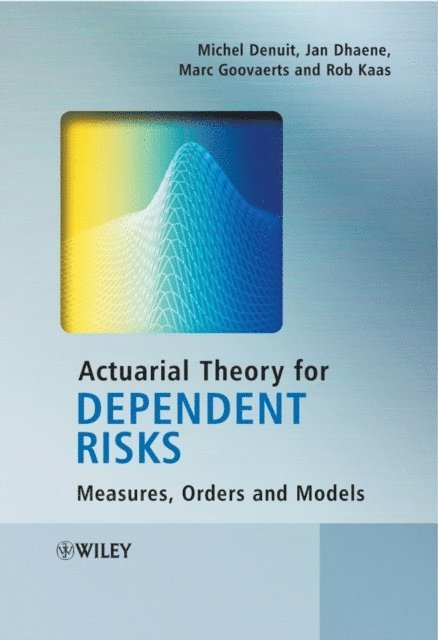
Actuarial Theory for Dependent Risks
Measures, Orders and Models
Av Rob Kaas, Marc Goovaerts m. fl.
E-bok, 2006
1776 kr
Lägg i varukorg
The increasing complexity of insurance and reinsurance products has seen a growing interest amongst actuaries in the modelling of dependent risks. For efficient risk management, actuaries need to be able to answer fundamental questions such as: Is the correlation structure dangerous? And, if yes, …
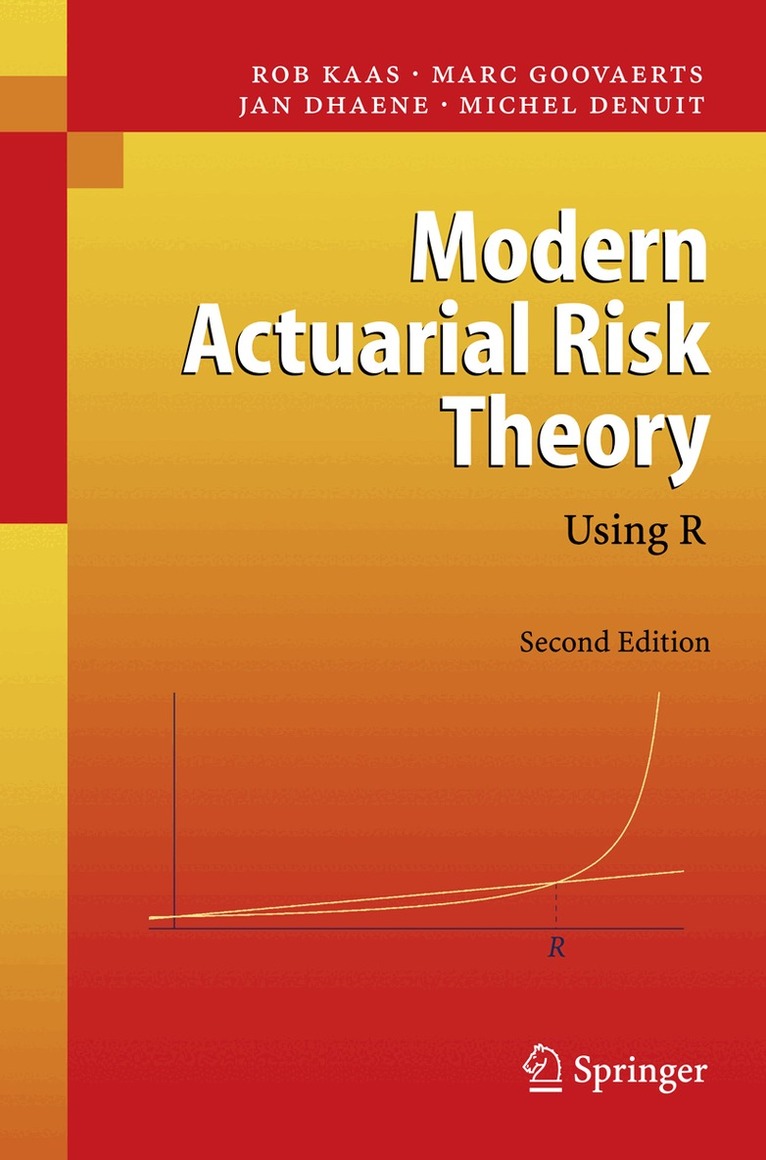
Modern Actuarial Risk Theory
Using R
Av Rob Kaas, Marc Goovaerts m. fl.
Inbunden, 2008
1643 kr
Lägg i varukorg
Modern Actuarial Risk Theory contains what every actuary needs to know about non-life insurance mathematics. It starts with the standard material like utility theory, individual and collective model and basic ruin theory. Other topics are risk measures and premium principles, bonus-malus systems, …
Modern Actuarial Risk Theory
Using R
Av Michel Denuit, Jan Dhaene m. fl.
E-bok, 2008
1634 kr
Lägg i varukorg
Modern Actuarial Risk Theory contains what every actuary needs to know about non-life insurance mathematics. It starts with the standard material like utility theory, individual and collective model and basic ruin theory. Other topics are risk measures and premium principles, bonus-malus systems, …
Modern Actuarial Risk Theory
Using R
Av Rob Kaas, Marc Goovaerts m. fl.
Häftad, 2009
1207 kr
Lägg i varukorg
Modern Actuarial Risk Theory contains what every actuary needs to know about non-life insurance mathematics. It starts with the standard material like utility theory, individual and collective model and basic ruin theory. Other topics are risk measures and premium principles, bonus-malus systems, …
Premium Calculation in Insurance
Av F. Etienne De Vylder, Marc Goovaerts m. fl.
Inbunden, 1984
2188 kr
Lägg i varukorg
I am pleased to participate in this Summer School and look forward to sharing some ideas with you over the next few days. At the outset I would like to describe the approach I will take in 1 presenting the material. I aim to present the material in a non rigorous way and hopefully in an intuitive …
Insurance and Risk Theory
Av Marc Goovaerts, F. Etienne De Vylder m. fl.
Inbunden, 1986
2254 kr
Lägg i varukorg
Canadian financial institutions have been in rapid change in the past five years. In response to these changes, the Department of Finance issued a discussion paper: The Regulation of Canadian Financial Institutions, in April 1985, and the government intends to introduce legislation in the fall. …
Insurance and Risk Theory
Av J. Haezendonck, F. Etienne De Vylder m. fl.
E-bok, 2012
3013 kr
Lägg i varukorg
Canadian financial institutions have been in rapid change in the past five years. In response to these changes, the Department of Finance issued a discussion paper: The Regulation of Canadian Financial Institutions, in April 1985, and the government intends to introduce legislation in the fall. …
Premium Calculation in Insurance
Av J. Haezendonck, Marc Goovaerts m. fl.
E-bok, 2012
2925 kr
Lägg i varukorg
I am pleased to participate in this Summer School and look forward to sharing some ideas with you over the next few days. At the outset I would like to describe the approach I will take in 1 presenting the material. I aim to present the material in a non rigorous way and hopefully in an intuitive …
Premium Calculation in Insurance
Av F. Etienne De Vylder, Marc Goovaerts m. fl.
Häftad, 2011
2188 kr
Lägg i varukorg
I am pleased to participate in this Summer School and look forward to sharing some ideas with you over the next few days. At the outset I would like to describe the approach I will take in 1 presenting the material. I aim to present the material in a non rigorous way and hopefully in an intuitive …
Insurance and Risk Theory
Av Marc Goovaerts, F. Etienne De Vylder m. fl.
Häftad, 2011
2254 kr
Lägg i varukorg
Canadian financial institutions have been in rapid change in the past five years. In response to these changes, the Department of Finance issued a discussion paper: The Regulation of Canadian Financial Institutions, in April 1985, and the government intends to introduce legislation in the fall. …