Marc Langheinrich – författare
Visar alla böcker från författaren Marc Langheinrich. Handla med fri frakt och snabb leverans.
6 produkter
Privacy in Mobile and Pervasive Computing
Av Marc Langheinrich, Florian Schaub
Häftad, 2018
660 kr
Lägg i varukorg
It is easy to imagine that a future populated with an ever-increasing number of mobile and pervasive devices that record our minute goings and doings will significantly expand the amount of information that will be collected, stored, processed, and shared about us by both corporations and …
Privacy in Mobile and Pervasive Computing
Av Florian Schaub, Marc Langheinrich
E-bok, 2022
897 kr
Lägg i varukorg
It is easy to imagine that a future populated with an ever-increasing number of mobile and pervasive devices that record our minute goings and doings will significantly expand the amount of information that will be collected, stored, processed, and shared about us by both corporations and …
Pervasive Computing
5th International Conference, PERVASIVE 2007, Toronto, Canada, May 13-16, 2007, Proceedings
Av Anthony LaMarca, Marc Langheinrich m. fl.
Häftad, 2007
569 kr
Lägg i varukorg
This book constitutes the refereed proceedings of the 5th International Conference on Pervasive Computing, PERVASIVE 2007, held in Toronto, Canada in May 2007. The 21 revised full papers are organized in topical sections on reaching out, context and its application, security and privacy, …
Pervasive Computing
5th International Conference, PERVASIVE 2007, Toronto, Canada, May 13-16, 2007, Proceedings
Av Khai N. Truong, Marc Langheinrich m. fl.
E-bok, 2007
755 kr
Lägg i varukorg
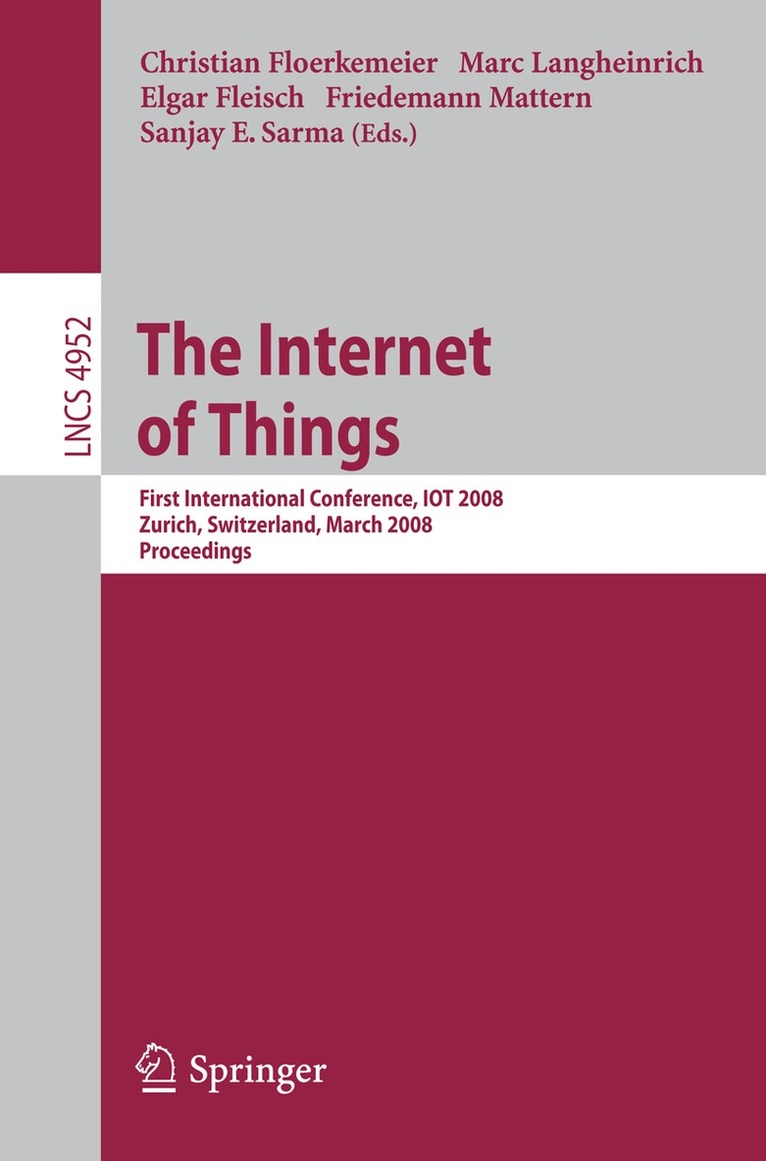
Internet of Things
First International Conference, IOT 2008, Zurich, Switzerland, March 26-28, 2008, Proceedings
Av Christian Floerkemeier, Marc Langheinrich m. fl.
Häftad, 2008
569 kr
Lägg i varukorg
ThisvolumecontainstheproceedingsoftheInternetofThings(IOT)Conference 2008, the ?rst international conference of its kind. The conference took place in Zurich,Switzerland, March26–28,2008. The term ‘Internet of Things’ hascome to describe a number of technologies and researchdisciplines that enable …
Internet of Things
First International Conference, IOT 2008, Zurich, Switzerland, March 26-28, 2008, Proceedings
Av Sanjay E. Sarma, Friedemann Mattern m. fl.
E-bok, 2008
755 kr
Lägg i varukorg
ThisvolumecontainstheproceedingsoftheInternetofThings(IOT)Conference 2008, the ?rst international conference of its kind. The conference took place in Zurich,Switzerland, March26–28,2008. The term ‘Internet of Things’ hascome to describe a number of technologies and researchdisciplines that enable …