Maria Carrizosa - Böcker
Visar alla böcker från författaren Maria Carrizosa. Handla med fri frakt och snabb leverans.
4 produkter
4 produkter
2 088 kr
Skickas inom 10-15 vardagar
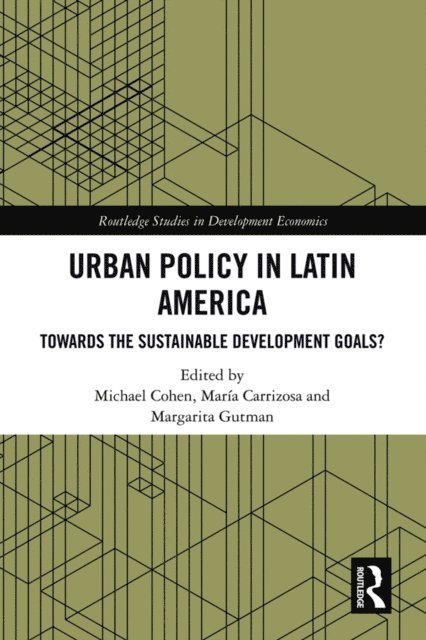
This book evaluates the impact of 20 years of urban policies in six Latin American countries: Argentina, Brazil, Chile, Colombia, Ecuador and Mexico. It argues that evaluating the fulfillment of past commitments is essential for framing and meeting the new commitments that were taken in Habitat III over the next 20 years. Taken as a whole, the book provides a critical assessment of the economic, social and environmental consequences of urban interventions during Habitat II. The country-level chapters have been written by recognized experts in urban issues, with first-hand knowledge of the Habitat process, and deep familiarity with the problems, statistics, actors and political contexts of their nations. The latter part of the volume considers wider topics such as the Habitat Commitment Index, the New Urban Agenda and the regional and global-scale lessons that can be extracted from this group of countries. Urban Policy in Latin America will be of interest to advanced students, researchers and policymakers across development economics, urban studies and Latin American studies.
644 kr
Skickas inom 10-15 vardagar
This book evaluates the impact of 20 years of urban policies in six Latin American countries: Argentina, Brazil, Chile, Colombia, Ecuador and Mexico. It argues that evaluating the fulfillment of past commitments is essential for framing and meeting the new commitments that were taken in Habitat III over the next 20 years. Taken as a whole, the book provides a critical assessment of the economic, social and environmental consequences of urban interventions during Habitat II. The country-level chapters have been written by recognized experts in urban issues, with first-hand knowledge of the Habitat process, and deep familiarity with the problems, statistics, actors and political contexts of their nations. The latter part of the volume considers wider topics such as the Habitat Commitment Index, the New Urban Agenda and the regional and global-scale lessons that can be extracted from this group of countries. Urban Policy in Latin America will be of interest to advanced students, researchers and policymakers across development economics, urban studies and Latin American studies.
1 954 kr
Skickas inom 10-15 vardagar
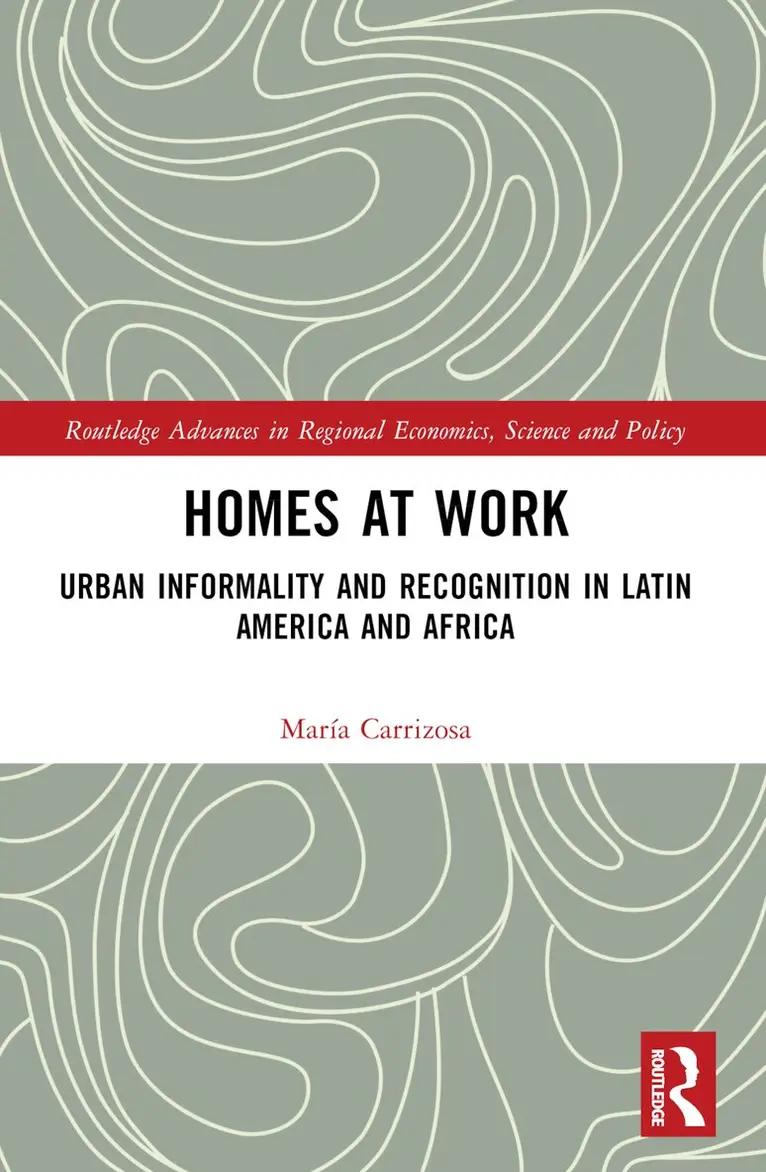
Following the outbreak of the COVID-19 pandemic, working from home became a global phenomenon, yet before 2020, it was a relatively understudied practice. But in informal settlements, the definition of "home" and "employment" is completely intertwined, which is why there is so much to learn from them. For over half a century, mainstream theoretical approaches to urban informality, dominated by development economics, often fail to see this economic and spatial phenomenon jointly. Labor studies tend to be space-blind and spatial studies often disregard informal employment. Profoundly interdisciplinary, this work connects scholarship in development, public policy, labor studies, and feminist economics, with that in urban studies, planning, housing, architecture, and visual studies.The book walks the reader behind the closed doors of working homes that make the fabric, both social and economic, of most cities. It applies a visual methodology to reveal their "space-use intensity" and quantify the extent to which houses in informal settlements fill their inner pores with economic activity and community services. The research also revisits urban formalization policies in Latin America and Africa, to uncover a fallacious politics of recognition. It ultimately argues for a recognition continuum: an approach to urban informality that is more practical and fairer.The book is of interest to development economists, urban scholars, public policy specialists, time-use researchers, and architects working on housing, employment generation, urban livelihoods, gender studies, and related topics.
576 kr
Skickas inom 10-15 vardagar
Following the outbreak of the COVID-19 pandemic, working from home became a global phenomenon, yet before 2020, it was a relatively understudied practice. But in informal settlements, the definition of "home" and "employment" is completely intertwined, which is why there is so much to learn from them. For over half a century, mainstream theoretical approaches to urban informality, dominated by development economics, often fail to see this economic and spatial phenomenon jointly. Labor studies tend to be space-blind and spatial studies often disregard informal employment. Profoundly interdisciplinary, this work connects scholarship in development, public policy, labor studies, and feminist economics, with that in urban studies, planning, housing, architecture, and visual studies.The book walks the reader behind the closed doors of working homes that make the fabric, both social and economic, of most cities. It applies a visual methodology to reveal their "space-use intensity" and quantify the extent to which houses in informal settlements fill their inner pores with economic activity and community services. The research also revisits urban formalization policies in Latin America and Africa, to uncover a fallacious politics of recognition. It ultimately argues for a recognition continuum: an approach to urban informality that is more practical and fairer.The book is of interest to development economists, urban scholars, public policy specialists, time-use researchers, and architects working on housing, employment generation, urban livelihoods, gender studies, and related topics.