María Lomeña-Galiano - Böcker
Visar alla böcker från författaren María Lomeña-Galiano. Handla med fri frakt och snabb leverans.
4 produkter
4 produkter
Critical Approaches to Institutional Translation and Interpreting
Challenging Epistemologies
Inbunden, Engelska, 2024
2 419 kr
Skickas inom 10-15 vardagar
This collection re-envisions the academic study of institutional translation and interpreting (ITI), uncovering the ways in which institutional practices have inhibited knowledge creation and encouraging stakeholders to continue to challenge the assumptions and epistemics which underpin the field.ITI is broadly conceived here as translation and interpreting delivered in or for specific organizations and institutional social systems, spanning national, supranational, and international organizations as well as financial markers, universities, and national courts. This volume is organized around three sections, which collectively interrogate the knower – the field itself – to engage in questions around “how we know what we know” in ITI and how institutions have contributed to or hindered the social practice of knowledge creation in ITI studies. The first section challenges the paths which have led to current epistemologies of ignorance while the second turns the critical lens on specific institutional practices. The final section explores specific proposals to challenge existing epistemologies by broadening the scope of ITI studies.Giving a platform to perspectives which have been historically marginalized within ITI studies and new paths to continue challenging dominant assumptions, this book will appeal to scholars and policymakers in translation and interpreting studies.
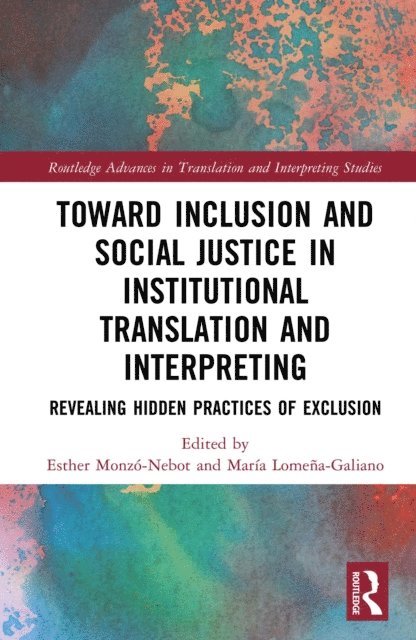
Toward Inclusion and Social Justice in Institutional Translation and Interpreting
Revealing Hidden Practices of Exclusion
Inbunden, Engelska, 2024
2 103 kr
Skickas inom 10-15 vardagar
This collection re-envisions the academic study of institutional translation and interpreting (ITI), revealing oppression in established institutional spaces toward challenging existing policies and the myths which inhibit critical inquiry within the field.ITI is broadly conceived here as translation and interpreting delivered in or for specific institutions, understood as social systems and spanning national, supranational, and international organizations as well as immigration detention centers, prisons, and national courts. The volume is organized around three parts, which explore ITI spaces and practices revealing oppressive practices, dispelling myths regarding translation and interpreting, and shedding light on institutional spaces that have remained invisible and hidden, and therefore underexplored. The chapters in this book vividly illustrate similarities and contrasts between the different contexts of ITI, revealing shared power dynamics that uphold social hierarchies. Throughout this comparison, the book makes a compelling case to consider the different contexts of ITI as equally contributing to actionable knowledge on how institutions shape translation and interpreting and how these are operated in sustaining such hierarchies.Offering a window into previously underexplored spaces and generating new lines of inquiry within ITI studies, this book will be of interest to scholars and policymakers in translation and interpreting studies.
Toward Inclusion and Social Justice in Institutional Translation and Interpreting
Revealing Hidden Practices of Exclusion
Häftad, Engelska, 2025
648 kr
Skickas inom 10-15 vardagar
This collection re-envisions the academic study of institutional translation and interpreting (ITI), revealing oppression in established institutional spaces toward challenging existing policies and the myths which inhibit critical inquiry within the field.ITI is broadly conceived here as translation and interpreting delivered in or for specific institutions, understood as social systems and spanning national, supranational, and international organizations as well as immigration detention centers, prisons, and national courts. The volume is organized around three parts, which explore ITI spaces and practices revealing oppressive practices, dispelling myths regarding translation and interpreting, and shedding light on institutional spaces that have remained invisible and hidden, and therefore underexplored. The chapters in this book vividly illustrate similarities and contrasts between the different contexts of ITI, revealing shared power dynamics that uphold social hierarchies. Throughout this comparison, the book makes a compelling case to consider the different contexts of ITI as equally contributing to actionable knowledge on how institutions shape translation and interpreting and how these are operated in sustaining such hierarchies.Offering a window into previously underexplored spaces and generating new lines of inquiry within ITI studies, this book will be of interest to scholars and policymakers in translation and interpreting studies.
Critical Approaches to Institutional Translation and Interpreting
Challenging Epistemologies
Häftad, Engelska, 2025
648 kr
Skickas inom 10-15 vardagar
This collection re-envisions the academic study of institutional translation and interpreting (ITI), uncovering the ways in which institutional practices have inhibited knowledge creation and encouraging stakeholders to continue to challenge the assumptions and epistemics which underpin the field.ITI is broadly conceived here as translation and interpreting delivered in or for specific organizations and institutional social systems, spanning national, supranational, and international organizations as well as financial markers, universities, and national courts. This volume is organized around three sections, which collectively interrogate the knower – the field itself – to engage in questions around “how we know what we know” in ITI and how institutions have contributed to or hindered the social practice of knowledge creation in ITI studies. The first section challenges the paths which have led to current epistemologies of ignorance while the second turns the critical lens on specific institutional practices. The final section explores specific proposals to challenge existing epistemologies by broadening the scope of ITI studies.Giving a platform to perspectives which have been historically marginalized within ITI studies and new paths to continue challenging dominant assumptions, this book will appeal to scholars and policymakers in translation and interpreting studies.