Mariem Malouche - Böcker
Visar alla böcker från författaren Mariem Malouche. Handla med fri frakt och snabb leverans.
5 produkter
5 produkter
449 kr
Skickas inom 10-15 vardagar
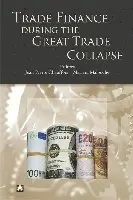
On September 15, 2008, Lehman Brothers, the fourth largest U.S. investment bank filed for bankruptcy. Global credit markets tightened. Spreads skyrocketed. International trade plummeted by double-digits. Banks were reportedly unable to meet the demand from their customers to finance their international trade operations, leaving a trade finance “gap” estimated at around US$25 billion. Governments and international institutions were encouraged to intervene based on the information that some 80-90 percent of world trade relies on some form of trade finance. As the recovery unfolds, time has come to provide policy makers and analysts with a comprehensive assessment of the role of trade finance in the 2008-09 “great” trade collapse and the subsequent role of governments and institutions to help restore trade finance markets. After reviewing the underpinning of trade finance and inter-firm trade credit, ""Trade Finance during the Great Trade Collapse: Role, Response, and Results"" aims to answer the following questions: Was the availability and cost of trade finance a major constraint for trade during the 2008-2009 global economic crisis? What are the underpinnings and limits for national and international public interventions in support of trade finance markets in times of crisis? How effective were the public and private sector mechanisms put in place during the crisis to support trade and trade finance? And to what extent have the new banking regulations under Basel II and Basel III exacerbated the trade finance shortfall during the crisis and in the post-crisis environment, respectively? The book offers insights for policy makers in developed and developing countries and international organizations on the challenges confronting trade finance in times of crisis, especially in low-income countries and for small-and-medium size traders. Trade Finance during the Great Trade Collapse: Role, Response, and Results is the product of a fruitful collaboration during the crisis and includes mainly original contributions from the World Bank Group, international financial partners, private banks, and academia.
297 kr
Skickas inom 10-15 vardagar
This toolkit provides a novel approach and a set of tools that allow policymakers and analysts to identify non-tariff measures (NTMs), assess their trade restrictiveness and impact on prices and welfare, and to strengthen the institutional coordination mechanism, transparency, and regulatory governance on NTMs. It also aims at encouraging economies to increasingly address the NTM agenda from a domestic competitiveness and/or poverty perspective rather than from a mercantilist standpoint of concessions to trading partners. NTMs are policy measures, other than ordinary customs tariffs, that can potentially have an economic effect on international trade in goods, changing quantities traded, or prices or both. While most NTMs are already subject to WTO disciplines, the main challenge is to allow governments to address public policy concerns without unnecessarily hurting trade competitiveness and while preventing disguised protectionism. This toolkit is predicated on the idea that the complexity and diversity of NTMs should be recognized. Problems should be identified at the country level through consultations with the private sector, and technical solutions should be sought through careful analysis and private/public dialogue. The underlying philosophy is similar to what is known as “Regulatory Impact Assessment” (RIA), but applied to the review of existing measures (no ex ante analysis), in response to specific demands from countries struggling with legacies of complicated and penalizing regulations. Dealing with existing measures has the advantage of responding to an immediate need and focusing on measures whose effects are known. The toolkit is organized as follows. Chapter 1 discusses the newly revamped NTM classification and pervasiveness of NTM. Chapter 2 elaborates on the analytics of an NTM review, walking the reader step by step through the key questions. Chapter 3 focuses on the institutional set up and key principles to successfully pursue the streamlining of regulations. Finally, chapters 4 and 5 provide some practical cases of streamlining both at the country and regional levels, and for product specific examples.
Toward New Sources of Competitiveness in Bangladesh
Key Insights of the Diagnostic Trade Integration Study
Häftad, Engelska, 2015
283 kr
Skickas inom 10-15 vardagar
Bangladesh has a strong track record on growth and employment. To grow faster, absorb more labor, and continue its pace of poverty reduction, the country will need to build on that record and improve on several fronts - from education and infrastructure to investment climate and trade policies, to support a multi-sector competitiveness agenda.
Strengthening Competitiveness in Bangladesh: Thematic Assessment
A Diagnostic Trade Integration Study
Häftad, Engelska, 2016
449 kr
Skickas inom 10-15 vardagar
The report identifies a four-pillar strategy for Bangladesh to sustain and accelerate export growth: breaking into new markets, breaking into new products, improving worker and consumer welfare, and building a supportive environment.
Attracting Investment in Bangladesh: Sectoral Analyses
A Diagnostic Trade Integration Study
Häftad, Engelska, 2016
449 kr
Skickas inom 10-15 vardagar
The report identifies a four-pillar strategy for Bangladesh to sustain and accelerate export growth: breaking into new markets, breaking into new products, improving worker and consumer welfare, and building a supportive environment.