Marilyn McCord Adams - Böcker
Visar alla böcker från författaren Marilyn McCord Adams. Handla med fri frakt och snabb leverans.
10 produkter
10 produkter
1 091 kr
Skickas inom 5-8 vardagar
Housing the powers? What powers? Soul powers -- powers that shape the lives of human souls. They may be housed, and exercised, by those souls or by other agents. This book is about views on that subject developed by Christian philosophical theologians in western Europe from the mid-12th to the early 14th century, with some borrowing of thoughts from their Islamic counterparts. Chapters 1 to 3 discuss in increasing breadth and depth those theologians' views about their own housing and exercise of soul powers. Chapters 4 to 8 discuss their views as to the possibility of some of our soul powers being outsourced -- that is, housed and exercised by God or a super-human emanation of God. Chapter 4 is about outsourcing the subject -- in an Islamic form that postulated an outsourcing of intellectual thinking from individual human beings to a single intellect that is eternally emanated from God and is the sole thinker of all the thoughts that humans ever think. That theory attracted the interest, though not the agreement, of European Christian philosophers. They found ideas of outsourcing the object, rather than the subject, of religious thought more congenial. The remaining four chapters of the book deal with that more congenial topic. In chapters 5 and 6 the focus is mainly on divine gifts of knowledge and understanding, and in chapters 7 and 8 on gifts of action and willing or desire.
494 kr
Skickas inom 5-8 vardagar
This collection of important writings fills the need for an anthology that adequately represents recent work on the problem of evil. This is perhaps one of the most discussed topics in the philosophy of religion, and is of perennial interest to philosophers and theologians.
Some Later Medieval Theories of the Eucharist
Thomas Aquinas, Gilles of Rome, Duns Scotus, and William Ockham
Inbunden, Engelska, 2010
747 kr
Skickas inom 5-8 vardagar
How can the Body and Blood of Christ, without ever leaving heaven, come to be really present on eucharistic altars where the bread and wine still seem to be? Thirteenth and fourteenth century Christian Aristotelians thought the answer had to be "transubstantiation." Acclaimed philosopher, Marilyn McCord Adams, investigates these later medieval theories of the Eucharist, concentrating on the writings of Thomas Aquinas, Giles of Rome, Duns Scotus, and William Ockham, with some reference to Peter Lombard, Hugh of St. Victor, and Bonaventure. She examines how their efforts to formulate and integrate this theological datum provoked them to make significant revisions in Aristotelian philosophical theories regarding the metaphysical structure and location of bodies, differences between substance and accidents, causality and causal powers, and fundamental types of change. Setting these developments in the theological context that gave rise to the question draws attention to their understandings of the sacraments and their purpose, as well as to their understandings of the nature and destiny of human beings. Adams concludes that their philosophical modifications were mostly not ad hoc, but systematic revisions that made room for transubstantiation while allowing Aristotle still to describe what normally and naturally happens. By contrast, their picture of the world as it will be (after the last judgment) seems less well integrated with their sacramental theology and their understandings of human nature.
Some Later Medieval Theories of the Eucharist
Thomas Aquinas, Gilles of Rome, Duns Scotus, and William Ockham
Häftad, Engelska, 2012
523 kr
Skickas inom 7-10 vardagar
How can the Body and Blood of Christ, without ever leaving heaven, come to be really present on eucharistic altars where the bread and wine still seem to be? Thirteenth and fourteenth century Christian Aristotelians thought the answer had to be "transubstantiation." Acclaimed philosopher, Marilyn McCord Adams, investigates these later medieval theories of the Eucharist, concentrating on the writings of Thomas Aquinas, Giles of Rome, Duns Scotus, and William Ockham, with some reference to Peter Lombard, Hugh of St. Victor, and Bonaventure. She examines how their efforts to formulate and integrate this theological datum provoked them to make significant revisions in Aristotelian philosophical theories regarding the metaphysical structure and location of bodies, differences between substance and accidents, causality and causal powers, and fundamental types of change. Setting these developments in the theological context that gave rise to the question draws attention to their understandings of the sacraments and their purpose, as well as to their understandings of the nature and destiny of human beings. Adams concludes that their philosophical modifications were mostly not ad hoc, but systematic revisions that made room for transubstantiation while allowing Aristotle still to describe what normally and naturally happens. By contrast, their picture of the world as it will be (after the last judgment) seems less well integrated with their sacramental theology and their understandings of human nature.
Del 4 - Current Issues in Theology
Christ and Horrors
The Coherence of Christology
Häftad, Engelska, 2006
485 kr
Skickas inom 7-10 vardagar
Who would the Saviour have to be, what would the Saviour have to do to rescue human beings from the meaning-destroying experiences of their lives? This book offers a systematic Christology that is at once biblical and philosophical. Starting with human radical vulnerability to horrors such as permanent pain, sadistic abuse or genocide, it develops what must be true about Christ if He is the horror-defeater who ultimately resolves all the problems affecting the human condition and Divine-human relations. Distinctive elements of Marilyn McCord Adams' study are her defence of the two-natures theory, of Christ as Inner Teacher and a functional partner in human flourishing, and her arguments in favour of literal bodily resurrection (Christ's and ours) and of a strong doctrine of corporeal Eucharistic presence. The book concludes that Christ is the One in Whom, not only Christian doctrine, but cosmos, church, and the human psyche hold together.
Del 4 - Current Issues in Theology
Christ and Horrors
The Coherence of Christology
Inbunden, Engelska, 2006
995 kr
Skickas inom 7-10 vardagar
Who would the Saviour have to be, what would the Saviour have to do to rescue human beings from the meaning-destroying experiences of their lives? This book offers a systematic Christology that is at once biblical and philosophical. Starting with human radical vulnerability to horrors such as permanent pain, sadistic abuse or genocide, it develops what must be true about Christ if He is the horror-defeater who ultimately resolves all the problems affecting the human condition and Divine-human relations. Distinctive elements of Marilyn McCord Adams' study are her defence of the two-natures theory, of Christ as Inner Teacher and a functional partner in human flourishing, and her arguments in favour of literal bodily resurrection (Christ's and ours) and of a strong doctrine of corporeal Eucharistic presence. The book concludes that Christ is the One in Whom, not only Christian doctrine, but cosmos, church, and the human psyche hold together.
239 kr
Skickas inom 5-8 vardagar
Drawing from Jesus' words to the disciples to become like children, Marilyn McCord Adams presents more than two hundred fifty original prayers that serve as powerful and practical examples of how adults can pray in a manner that combines the complexity and richness of their adult experiences with the candor and expectations of a child. The prayers in this collection encourage a deeper level of intimacy and openness to God, which McCord Adams believes will compel us to bring the pressing problems facing us directly to God. This resource, which can be used for public worship and private devotion, includes prayers that address social and personal concerns.
701 kr
Skickas inom 10-15 vardagar
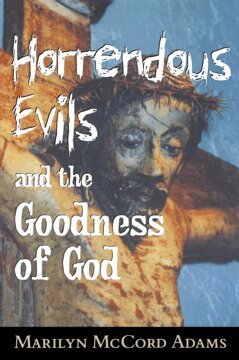
If you thought nothing new could come of the stalled, stale debates in analytic philosophy over the problem of evil, think again. With characteristic elegance and precision, Marilyn McCord Adams decisively advances the discussion by including overlooked problems―notably, the horrendous evils of her title―and overlooked resources―from the Bible and the history of Christian thought.― Kathryn Tanner, University of ChicagoWhen confronted by horrendous evil, even the most pious believer may question not only life's worth but also God's power and goodness. A distinguished philosopher and a practicing minister, Marilyn McCord Adams has written a highly original work on a fundamental dilemma of Christian thought-how to reconcile faith in God with the evils that afflict human beings.Adams argues that much of the discussion in analytic philosophy of religion over the last forty years has offered too narrow an understanding of the problem. The ground rules accepted for the discussion have usually led philosophers to avert their gaze from the worst-horrendous-evils and their devastating impact on human lives. They have agreed to debate the issue on the basis of religion-neutral values, and have focused on morals, an approach that-Adams claims-is inadequate for formulating and solving the problem of horrendous evils. She emphasizes instead the fruitfulness of other evaluative categories such as purity and defilement, honor and shame, and aesthetics. If redirected, philosophical reflection on evil can, Adams's book demonstrates, provide a valuable approach not only to theories of God and evil but also to pastoral care.
352 kr
Skickas inom 10-15 vardagar
If you thought nothing new could come of the stalled, stale debates in analytic philosophy over the problem of evil, think again. With characteristic elegance and precision, Marilyn McCord Adams decisively advances the discussion by including overlooked problems―notably, the horrendous evils of her title―and overlooked resources―from the Bible and the history of Christian thought.― Kathryn Tanner, University of ChicagoWhen confronted by horrendous evil, even the most pious believer may question not only life's worth but also God's power and goodness. A distinguished philosopher and a practicing minister, Marilyn McCord Adams has written a highly original work on a fundamental dilemma of Christian thought-how to reconcile faith in God with the evils that afflict human beings.Adams argues that much of the discussion in analytic philosophy of religion over the last forty years has offered too narrow an understanding of the problem. The ground rules accepted for the discussion have usually led philosophers to avert their gaze from the worst-horrendous-evils and their devastating impact on human lives. They have agreed to debate the issue on the basis of religion-neutral values, and have focused on morals, an approach that-Adams claims-is inadequate for formulating and solving the problem of horrendous evils. She emphasizes instead the fruitfulness of other evaluative categories such as purity and defilement, honor and shame, and aesthetics. If redirected, philosophical reflection on evil can, Adams's book demonstrates, provide a valuable approach not only to theories of God and evil but also to pastoral care.
What Sort of Human Nature?
Medieval Philosophy and the Systematics of Christology.
Häftad, Engelska, 1999
152 kr
Skickas inom 7-10 vardagar