Marion A. Kaplan - Böcker
Visar alla böcker från författaren Marion A. Kaplan. Handla med fri frakt och snabb leverans.
5 produkter
5 produkter
The Making of the Jewish Middle Class
Women and German-Jewish Identity in Imperial Germany
Inbunden, Engelska, 1991
1 559 kr
Skickas inom 5-8 vardagar
This comprehensive study of Jewish women in Imperial Germany (1871-1918) addresses the complex interrelationships of ethnicity, sex, and class. It examines the changing lives and roles of women who were part of an urbanizing, economically mobile, but socially spurned minority group, and also looks at their relationship with the rest of society.The author identifies German-Jewish women's `double burden' as females - discriminated against in both German and Jewish traditions - and as Jews - objects of the increasing anti-Semitism of their era. She also points out the ambiguous, often contradictory role that Jewish women played: they were powerful agents of acculturation, encouraging their families to adapt outwardly to German customs and norms, and also determined upholders of tradition, maintaining family rituals, kin networks, and Jewish communal organizations.
The Making of the Jewish Middle Class
Women, Family and Identity in Imperial Germany
Häftad, Engelska, 1995
414 kr
Skickas inom 5-8 vardagar
A social history of Jewish women in Imperial Germany, this study synthesizes German, women's, and Jewish history. The book explores the private--familial and religious--lives of the German-Jewish bourgeoisie and the public roles of Jewish women in the university, paid employment and social service. It analyses the changing roles of Jewish women as members of an economically mobile, but socially spurned minority. The author emphasizes the crucial role women played in creating the Jewish middle class, as well as their dual role within the Jewish family and community as powerful agents of class formation and acculturation and determined upholders of tradition.
284 kr
Skickas inom 5-8 vardagar
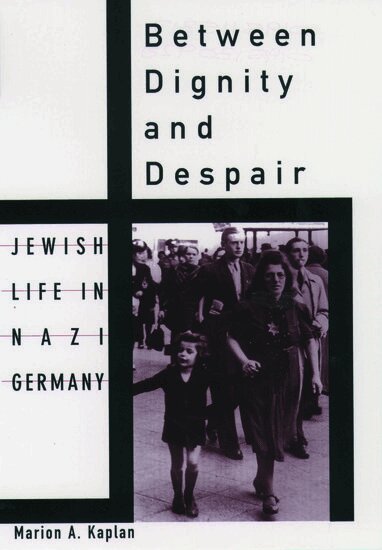
Between Dignity and Despair draws on the extraordinary memoirs, diaries, interviews, and letters of Jewish women and men to give us the first intimate portrait of Jewish life in Nazi Germany.Kaplan tells the story of Jews in Germany not from the hindsight of the Holocaust, nor from the vantage of the persecutors, but from the bewildered and ambiguous perspective of Jews trying to navigate their daily lives in a world that was becoming more and more insane. Answering the charge that Jews should have left earlier, Kaplan shows that far from seeming inevitable, the Holocaust was impossible to foresee precisely because Nazi repression occurred in irregular and unpredictable steps until the massive violence of Novemer 1938. Then the flow of emigration turned into a torrent, only to be stopped by the war. By that time Jews had been evicted from their homes, robbed of their possessions and their livelihoods, shunned by their former friends, persecuted by their neighbors, and driven into forced labor. For those trapped in Germany, mere survival became a nightmare of increasingly desperate options. Many took their own lives to retain at least some dignity in death; many others went underground and endured the terrors of nightly bombings and the even greater fear of being discovered by the Nazis. Most were murdered. All were pressed to the limit of human endurance and human loneliness.Focusing on the fate of families and particularly women's experience, Between Dignity and Despair takes us into the neighborhoods, into the kitchens, shops, and schools, to give us the shape and texture, the very feel of what it was like to be a Jew in Nazi Germany.
1 025 kr
Skickas inom 5-8 vardagar
From the 17th century until the Holocaust, Germany's Jews lurched between progress and setback, between fortune and terrible misfortune. German society shunned Jews in the eighteenth century and opened unevenly to them in the nineteenth and early twentieth centuries, only to turn murderous in the Nazi era.This book portrays the drama of German-Jewish history -- the gradual ascent of Jews from impoverished outcasts to comfortable bourgeois citizens and then their dramatic descent into genocidal torment during the Nazi years -- by examining the everyday lives of ordinary Jews. Building on social, economic and political history, it focuses on the qualitative aspects of ordinary life -- emotions, subjective impressions, and quotidian perceptions. How did ordinary Jews make sense of their world? How did they construe changes brought about by industrialization? How did they make decisions to enter new professions or stick with the old, juggle traditional mores with contemporary ways?The Jewish adoption of secular, modern European culture and the struggle for legal equality exacted profound costs, both material and psychological. Even in the heady years of progress, a basic insecurity informed German-Jewish life. Jewish successes existed alongside an antisemitism that persisted as a frightful leitmotif throughout German-Jewish history.And yet the history that emerges from these pages belies simplistic interpretations that German antisemitism followed a straight path from Luther to Hitler or that Germans nurtured an "eliminationist" antisemitism. Just as German history cannot be typecast, neither can Germans. Non-Jews were not uniformly antisemitic and maintained a wide variety of religious, regional, political, and class allegiances that fostered a wide range of attitudes towards Jews. Jewish daily life thus provides another vantage point from which to study the social life of Germany. Focusing on both internal Jewish life -- family, religion, culture and Jewish community -- and the external world of German culture and society provides a uniquely well-rounded portrait of a world defined by the shifting sands of inclusion and exclusion.
319 kr
Skickas inom 7-10 vardagar
By revealing the importance of gender in interpreting the Jewish past, this collection of original essays highlights the profound influence that feminist scholarship has had on the study of Jewish history since the 1970s. Gender and Jewish History considers the impact of gender on Jewish religious practices and political behavior, educational accomplishments and communal structures, acculturation and choice of occupations. The book stimulates conversations on such topics as Jewish women's creativity and spirituality, violence against women, Jews' reactions to persecution in the Holocaust, and Judaism as lived religion and culture. Honoring Paula Hyman, one of the founders of Jewish gender studies, this volume shows gender to be an eye-opening entry into realms of Jewish history previously untouched by it.