Mariusz Rosik - Böcker
Visar alla böcker från författaren Mariusz Rosik. Handla med fri frakt och snabb leverans.
6 produkter
6 produkter
Buchpaket - A Structural Commentary on the So-Called Antilegomena
Vol. 3: The Second Letter of Peter: Proclaiming the Coming of the Lord
Inbunden, Engelska, 2024
2 780 kr
Skickas inom 11-20 vardagar
The structural approach facilitates exposure of the elements of eschatological teaching characteristic of 2 Peter’s author with its correct or incorrect interpretation. Narratives drawn from Jewish tradition aim to show two attitudes towards the announcement of destruction: a positive attitude, signifying salvation, and a negative attitude, signifying annihilation. This pattern is transferred to the attitude towards prophetic and apostolic eschatological teaching. Part 1 of the commentary (2 Pet 1–2) focuses on the misinterpretation of this teaching by false teachers and their followers. Their eschatological scepticism is ridiculed and their grim fate described. As the starting point for this description and Peter’s whole line of argumentation 2 Pet 2:3b is taken – the thesis is that God’s inaction is only apparent, while judgment and punishment are inevitable, although only God knows when they will be executed.Part 2 of the commentary (2 Pet 3) focuses on the proper interpretation of this teaching and on laying out the principles of the letter author's hermeneutics. This hermeneutic construes texts from Jewish tradition as foreshadowing and typologies of eschatological events. In explaining the principles of his hermeneutic, the letter’s author drew on the creation story, which Jewish apocalypticism read inversely, to mark that the eschatological hermeneutics is rooted in tradition. The starting point of Peter's line of argumentation was taken to be 2 Pet 3:5.7 with its thesis of God's creative and destructive word and God's sovereign will regarding the preservation of creation and the appointment of the time of judgement. This thesis explains the apparent lack of divine action, which was also a major concern in Part 1 of the commentary (2 Pet 1–2).
Structural Commentary on the So-Called Antilegomena
Volume 3: The Second Letter of Peter: Proclaiming the Coming of the Lord. Part 1. Eschatological Scepticism (2 Pet 1–2)
Inbunden, Engelska, 2024
1 808 kr
Skickas inom 11-20 vardagar
The structural approach facilitates exposure of the elements of eschatological teaching characteristic of 2 Peter’s author with its correct or incorrect interpretation. Narratives drawn from Jewish tradition aim to show two attitudes towards the announcement of destruction: a positive attitude, signifying salvation, and a negative attitude, signifying annihilation. This pattern is transferred to the attitude towards prophetic and apostolic eschatological teaching. Part 1 of the commentary (2 Pet 1–2) focuses on the misinterpretation of this teaching by false teachers and their followers. Their eschatological scepticism is ridiculed and their grim fate described. As the starting point for this description and Peter’s whole line of argumentation 2 Pet 2:3b is taken – the thesis is that God’s inaction is only apparent, while judgment and punishment are inevitable, although only God knows when they will be executed.Part 2 of the commentary (2 Pet 3) focuses on the proper interpretation of this teaching and on laying out the principles of the letter author's hermeneutics. This hermeneutic construes texts from Jewish tradition as foreshadowing and typologies of eschatological events. In explaining the principles of his hermeneutic, the letter’s author drew on the creation story, which Jewish apocalypticism read inversely, to mark that the eschatological hermeneutics is rooted in tradition. The starting point of Peter's line of argumentation was taken to be 2 Pet 3:5.7 with its thesis of God's creative and destructive word and God's sovereign will regarding the preservation of creation and the appointment of the time of judgement. This thesis explains the apparent lack of divine action, which was also a major concern in Part 1 of the commentary (2 Pet 1–2).
Structural Commentary on the So-Called Antilegomena
Volume 3: The Second Letter of Peter: Proclaiming the Coming of the Lord. Part 2. Eschatological Hermeneutics (2 Pet 3)
Inbunden, Engelska, 2024
1 256 kr
Skickas inom 11-20 vardagar
The structural approach facilitates exposure of the elements of eschatological teaching characteristic of 2 Peter’s author with its correct or incorrect interpretation. Narratives drawn from Jewish tradition aim to show two attitudes towards the announcement of destruction: a positive attitude, signifying salvation, and a negative attitude, signifying annihilation. This pattern is transferred to the attitude towards prophetic and apostolic eschatological teaching. Part 1 of the commentary (2 Pet 1–2) focuses on the misinterpretation of this teaching by false teachers and their followers. Their eschatological scepticism is ridiculed and their grim fate described. As the starting point for this description and Peter’s whole line of argumentation 2 Pet 2:3b is taken – the thesis is that God’s inaction is only apparent, while judgment and punishment are inevitable, although only God knows when they will be executed.Part 2 of the commentary (2 Pet 3) focuses on the proper interpretation of this teaching and on laying out the principles of the letter author's hermeneutics. This hermeneutic construes texts from Jewish tradition as foreshadowing and typologies of eschatological events. In explaining the principles of his hermeneutic, the letter’s author drew on the creation story, which Jewish apocalypticism read inversely, to mark that the eschatological hermeneutics is rooted in tradition. The starting point of Peter's line of argumentation was taken to be 2 Pet 3:5.7 with its thesis of God's creative and destructive word and God's sovereign will regarding the preservation of creation and the appointment of the time of judgement. This thesis explains the apparent lack of divine action, which was also a major concern in Part 1 of the commentary (2 Pet 1–2).
Structural Commentary on the So-Called Antilegomena
Volume 2. The Letter of Jude: Expecting for the Mercy
Inbunden, Engelska, 2021
1 808 kr
Skickas inom 11-20 vardagar
Most commentators view the Epistle of Jude as a parenetic text. The commentary Expecting for the Mercy highlights its soteriological and Christological contents. This has been possible by taking a structural approach to the text and showing that its structure is chiastic, with Jude 1415 at its centre a description of the eschatological judgment foretold from the beginning of the world. The judgment is seen primarily as a time to show mercy to the faithful. Knowing this, the believers should also show mercy to the straying. Placing Jude 1415 at the centre of the theological reflection has allowed us to reveal the hermeneutic perspective applied to interpret apocalyptic texts. The narrator interprets this kind of texts from the Christocentric angle, just like all other writings belonging to the Jewish tradition. In addition, he uses typology and the pesher method. The commentary is ecumenical, taking into account both Catholic and Lutheran perspectives.
Del 6 - European Studies in Theology, Philosophy and History of Religions
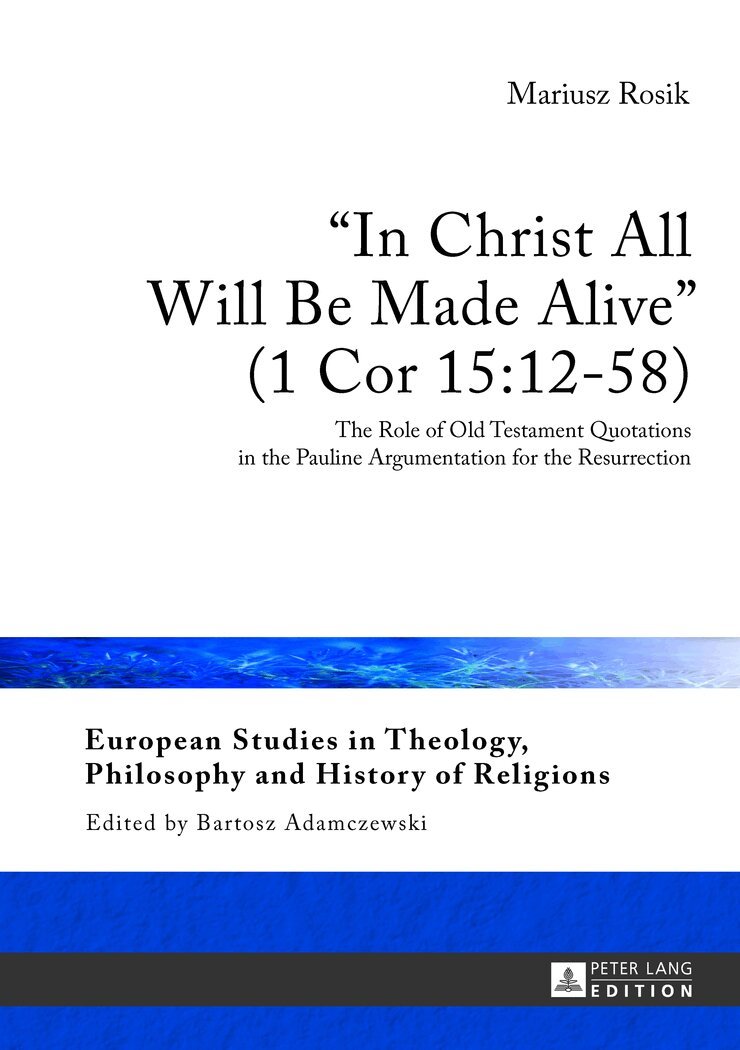
«In Christ All Will Be Made Alive» (1 Cor 15:12-58)
The Role of Old Testament Quotations in the Pauline Argumentation for the Resurrection
Inbunden, Engelska, 2013
600 kr
Tillfälligt slut
In his argumentation defending the resurrection of the dead, Paul reaches for the Old Testament. In this book the author discusses six Old Testament citations in 1 Cor 15:12-58. The analysis is based on three steps: identifying the source of a quotation, considering the phrase quoted in its direct OT context, and discussing its importance in various parts of 1 Cor 15:12-58. It should be noted that Paul changes the quotes for rhetorical purposes and also changes the context of the quoted fragments. It seems surprising that five of the quotations in the original context definitely do not speak about resurrection, and when exegetes today argue in support of resurrection, they reach for texts different from those that Paul chose in order to justify the hope for the rising of the dead.
Del 20 - European Studies in Theology, Philosophy and History of Religions
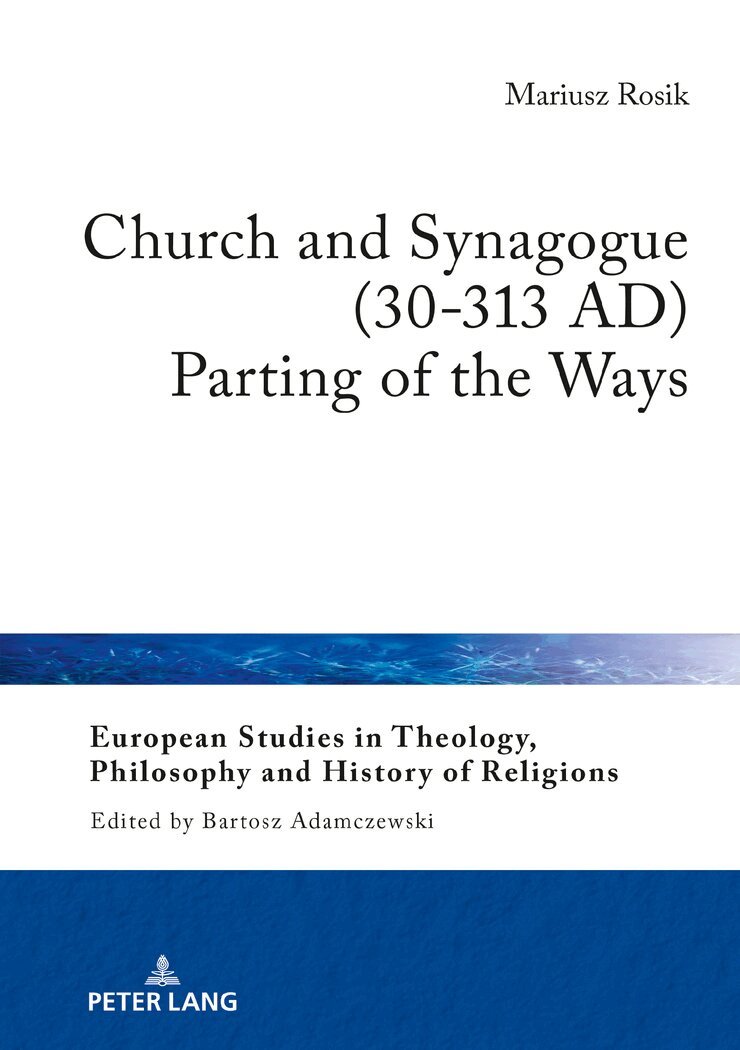
Church and Synagogue (30-313 AD)
Parting of the Ways
Inbunden, Engelska, 2019
870 kr
Skickas inom 5-8 vardagar
The separation of Church from Synagogue was not a one-time act, but a long-lasting, multilayered, and diversified process. The attempt to explain this process, namely the process of parting of the ways between Judaism and Christianity in the years 30–313 AD, constitutes the main research subject of this publication. The aim of this study is the presentation of the dynamism of Christian–Jewish relations in the first three centuries of the existence of the Church, taking into account mainly historical and theological (but not the only) factors which influenced these relations and finally led to the creation of two separate religions. The two religions existing side by side were in many aspects connected with each other mostly because both originated from biblical Judaism.