Mark Schuller - Böcker
Visar alla böcker från författaren Mark Schuller. Handla med fri frakt och snabb leverans.
12 produkter
12 produkter
681 kr
Skickas inom 5-8 vardagar
Homing Devices is a collection of ethnographies that address the central problem affecting not only the United States but also other developed and developing nations around the globe-affordable housing. These ethnographies cut across national and cultural borders, offering a diverse look at housing policies and practices as well as addressing the problems associated with providing or obtaining affordable housing. The studies incorporate perspectives of both policymakers and recipients and as such provide comparative insight into public housing policy programs and practices based on qualitative research. The collected experts provide an analysis of such problems as displacement, resettlement, policy implementation, collaborative planning, exclusionary practices, environmental racism, and silencing the voices of dissent. Editors Schuller and thomas-houston have assembled a strong volume that offers a fresh approach to discussing policy while bringing the particular problem of housing to the forefront in a way that will appeal to scholars of anthropology and social science, governmental policy departments, and activists from the general public across the nation.
1 570 kr
Skickas inom 7-10 vardagar
In Capitalizing on Catastrophe an international group of scholars and professionals critically examine how local communities around the world have prepared for and responded to recent cataclysms. The book's principal focus is the increasing trend to rely on the private sector to deal with natural disasters and other forms of large-scale devastation, from hurricanes and tsunamis to civil wars and industrial accidents. Called 'disaster capitalism' by its critics, the tendency to contract private interests to solve massive, urgent public problems may be inevitable but is extremely problematic_especially with respect to peoples who need help the most. Can private relief groups give the highest priority to potential and actual victims of large disasters, for example, if that means devoting fewer resources to protecting tourism and other profitable industries? The high-profile contributors to this volume straightforwardly tackle such timely and difficult questions of great public concern.
1 432 kr
Skickas inom 5-8 vardagar
Winner of the 2015 Margaret Mead Award from the American Anthropological Association and the Society for Applied AnthropologyAfter Haiti’s 2010 earthquake, over half of U.S. households donated to thousands of nongovernmental organizations (NGOs) in that country. Yet we continue to hear stories of misery from Haiti. Why have NGOs failed at their mission?Set in Haiti during the 2004 coup and aftermath and enhanced by research conducted after the 2010 earthquake, Killing with Kindness analyzes the impact of official development aid on recipient NGOs and their relationships with local communities. Written like a detective story, the book offers rich ethnographic comparisons of two Haitian women’s NGOs working in HIV/AIDS prevention, one with public funding (including USAID), the other with private European NGO partners. Mark Schuller looks at participation and autonomy, analyzing donor policies that inhibit these goals. He focuses on NGOs’ roles as intermediaries in “gluing” the contemporary world system together and shows how power works within the aid system as these intermediaries impose interpretations of unclear mandates down the chain-a process Schuller calls “trickle-down imperialism.”
397 kr
Skickas inom 5-8 vardagar
Winner of the 2015 Margaret Mead Award from the American Anthropological Association and the Society for Applied AnthropologyAfter Haiti’s 2010 earthquake, over half of U.S. households donated to thousands of nongovernmental organizations (NGOs) in that country. Yet we continue to hear stories of misery from Haiti. Why have NGOs failed at their mission?Set in Haiti during the 2004 coup and aftermath and enhanced by research conducted after the 2010 earthquake, Killing with Kindness analyzes the impact of official development aid on recipient NGOs and their relationships with local communities. Written like a detective story, the book offers rich ethnographic comparisons of two Haitian women’s NGOs working in HIV/AIDS prevention, one with public funding (including USAID), the other with private European NGO partners. Mark Schuller looks at participation and autonomy, analyzing donor policies that inhibit these goals. He focuses on NGOs’ roles as intermediaries in “gluing” the contemporary world system together and shows how power works within the aid system as these intermediaries impose interpretations of unclear mandates down the chain-a process Schuller calls “trickle-down imperialism.”
363 kr
Skickas inom 5-8 vardagar
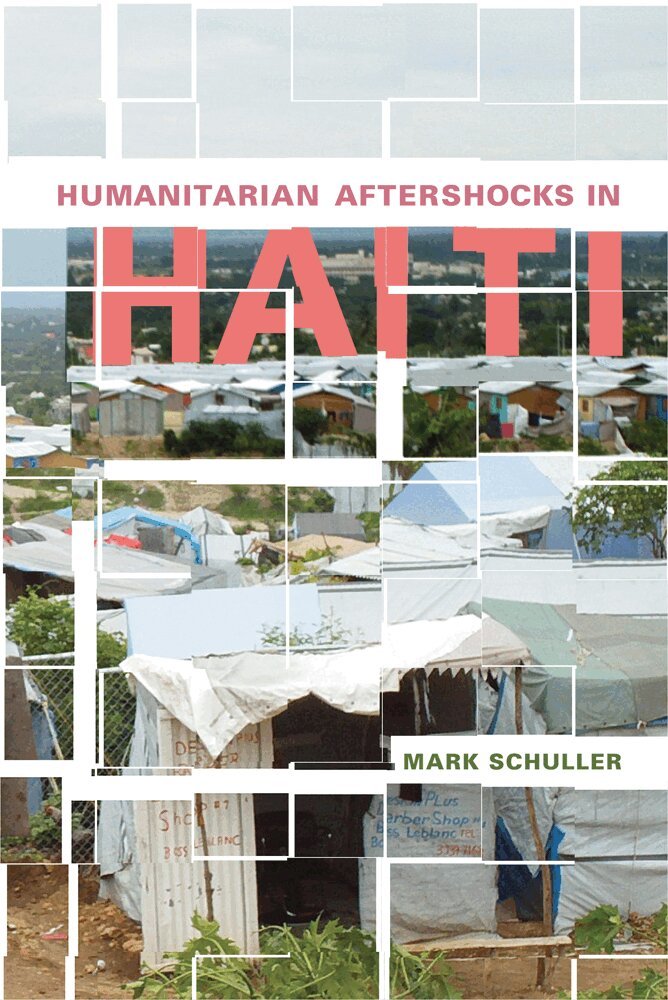
Winner of the 2016 Anthropology in Media Award from the American Anthropological Association The 2010 earthquake in Haiti was one of the deadliest disasters in modern history, sparking an international aid response-with pledges and donations of $16 billion-that was exceedingly generous. But now, five years later, that generous aid has clearly failed. In Humanitarian Aftershocks in Haiti, anthropologist Mark Schuller captures the voices of those involved in the earthquake aid response, and they paint a sharp, unflattering view of the humanitarian enterprise. Schuller led an independent study of eight displaced-persons camps in Haiti, compiling more than 150 interviews ranging from Haitian front-line workers and camp directors to foreign humanitarians and many displaced Haitian people. The result is an insightful account of why the multi-billion-dollar aid response not only did little to help but also did much harm, triggering a range of unintended consequences, rupturing Haitian social and cultural institutions, and actually increasing violence, especially against women. The book shows how Haitian people were removed from any real decision-making, replaced by a top-down, NGO-dominated system of humanitarian aid, led by an army of often young, inexperienced foreign workers. Ignorant of Haitian culture, these aid workers unwittingly enacted policies that triggered a range of negative results. Haitian interviewees also note that the NGOs “planted the flag,” and often tended to “just do something,” always with an eye to the “photo op” (in no small part due to the competition over funding). Worse yet, they blindly supported the eviction of displaced people from the camps, forcing earthquake victims to relocate in vast shantytowns that were hotbeds of violence. Humanitarian Aftershocks in Haiti concludes with suggestions to help improve humanitarian aid in the future, perhaps most notably, that aid workers listen to-and respect the culture of-the victims of catastrophe.
1 391 kr
Skickas inom 5-8 vardagar
Winner of the 2016 Anthropology in Media Award from the American Anthropological Association The 2010 earthquake in Haiti was one of the deadliest disasters in modern history, sparking an international aid response-with pledges and donations of $16 billion-that was exceedingly generous. But now, five years later, that generous aid has clearly failed. In Humanitarian Aftershocks in Haiti, anthropologist Mark Schuller captures the voices of those involved in the earthquake aid response, and they paint a sharp, unflattering view of the humanitarian enterprise. Schuller led an independent study of eight displaced-persons camps in Haiti, compiling more than 150 interviews ranging from Haitian front-line workers and camp directors to foreign humanitarians and many displaced Haitian people. The result is an insightful account of why the multi-billion-dollar aid response not only did little to help but also did much harm, triggering a range of unintended consequences, rupturing Haitian social and cultural institutions, and actually increasing violence, especially against women. The book shows how Haitian people were removed from any real decision-making, replaced by a top-down, NGO-dominated system of humanitarian aid, led by an army of often young, inexperienced foreign workers. Ignorant of Haitian culture, these aid workers unwittingly enacted policies that triggered a range of negative results. Haitian interviewees also note that the NGOs “planted the flag,” and often tended to “just do something,” always with an eye to the “photo op” (in no small part due to the competition over funding). Worse yet, they blindly supported the eviction of displaced people from the camps, forcing earthquake victims to relocate in vast shantytowns that were hotbeds of violence. Humanitarian Aftershocks in Haiti concludes with suggestions to help improve humanitarian aid in the future, perhaps most notably, that aid workers listen to-and respect the culture of-the victims of catastrophe.
Del 7 - Francophone Postcolonial Studies
Haiti Exception
Anthropology and the Predicament of Narrative
Inbunden, Engelska, 2016
2 119 kr
Skickas inom 7-10 vardagar
This collection of essays considers the means and extent ofHaiti’s ‘exceptionalization’ – its perception in multiple arenas asdefinitively unique with respect not only to the countries of the NorthAtlantic, but also to the rest of the Americas. Painted as repulsive andattractive, abject and resilient, singular and exemplary, Haiti has long beenframed discursively by an extraordinary epistemological ambivalence. Thisnation has served at once as cautionary tale, model for humanitarian aid anddevelopment projects and point of origin for general theorising of theso-called Third World. What to make of this dialectic of exemplarity andalterity? How to pull apart this multivalent narrative in order to examine itsconstituent parts? Conscientiously gesturing to James Clifford’s ThePredicament of Culture (1988), the contributors to The Haiti Exception workon the edge of multiple disciplines, notably that of anthropology, to take upthese and other such questions from a variety of methodological anddisciplinary perspectives, including Africana Studies, Anthrohistory, ArtHistory, Black Studies, Caribbean Studies, education, ethnology, JewishStudies, Literary Studies, Performance Studies and Urban Studies. Ascontributors revise and interrogate their respective praxes, they accept thechallenge of thinking about the particular stakes of and motivations for theirown commitment to Haiti.
1 956 kr
Skickas inom 3-6 vardagar
Contextualizing Disaster offers a comparative analysis of six recent "highly visible" disasters and several slow-burning, "hidden," crises that include typhoons, tsunamis, earthquakes, chemical spills, and the unfolding consequences of rising seas and climate change. The book argues that, while disasters are increasingly represented by the media as unique, exceptional, newsworthy events, it is a mistake to think of disasters as isolated or discrete occurrences. Rather, building on insights developed by political ecologists, this book makes a compelling argument for understanding disasters as transnational and global phenomena.
358 kr
Skickas inom 3-6 vardagar
Contextualizing Disaster offers a comparative analysis of six recent "highly visible" disasters and several slow-burning, "hidden," crises that include typhoons, tsunamis, earthquakes, chemical spills, and the unfolding consequences of rising seas and climate change. The book argues that, while disasters are increasingly represented by the media as unique, exceptional, newsworthy events, it is a mistake to think of disasters as isolated or discrete occurrences. Rather, building on insights developed by political ecologists, this book makes a compelling argument for understanding disasters as transnational and global phenomena.
Del 7 - Francophone Postcolonial Studies
Haiti Exception
Anthropology and the Predicament of Narrative
Häftad, Engelska, 2021
537 kr
Skickas inom 7-10 vardagar
This collection of essays considers the means and extent ofHaiti’s ‘exceptionalization’ – its perception in multiple arenas asdefinitively unique with respect not only to the countries of the NorthAtlantic, but also to the rest of the Americas. Painted as repulsive andattractive, abject and resilient, singular and exemplary, Haiti has long beenframed discursively by an extraordinary epistemological ambivalence. Thisnation has served at once as cautionary tale, model for humanitarian aid anddevelopment projects and point of origin for general theorising of theso-called Third World. What to make of this dialectic of exemplarity andalterity? How to pull apart this multivalent narrative in order to examine itsconstituent parts? Conscientiously gesturing to James Clifford’s ThePredicament of Culture (1988), the contributors to The Haiti Exception workon the edge of multiple disciplines, notably that of anthropology, to take upthese and other such questions from a variety of methodological anddisciplinary perspectives, including Africana Studies, Anthrohistory, ArtHistory, Black Studies, Caribbean Studies, education, ethnology, JewishStudies, Literary Studies, Performance Studies and Urban Studies. Ascontributors revise and interrogate their respective praxes, they accept thechallenge of thinking about the particular stakes of and motivations for theirown commitment to Haiti.
323 kr
Skickas inom 7-10 vardagar
Are we as a species headed towards extinction? As our economic system renders our planet increasingly inhospitable to human life, powerful individuals fight over limited resources, and racist reaction to migration strains the social fabric of many countries. How can we retain our humanity in the midst of these life-and-death struggles? Humanity’s Last Stand dares to ask these big questions, exploring the interconnections between climate change, global capitalism, xenophobia, and white supremacy. As it unearths how capitalism was born from plantation slavery and the slaughter of Indigenous people, it also invites us to imagine life after capitalism. The book teaches its readers how to cultivate an anthropological imagination, a mindset that remains attentive to local differences even as it identifies global patterns of inequality and racism. Surveying the struggles of disenfranchised peoples around the globe from frontline communities affected by climate change, to #BlackLivesMatter activists, to Indigenous water protectors, to migrant communities facing increasing hostility, anthropologist Mark Schuller argues that we must develop radical empathy in order to move beyond simply identifying as “allies” and start acting as “accomplices.” Bringing together the insights of anthropologists and activists from many cultures, this timely study shows us how to stand together and work toward a more inclusive vision of humanity before it’s too late.More information and instructor resources (https://humanityslaststand.org)
770 kr
Skickas inom 7-10 vardagar
Are we as a species headed towards extinction? As our economic system renders our planet increasingly inhospitable to human life, powerful individuals fight over limited resources, and racist reaction to migration strains the social fabric of many countries. How can we retain our humanity in the midst of these life-and-death struggles? Humanity’s Last Stand dares to ask these big questions, exploring the interconnections between climate change, global capitalism, xenophobia, and white supremacy. As it unearths how capitalism was born from plantation slavery and the slaughter of Indigenous people, it also invites us to imagine life after capitalism. The book teaches its readers how to cultivate an anthropological imagination, a mindset that remains attentive to local differences even as it identifies global patterns of inequality and racism. Surveying the struggles of disenfranchised peoples around the globe from frontline communities affected by climate change, to #BlackLivesMatter activists, to Indigenous water protectors, to migrant communities facing increasing hostility, anthropologist Mark Schuller argues that we must develop radical empathy in order to move beyond simply identifying as “allies” and start acting as “accomplices.” Bringing together the insights of anthropologists and activists from many cultures, this timely study shows us how to stand together and work toward a more inclusive vision of humanity before it’s too late.More information and instructor resources (https://humanityslaststand.org)