Markus Thiel – författare
1 416 kr
Läs direkt efter köp
1 084 kr
Skickas inom 10-15 vardagar
2 022 kr
Skickas inom 10-15 vardagar
643 kr
Skickas inom 10-15 vardagar
2 243 kr
Skickas inom 10-15 vardagar
786 kr
Skickas inom 10-15 vardagar
1 107 kr
Läs direkt efter köp
757 kr
Läs direkt efter köp
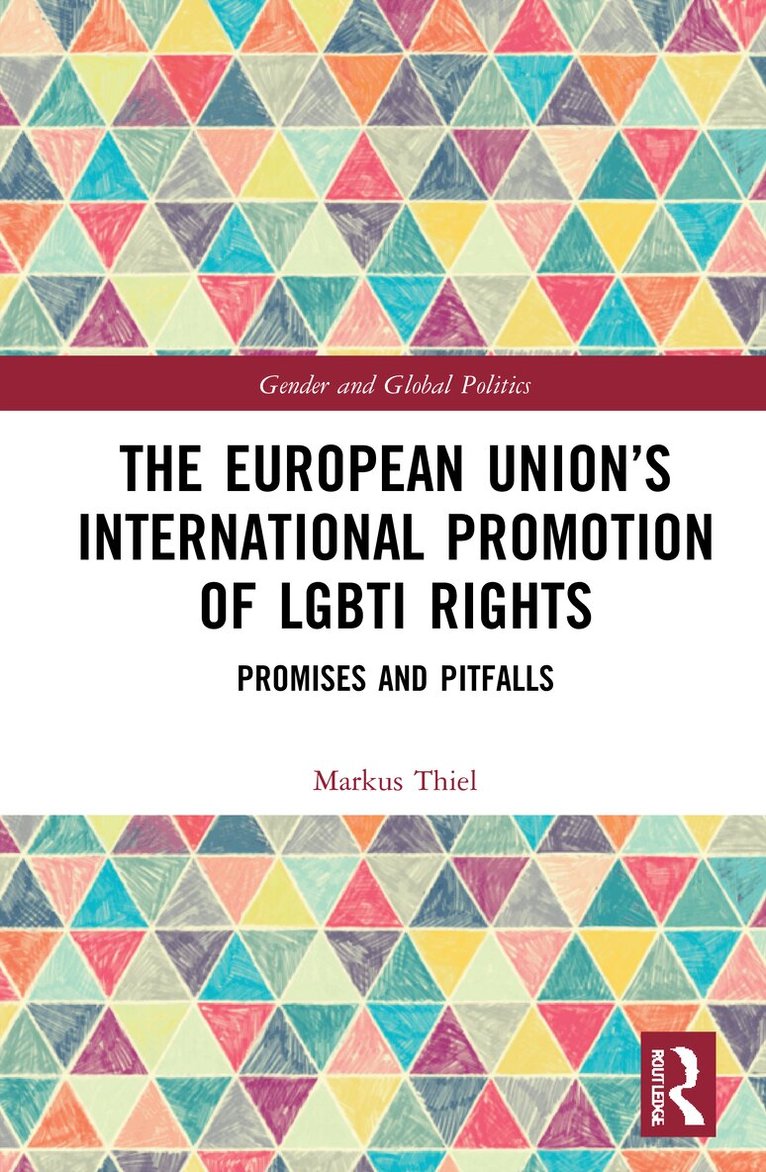
This book critically analyzes the European Union’s promotion of LGBTI rights in the international arena. Lesbian, Gay, Bisexual, Transgender, and Intersex rights are heavily contested across the globe, with over 70 countries criminalizing same-sex relations and at least 10 imposing the death penalty. The book details how the EU, based on different member state positions, attempts to jointly formulate and implement guidelines for the external promotion of LGBTI rights. It also problematizes the various normative and policy-based Eurocentric prescriptions to further these rights. Drawing on an international political sociology framework infused with queer theoretical thought, the author investigates the apparent normative tensions emerging from Europe’s promotion of LGBTI rights as liberal human rights and the ensuing pushback by culturally and politically conservative states. He examines the compatibility of EU institutional and member states’ conceptions of LGBTI rights and the more general question of the EU’s normative agenda-setting power on the world stage. He then explores the external policy areas in which LGBTI rights promotion is formulated and diffused – namely in development and foreign aid, in enlargement and neighbourhood policies, and in other international organizations. In conclusion, the author suggests viewing the contention surrounding LGBTI rights within broader governance contexts, and thus reimagining rights promotion in a more holistic manner. This book will be of great interest to students and scholars of LGBTI and Human Rights, European Politics, and International Relations.
730 kr
Läs direkt efter köp
This book critically analyzes the European Union’s promotion of LGBTI rights in the international arena. Lesbian, Gay, Bisexual, Transgender, and Intersex rights are heavily contested across the globe, with over 70 countries criminalizing same-sex relations and at least 10 imposing the death penalty. The book details how the EU, based on different member state positions, attempts to jointly formulate and implement guidelines for the external promotion of LGBTI rights. It also problematizes the various normative and policy-based Eurocentric prescriptions to further these rights. Drawing on an international political sociology framework infused with queer theoretical thought, the author investigates the apparent normative tensions emerging from Europe’s promotion of LGBTI rights as liberal human rights and the ensuing pushback by culturally and politically conservative states. He examines the compatibility of EU institutional and member states’ conceptions of LGBTI rights and the more general question of the EU’s normative agenda-setting power on the world stage. He then explores the external policy areas in which LGBTI rights promotion is formulated and diffused – namely in development and foreign aid, in enlargement and neighbourhood policies, and in other international organizations. In conclusion, the author suggests viewing the contention surrounding LGBTI rights within broader governance contexts, and thus reimagining rights promotion in a more holistic manner. This book will be of great interest to students and scholars of LGBTI and Human Rights, European Politics, and International Relations.
827 kr
Skickas inom 10-15 vardagar
827 kr
Skickas inom 10-15 vardagar
2 438 kr
Skickas inom 10-15 vardagar
714 kr
Skickas inom 10-15 vardagar
897 kr
Läs direkt efter köp
897 kr
Läs direkt efter köp
975 kr
Läs direkt efter köp
975 kr
Läs direkt efter köp
866 kr
Läs direkt efter köp
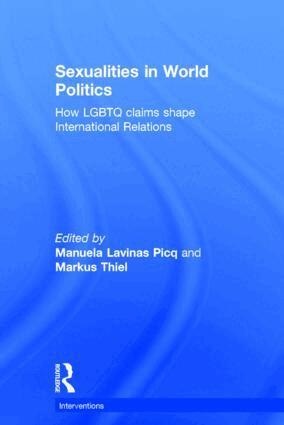
As LGBTQ claims acquire global relevance, how do sexual politics impact the study of International Relations? This book argues that LGBTQ perspectives are not only an inherent part of world politics but can also influence IR theory-making. LGBTQ politics have simultaneously gained international prominence in the past decade, achieving significant policy change, and provoked cultural resistance and policy pushbacks.
Sexuality politics, more so than gender-based theories, arrived late on the theoretical scene in part because sexuality and gender studies initially highlighted post-structuralist thinking, which was hardly accepted in mainstream political science. This book responds to a call for a more empirically motivated but also critical scholarship on this subject. It offers comparative case-studies from regional, cultural and theoretical peripheries to identify ways of rethinking IR. Further, it aims to add to critical theory, broadening the knowledge about previously unrecognized perspectives in an accessible manner. Being aware of preoccupations with the de-queering, disciplining nature of theory establishment in the social sciences, we critically reconsider IR concepts from a particular LGBTQ vantage point and infuse them with queer thinking. Considering the relative dearth of contemporary mainstream IR-theorizing, authors ask what contribution LGBTQ politics can provide for conceiving the political subject, as well as the international structure in which activism is embedded.
This book will be of interest to students and scholars of gender politics, cultural studies and international relations theory.
866 kr
Läs direkt efter köp
As LGBTQ claims acquire global relevance, how do sexual politics impact the study of International Relations? This book argues that LGBTQ perspectives are not only an inherent part of world politics but can also influence IR theory-making. LGBTQ politics have simultaneously gained international prominence in the past decade, achieving significant policy change, and provoked cultural resistance and policy pushbacks.
Sexuality politics, more so than gender-based theories, arrived late on the theoretical scene in part because sexuality and gender studies initially highlighted post-structuralist thinking, which was hardly accepted in mainstream political science. This book responds to a call for a more empirically motivated but also critical scholarship on this subject. It offers comparative case-studies from regional, cultural and theoretical peripheries to identify ways of rethinking IR. Further, it aims to add to critical theory, broadening the knowledge about previously unrecognized perspectives in an accessible manner. Being aware of preoccupations with the de-queering, disciplining nature of theory establishment in the social sciences, we critically reconsider IR concepts from a particular LGBTQ vantage point and infuse them with queer thinking. Considering the relative dearth of contemporary mainstream IR-theorizing, authors ask what contribution LGBTQ politics can provide for conceiving the political subject, as well as the international structure in which activism is embedded.
This book will be of interest to students and scholars of gender politics, cultural studies and international relations theory.
1 084 kr
Skickas inom 10-15 vardagar
2 269 kr
Skickas inom 10-15 vardagar
3 636 kr
Kommande
The Sage Handbook of Queer Studies Two Volume Collection offers a comprehensive and globally informed overview of the field, bringing together fifty chapters that map the foundations, developments, and future challenges of queer and LGBTQ+ scholarship. Spanning social theory, politics, history, geography, and cultural analysis, the handbook situates queer identities and experiences within their broader social, institutional, and political contexts rather than treating them as isolated cultural phenomena.
Across its two volumes, the handbook traces the emergence and consolidation of queer/LGBTQ+ studies in the academy, the deep connections between scholarship and activism, and the uneven global conditions shaping sexual rights and visibility. It also addresses newer debates around race, colonialism, political mainstreaming, and backlash, offering critical perspectives on the possibilities and limits of social change. Together, the volumes provide an essential interdisciplinary resource for understanding queer lives, politics, and knowledge production in a rapidly changing world.
Together these volumes offer a holistic overview of Queer Studies, from it’s foundations to it’s potential futures that researchers and scholars engaged in the field will find invaluable.
The Sage Handbook of Queer Studies: Volume One, Foundations, Emergence and Consolidations
Part One: Foundations and Consolidations
Part Two: Building Queer Communities: Spaces, Sex, and Identities
Part Three: The Impacts of LGBTQ Studies on Academic Disciplines
The Sage Handbook of Queer Studies: Volume Two, Developments, Challenges, and Futures
Part One: Seeing the Importance of Race through Intersectional and Postcolonial Impacts
Part Two: Queer Studies and Socio-Political Issues
Part Three: Future Challenges in Queer Studies
1 822 kr
Kommande
The Sage Handbook of Queer Studies: Volume One, Foundations, Emergence and Consolidations provides a wide-ranging, globally attentive overview of the contemporary field of Queer Studies, offering readers an analytical grounding in how social worlds shape queer identities and experiences. Recognising that no single text can be exhaustive, this volume assembles a major collection of scholarship that clarifies the scope and limits of disciplinary approaches, while also making the case for a more explicitly transdisciplinary understanding of sexualities. Across its chapters, Queer Studies is approached neither as “only” cultural studies nor as a narrow set of empirical facts, but as a field that requires humanistic, sociological, and political explanation in tandem.
This first volume begins by tracing the emergence and consolidation of Queer studies within the academy, foregrounding the inseparable relationship between queer experience, activism, and the growth of scholarly legitimacy. It shows how positionality and standpoint have been foundational to the development of queer research, and how collective organising has shaped political change as well as the intellectual agendas of the field. At the same time, the volume remains attentive to the “who, when, and where” of queer studies, highlighting how academic institutionalisation has been uneven, historically concentrated in the Global North, and shaped by broader social and political conditions including decriminalisation, shifting public attitudes, and the expansion of rights-based governance frameworks.
By mapping key areas of social and political research and following their chronological development, The Sage Handbook of Queer Studies Volume One offers a structured account of how Queer Studies took shape, how it became established across disciplines, and how its successes are accompanied by important limitations. This volume is an invaluable resource for researchers seeking to deepen their foundational knowledge of Queer Studies.
Part One: Foundations and Consolidations
Part Two: Building Queer Communities: Spaces, Sex, and Identities
Part Three: The Impacts of LGBTQ Studies on Academic Disciplines
1 822 kr
Kommande
The Sage Handbook of Queer Studies: Volume Two, Developments, Challenges, and Futures turns to the most urgent contemporary shifts shaping queer scholarship and queer life. Building on the foundations established in Volume One, this volume engages directly with the ways Queer Studies has been pushed, intellectually and politically, by more thorough attention to ethnicity, race, and on-going legacies of colonialism, and by growing recognition of how global power relations shape the production of knowledge about sexuality. It deepens the handbook’s transdisciplinary ambition by examining how queer identities and experiences are structured not only by culture and representation, but by governance, political struggle, institutional power, and global inequality.
Attuned to the changing political landscape, Volume Two explores the benefits and complications that have come with the political mainstreaming of queer existence and analysis. It examines what is gained when queer issues become more visible in public life and institutional settings, while also confronting the ways this visibility can produce new vulnerabilities, exclusions, and forms of expendability, particularly in a period marked by renewed authoritarianism and a widening global divide over LGBTQ+ rights. The volume reflects critically on how queer studies can remain reflexive about its own histories and locations, resisting assumptions that treat Western trajectories as universal models for sexual modernity, rights expansion, or scholarly development.
Concluding with the issues likely to shape the future of Queer Studies, The Sage Handbook of Queer Studies Volume Two positions the field at a pivotal moment: one in which both the possibilities and the limits of social change are increasingly visible, and in which the need for intersectional, decolonial, and globally aware scholarship is more pressing than ever. Together with Volume One, it demonstrates the full range of theoretical frameworks and empirical approaches that define Queer Studies and insists on the necessity of interdisciplinary thinking to understand sexualities in a rapidly changing world. This volume is a comprehensive resource for researchers to understand the challenges and futures of Queer Studies.
Part One: Seeing the Importance of Race through Intersectional and Postcolonial Impacts
Part Two: Queer Studies and Socio-Political Issues
Part Three: Future Challenges in Queer Studies
1 515 kr
Skickas inom 10-15 vardagar
1 891 kr
Läs direkt efter köp
“An excellent collection of essays that illustrate how EU member states’ wish to implement normatively inspired policies is confronted with the geopolitical realities of today’s world. The authors succeed in presenting an even-handed account of the way in which the tensions between norms and geopolitics play out, as well as of the responses given by EU policy makers.”—Wil Hout, International Institute of Social Studies, Erasmus University, the Netherlands
The European Union (EU), while collectively constituting the world’s largest development provider, has come under internal and external pressures over the past decade. This book argues that the EU’s development policies are situated between the bloc’s normative ideals and the global geopolitical realities in which it is embedded. In order to investigate these tensions, it asks how far the ''normative power'' Europe concept exists in EU development policies, and how far it is recognizable in the EU’s focus on human rights, the rule of law, and sustainability. In light of the tension in EU development policies between those ideals and the necessity to project neoliberal and geopolitical interests, how do receiving countries perceive the EU’s development efforts? This volume, complete with contributions from academics from a wide range of disciplines based all around the globe, provides answers to these essential questions.
1 515 kr
Skickas inom 10-15 vardagar
1 891 kr
Läs direkt efter köp
648 kr
Skickas inom 5-8 vardagar
1 515 kr
Skickas inom 10-15 vardagar