Marschark - Böcker
Visar alla böcker från författaren Marschark. Handla med fri frakt och snabb leverans.
3 produkter
3 produkter
1 919 kr
Skickas inom 5-8 vardagar
In recent years, the intersection of cognitive psychology, developmental psychology, and neuroscience with regard to deaf individuals has received increasing attention from a variety of academic and educational audiences. Both research and pedagogy have addressed questions about whether deaf children learn in the same ways that hearing children learn, how signed languages and spoken languages might affect different aspects of cognition and cognitive development, and the ways in which hearing loss influences how the brain processes and retains information. There are now a number of preliminary answers to these questions, but there has been no single forum in which research into learning and cognition is brought together. The Oxford Handbook of Deaf Studies in Learning and Cognition aims to provide this shared forum, focusing exclusively on learning, cognition, and cognitive development from theoretical, psychological, biological, linguistic, social-emotional, and educational perspectives. Each chapter includes state-of-the-art research conducted and reviewed by international experts in the area. Drawing this research together, this volume allows for a synergy of ideas that possesses the potential to move research, theory, and practice forward.
2 303 kr
Skickas inom 5-8 vardagar
Language development, and the challenges it can present for individuals who are deaf or hard-of-hearing, have long been a focus of research, theory, and practice in D/deaf studies and deaf education. Over the past 150 years, but most especially near the end of the 20th and beginning of the 21st century, advances in the acquisition and development of language competencies and skills have been increasing rapidly. This volume addresses many of those accomplishments as well as remaining challenges and new questions that have arisen from multiple perspectives: theoretical, linguistic, social-emotional, neuro-biological, and socio-cultural. The contributors comprise an international group of prominent scholars and practitioners from a variety of academic and clinical backgrounds. The result is a volume that addresses, in detail, current knowledge, emerging questions, and innovative educational practice in a variety of contexts. The volume takes on topics such as discussion of the transformation of efforts to identify a "best" language approach (the "sign" versus "speech" debate) to a stronger focus on individual strengths, potentials, and choices for selecting and even combining approaches; the effects of language on other areas of development as well as effects from other domains on language itself; and how neurological, socio-cognitive, and linguistic bases of learning are leading to more specialized approaches to instruction that address the challenges that remain for deaf and hard-of-hearing individuals. This volume both complements and extends The Oxford Handbook of Deaf Studies and Deaf Education, Volumes 1 and 2, going further into the unique challenges and demands for deaf or hard-of-hearing individuals than any other text and providing not only compilations of what is known but setting the course for investigating what is still to be learned.
488 kr
Skickas inom 5-8 vardagar
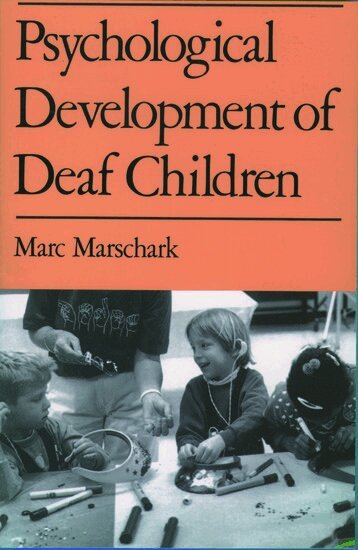
This volume provides the first comprehensive examination of deaf children's development. In examining its role from the pre-natal period to adulthood, deafness becomes a potential determiner of differences in social and cognitive functioning. Special attention is given to the role of interpersonal communication between deaf children and their parents, peers, and teachers. The majority of deaf children (those with hearing parents) have relatively little linguistic communication with their parents, but the apparent effects of this situation go far beyond language. Deaf children may develop social and cognitive strategies for dealing with the world that differ from those developed by hearing children. The existence of such differences need not imply that deaf children are any less capable than hearing peers, but a variety of studies have revealed that they lag behind hearing age-mates in several areas. A careful and balanced consideration of existing evidence concerning deafness and development provides a new psychological perspective on deaf children and deafness in light of recent findings concerning manual communication, parent-child interactions, and intellectual and academic assessments of hearing impaired children. The result is an integrated understanding of social, language, and cognitive development as they are affected by childhood deafness and by each other. In this context, several popular assumptions about deaf children - some in their favour, some against - are found to lack any basis in fact, and several new discoveries are evident.