Martin A. Guest – författare
Visar alla böcker från författaren Martin A. Guest. Handla med fri frakt och snabb leverans.
7 produkter
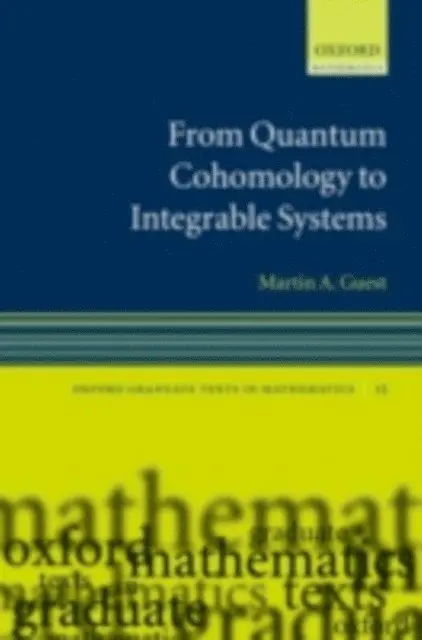
From Quantum Cohomology to Integrable Systems
E-bok, 2008
757 kr
Lägg i varukorg
Quantum cohomology has its origins in symplectic geometry and algebraic geometry, but is deeply related to differential equations and integrable systems. This text explains what is behind the extraordinary success of quantum cohomology, leading to its connections with many existing areas of …
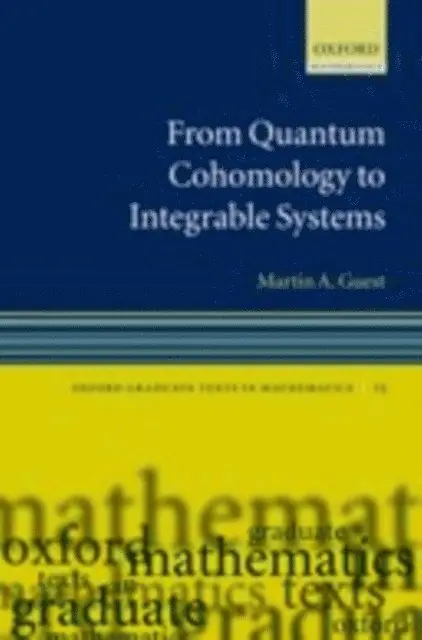
From Quantum Cohomology to Integrable Systems
E-bok, 2008
678 kr
Lägg i varukorg
Quantum cohomology has its origins in symplectic geometry and algebraic geometry, but is deeply related to differential equations and integrable systems. This text explains what is behind the extraordinary success of quantum cohomology, leading to its connections with many existing areas of …
From Quantum Cohomology to Integrable Systems
Inbunden, 2008
1898 kr
Lägg i varukorg
Quantum cohomology has its origins in symplectic geometry and algebraic geometry, but is deeply related to differential equations and integrable systems. This text explains what is behind the extraordinary success of quantum cohomology, leading to its connections with many existing areas of …
Harmonic Maps, Loop Groups, and Integrable Systems
Av Martin A. Guest, C. M. Series
Inbunden, 1997
1905 kr
Lägg i varukorg
Harmonic maps are generalisations of the concept of geodesics. They encompass many fundamental examples in differential geometry and have recently become of widespread use in many areas of mathematics and mathematical physics. This is an accessible introduction to some of the fundamental …
Harmonic Maps, Loop Groups, and Integrable Systems
Av Martin A. Guest, C. M. Series m. fl.
Häftad, 1997
830 kr
Lägg i varukorg
Harmonic maps are generalisations of the concept of geodesics. They encompass many fundamental examples in differential geometry and have recently become of widespread use in many areas of mathematics and mathematical physics. This is an accessible introduction to some of the fundamental …
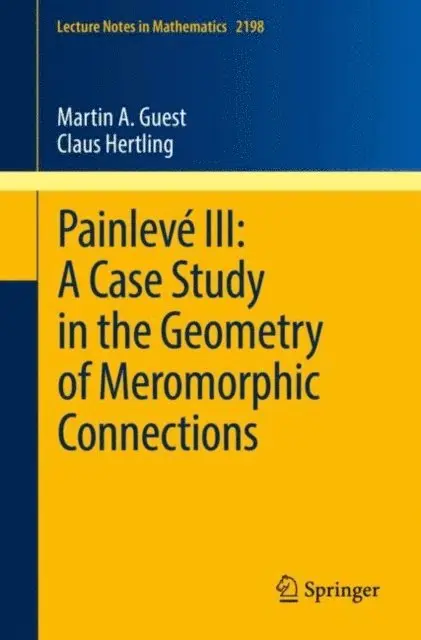
Painlevé III: A Case Study in the Geometry of Meromorphic Connections
Av Martin A. Guest, Claus Hertling
Häftad, 2017
420 kr
Lägg i varukorg
The purpose of this monograph is two-fold: it introduces a conceptual language for the geometrical objects underlying Painlevé equations, and it offers new results on a particular Painlevé III equation of type PIII (D6), called PIII (0, 0, 4, −4), describing its relation to isomonodromic families …
Painleve III: A Case Study in the Geometry of Meromorphic Connections
Av Claus Hertling, Martin A. Guest
E-bok, 2017
538 kr
Lägg i varukorg
The purpose of this monograph is two-fold: it introduces a conceptual language for the geometrical objects underlying Painlevé equations, and it offers new results on a particular Painlevé III equation of type PIII (D6), called PIII (0, 0, 4, −4), describing its relation to isomonodromic families …