Martin C. Henson - Böcker
Visar alla böcker från författaren Martin C. Henson. Handla med fri frakt och snabb leverans.
3 produkter
3 produkter
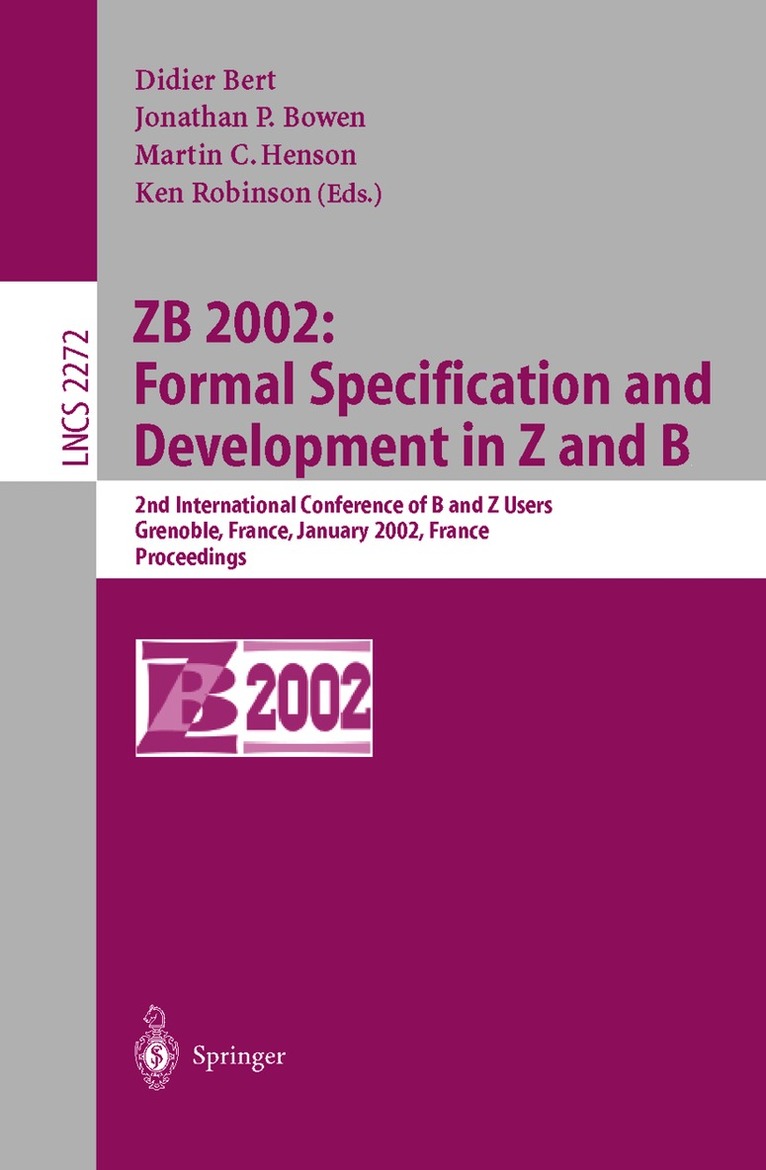
ZB 2002: Formal Specification and Development in Z and B
2nd International Conference of B and Z Users Grenoble, France, January 23-25, 2002, Proceedings
Häftad, Engelska, 2002
538 kr
Skickas inom 10-15 vardagar
These proceedings record the papers presented at the second International Conference of B and Z Users (ZB2002), held on 23-25 January 2002 in the city of Grenoble in the heart of the French Alps. This conference built on the success of the rst con- rence in this series, ZB2000, held at the University ofYork in the UK. The location of ZB2002 in Grenoble re ects the important work in the area of formal methods carried out at the Laboratoire Logiciels Systemes ' Reseaux ' within the Institut d'Informatique et Mathematiques ' Appliquees ' de Grenoble (LSR-IMAG), especially involving the B method. B and Z are two important formal methods that share a common conceptual o- gin; each are leading approaches applied in industry and academia for the speci cation and development (using formal re nement) of computer-based systems. At ZB2002 the B and Z communities were brought together to hold a second joint conference that simultaneously incorporated the 13th International Z User Meeting and the 4th Int- national Conference on the B method.Although organized logistically as an integral event, editorial control of the joint conference remained vested in two separate but c- perating program committees that respectively determined its B and Z content, but in a coordinated manner.
1 632 kr
Skickas inom 10-15 vardagar
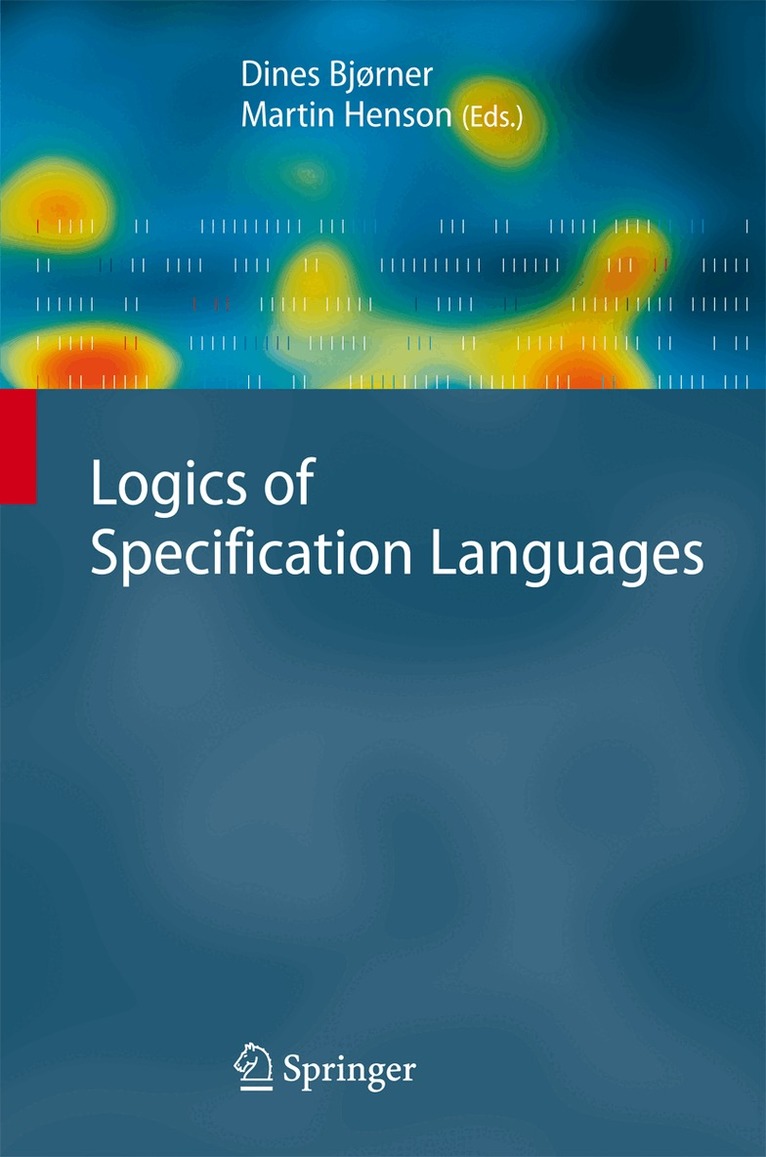
By a specification language we understand a formal system of syntax, semantics and proof rules. The syntax and semantics define a language; the proof rules define a proof system. Specifications are expressions in the language, and reasoning over properties of these specifications is done within the proof system. This book presents comprehensive studies on nine specification languages and their logics of reasoning.The editors and authors are authorities on these specification languages and their application. Dedicated chapters address: the use of ASM (Abstract State Machines) in the classroom; the Event-B modelling method; a methodological guide to CafeOBJ logic; CASL, the Common Algebraic Specification Language; the Duration Calculus; the logic of the RAISE specification language (RSL); the specification language TLA+; the typed logic of partial functions and the Vienna Development Method (VDM); and Z logic and its applications. Each chapter is self-contained, with references, and symbol and concept indexes. Finally, in a unique feature, the book closes with short commentaries on the specification languages written by researchers closely associated with their original development.With extensive references and pointers to future developments, this book will be of interest to researchers and graduate students engaged with formal specification languages.
1 632 kr
Skickas inom 10-15 vardagar
By a specification language we understand a formal system of syntax, semantics and proof rules. The syntax and semantics define a language; the proof rules define a proof system. Specifications are expressions in the language, and reasoning over properties of these specifications is done within the proof system. This book presents comprehensive studies on nine specification languages and their logics of reasoning.The editors and authors are authorities on these specification languages and their application. Dedicated chapters address: the use of ASM (Abstract State Machines) in the classroom; the Event-B modelling method; a methodological guide to CafeOBJ logic; CASL, the Common Algebraic Specification Language; the Duration Calculus; the logic of the RAISE specification language (RSL); the specification language TLA+; the typed logic of partial functions and the Vienna Development Method (VDM); and Z logic and its applications. Each chapter is self-contained, with references, and symbol and concept indexes. Finally, in a unique feature, the book closes with short commentaries on the specification languages written by researchers closely associated with their original development.With extensive references and pointers to future developments, this book will be of interest to researchers and graduate students engaged with formal specification languages.