Martin Edelman - Böcker
Visar alla böcker från författaren Martin Edelman. Handla med fri frakt och snabb leverans.
2 produkter
2 produkter
575 kr
Skickas inom 10-15 vardagar
In this clearly written and argued analysis of the various Israeli court systems, Martin Edelman probes a fundamental issue: whether those courts protect human rights while fostering the development of a common, inclusive national culture. Edelman's work is based on the assumption that courts are important agencies of government and that, like other governmental isntitutions in a democracy, courts have an inter-active relationship with a society's political culture. Isreal does not have an integrated court system. The courts of the 14 recognised religions have exclusive jurisdiction over members of their communities on matters of marriage and divorce. The civil courts have basic jurisdiction over criminal, civil and public law controversies. Palestinians in the occupied areas who are accused of acts against Israeli security are tried in the military courts. Moreover, Israel lacks the organising structure and directing force provided by a written constitution. Edelman describes the origins of Israel's courts and places them within the broader ocntext of Israel's unique history. He examines Israel's commitment to the rule of law and the various pressures upon the Israeli Supreme Court to define its legal and political culture in the absence of a written constitution and the power of American-style judicial review. He charts the pressures created by Israel's attempts to accommodate the interests of orthodox and non-orthodox Jews, Muslims and Druzes as well as the pressures generated by the nation's national security needs. Edelman demonstrates how the military and religious courts reinforce Israel's character as an ethnic democracy - a Jewish state that recognises and protects individual rights while simultaneously permitting group identity to materially affect citizen status. ""Courts, Politics, and Culture in Israel"" is an important contribution to the study of comparative constitutionalism and judicial politics.
416 kr
Tillfälligt slut
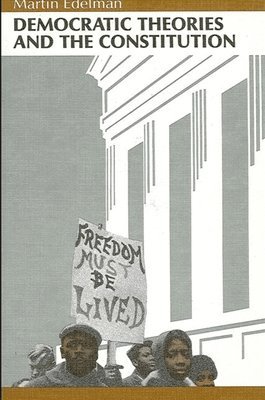
Although the government of the United States is traditionally viewed as a democracy, there is considerable disagreement about what democracy means and implies. In a comprehensive study Professor Edelman examines the three democratic paradigms most prevalent in America today: natural rights, contract, and competition. Theories based on these paradigms lead to different ideas of democracy, each of which yields variant interpretations of the Constitution. This close relationship between democratic theories and constitutional interpretations is analyzed in an extensive historical introduction, which focuses on some of the major thinkers in American history.Edelman's discussion shows that neither the Constitution nor the development of American political thought can serve as an authoritative basis for any one theory of democracy. Instead of a particular theory, the historical constant was an appeal to reason inherent in our basic charter. In his methodological section, Edelman argues that we must use reason to clarify the latent values inherent in the differing concepts of democracy and the consequences that flow from them. He analyzes judicial ideas in the light of three concepts deemed central to any democratic theory-citizenship, political participation, and political freedom-and concludes with a balanced account of contemporary democratic theories, the constitutional theories related to them, and a critique of both.