Martin King Whyte - Böcker
Visar alla böcker från författaren Martin King Whyte. Handla med fri frakt och snabb leverans.
8 produkter
8 produkter
2 103 kr
Skickas inom 10-15 vardagar
This book examines the American system of dating, mate choice, and marriage. It analyzes a wide range of established ideas about how dating and mate choice are changing, and identifies changes and continuities in premarital experiences in twentieth century America. A variety of ideas about what sorts of dating and premarital experiences will make for a successful marriage are tested and for the most part disproven, raising serious doubts about our fundamental assumption that dating experience helps individuals make a "wise" choice for a future mate. Marital success turns out to depend not so much on premarital experiences or on the social background characteristics of couples (such as race, religion, and social class) as on the way in which couples structure their day-to-day marital life together. Through its detailed examination of a wide range of ideas and predictions about dating, mating, and marriage, and through its dramatic findings, Dating, Mating, and Marriage challenges many previous assumptions and conclusions about the fate of American marriage and elevates our knowledge of the American system of mate choice to a higher level.
676 kr
Skickas inom 10-15 vardagar
This book examines the American system of dating, mate choice, and marriage. It analyzes a wide range of established ideas about how dating and mate choice are changing, and identifies changes and continuities in premarital experiences in twentieth century America. A variety of ideas about what sorts of dating and premarital experiences will make for a successful marriage are tested and for the most part disproven, raising serious doubts about our fundamental assumption that dating experience helps individuals make a "wise" choice for a future mate. Marital success turns out to depend not so much on premarital experiences or on the social background characteristics of couples (such as race, religion, and social class) as on the way in which couples structure their day-to-day marital life together. Through its detailed examination of a wide range of ideas and predictions about dating, mating, and marriage, and through its dramatic findings, Dating, Mating, and Marriage challenges many previous assumptions and conclusions about the fate of American marriage and elevates our knowledge of the American system of mate choice to a higher level.
337 kr
Skickas inom 7-10 vardagar
After 1949 the Chinese Communists carried out land reform, the collectivization of agriculture, and the formation of people's communes. The new economic and political organizations that emerged have made peasant life more comfortable and secure, but many economic and status differentials and traditional customs remain resistant to change. Focusing on rural Kwangtung province, William L. Parish and Martin King Whyte examine the rural work-incentive system, village equality and inequality, rural health care and education, marriage customs, and the position of women, among other topics, to determine what and how much of the traditional Chinese ways of life is left in Communist China.
431 kr
Skickas inom 7-10 vardagar
Through interviews with city residents, Martin King Whyte and William L. Parish provide a unique survey of urban life in the last decade of Mao Zedong's rule. They conclude that changes in society produced under communism were truly revolutionary and that, in the decade under scrutiny, the Chinese avoided ostensibly universal evils of urbanism with considerable success. At the same time, however, they find that this successful effort spawned new and equally serious urban problems—bureaucratic rigidity, low production, and more.
665 kr
Skickas inom 3-6 vardagar
Martin King Whyte’s Small Groups and Political Rituals in China examines how the Chinese Communist Party transformed Sun Yat-sen’s lament about China as a “sheet of loose sand” into a system of remarkable social cohesion. Whyte’s central argument is that political elites achieved this by embedding citizens in hsiao-tsu (small groups of 8–15 people) across nearly all institutions—factories, schools, communes, offices, labor camps, and military units—and by requiring them to participate in political rituals of study, criticism, and self-criticism. These rituals, grounded in Maoist ideology, mobilized peer pressure to reshape attitudes and behavior, creating an organizational model distinct from both Soviet and Western practices. Rather than spontaneous communities, these groups were deliberately designed and supervised by higher authorities, ensuring that even remote or socially marginal individuals were drawn into political life. Whyte contends that the combination of daily work with ritualized political activity generated a “strict political atmosphere” intended to secure compliance and foster ideological transformation.Because China’s closed environment prevented direct fieldwork, Whyte relies on intensive interviews with 101 recent refugees in Hong Kong (1968–69), cross-checked against early 1950s Party pamphlets that prescribed how hsiao-tsu should function. Using these prescriptive texts as benchmarks, he develops case studies across five organizational settings—government offices, schools, rural communes, factories, and corrective labor camps—to analyze how closely actual practice matched the ideal. His method is inductive: instead of testing Western small-group hypotheses, he builds generalizations about when and why hsiao-tsu succeeded or faltered in reshaping members’ conduct. Differences among cases reveal how organizational structure, leadership, and external pressures shaped outcomes. Ultimately, Whyte shows that small groups and rituals were crucial in the Communist project of national integration and mobilization, but their effectiveness varied with context, and persistent obstacles limited their capacity to fully unify society. The book provides both a portrait of China’s distinctive organizational strategies and a broader reflection on how states use ritual and group dynamics to transform political culture.This title is part of UC Press's Voices Revived program, which commemorates University of California Press’s mission to seek out and cultivate the brightest minds and give them voice, reach, and impact. Drawing on a backlist dating to 1893, Voices Revived makes high-quality, peer-reviewed scholarship accessible once again using print-on-demand technology. This title was originally published in 1974.
1 469 kr
Skickas inom 3-6 vardagar
Martin King Whyte’s Small Groups and Political Rituals in China examines how the Chinese Communist Party transformed Sun Yat-sen’s lament about China as a “sheet of loose sand” into a system of remarkable social cohesion. Whyte’s central argument is that political elites achieved this by embedding citizens in hsiao-tsu (small groups of 8–15 people) across nearly all institutions—factories, schools, communes, offices, labor camps, and military units—and by requiring them to participate in political rituals of study, criticism, and self-criticism. These rituals, grounded in Maoist ideology, mobilized peer pressure to reshape attitudes and behavior, creating an organizational model distinct from both Soviet and Western practices. Rather than spontaneous communities, these groups were deliberately designed and supervised by higher authorities, ensuring that even remote or socially marginal individuals were drawn into political life. Whyte contends that the combination of daily work with ritualized political activity generated a “strict political atmosphere” intended to secure compliance and foster ideological transformation.Because China’s closed environment prevented direct fieldwork, Whyte relies on intensive interviews with 101 recent refugees in Hong Kong (1968–69), cross-checked against early 1950s Party pamphlets that prescribed how hsiao-tsu should function. Using these prescriptive texts as benchmarks, he develops case studies across five organizational settings—government offices, schools, rural communes, factories, and corrective labor camps—to analyze how closely actual practice matched the ideal. His method is inductive: instead of testing Western small-group hypotheses, he builds generalizations about when and why hsiao-tsu succeeded or faltered in reshaping members’ conduct. Differences among cases reveal how organizational structure, leadership, and external pressures shaped outcomes. Ultimately, Whyte shows that small groups and rituals were crucial in the Communist project of national integration and mobilization, but their effectiveness varied with context, and persistent obstacles limited their capacity to fully unify society. The book provides both a portrait of China’s distinctive organizational strategies and a broader reflection on how states use ritual and group dynamics to transform political culture.This title is part of UC Press's Voices Revived program, which commemorates University of California Press’s mission to seek out and cultivate the brightest minds and give them voice, reach, and impact. Drawing on a backlist dating to 1893, Voices Revived makes high-quality, peer-reviewed scholarship accessible once again using print-on-demand technology. This title was originally published in 1974.
367 kr
Skickas inom 7-10 vardagar
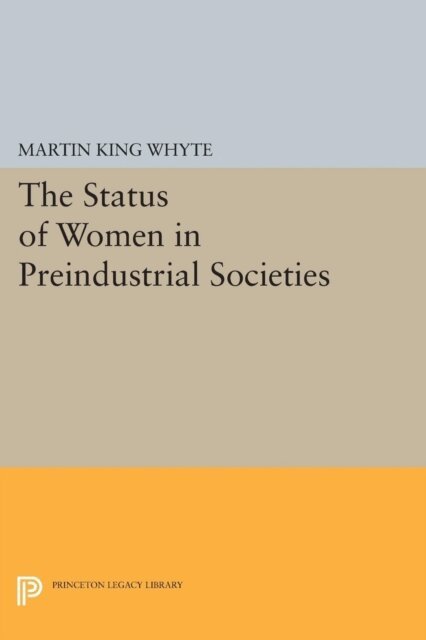
How does the status of women in different cultures actually compare with that of men? How does this position vary from one realm--religious, political, economic, domestic, or sexual--to another? To examine these questions, Martin King Whyte draws on a cross-cultural sample of 93 preindustrial societies throughout the world. His analysis describes women's roles in historical perspective, offering a much-needed foundation for feminist scholarship as well as provocative thoughts about the future. To determine why women fare better in some societies than others, Professor Whyte compares data from cultures ranging from small, preliterate hunting bands to the capitals of the Inca and Roman empires. This ethnographic material makes possible a systematic review of the diverse roles of women and also enables the author to test many of the theories advanced to explain the situation of women today. Some of the specific questions considered are: Does male supremacy have its origins in the hunting way of life of our distant ancestors? Are women always inferior to men? Do women have superior status in cultures where they produce much food and thereby play an important economic role?Has the position of women improved over the course of human evolution? Originally published in 1978. The Princeton Legacy Library uses the latest print-on-demand technology to again make available previously out-of-print books from the distinguished backlist of Princeton University Press. These editions preserve the original texts of these important books while presenting them in durable paperback and hardcover editions. The goal of the Princeton Legacy Library is to vastly increase access to the rich scholarly heritage found in the thousands of books published by Princeton University Press since its founding in 1905.
1 608 kr
Skickas inom 3-6 vardagar
How does the status of women in different cultures actually compare with that of men? How does this position vary from one realm--religious, political, economic, domestic, or sexual--to another? To examine these questions, Martin King Whyte draws on a cross-cultural sample of 93 preindustrial societies throughout the world. His analysis describes women's roles in historical perspective, offering a much-needed foundation for feminist scholarship as well as provocative thoughts about the future. To determine why women fare better in some societies than others, Professor Whyte compares data from cultures ranging from small, preliterate hunting bands to the capitals of the Inca and Roman empires. This ethnographic material makes possible a systematic review of the diverse roles of women and also enables the author to test many of the theories advanced to explain the situation of women today. Some of the specific questions considered are: Does male supremacy have its origins in the hunting way of life of our distant ancestors? Are women always inferior to men? Do women have superior status in cultures where they produce much food and thereby play an important economic role?Has the position of women improved over the course of human evolution? Originally published in 1978. The Princeton Legacy Library uses the latest print-on-demand technology to again make available previously out-of-print books from the distinguished backlist of Princeton University Press. These editions preserve the original texts of these important books while presenting them in durable paperback and hardcover editions. The goal of the Princeton Legacy Library is to vastly increase access to the rich scholarly heritage found in the thousands of books published by Princeton University Press since its founding in 1905.