Mary E. Gardiner - Böcker
Visar alla böcker från författaren Mary E. Gardiner. Handla med fri frakt och snabb leverans.
4 produkter
4 produkter
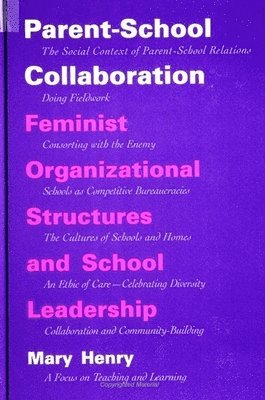
Parent-School Collaboration
Feminist Organizational Structures and School Leadership
Häftad, Engelska, 1996
566 kr
Skickas inom 3-6 vardagar
Examines in close detail public schools' relationships with their parents and communities.Mary E. Henry examines in close detail public schools' relationships with parents and communities. Using an anthropological approach and feminist theory, she argues that for educators, knowledge of family and social contexts, and work with communities is essential. Henry argues convincingly that the school structure has to change, that more demands can't be made of parents while schools remain the same. For school administrators, teachers, parents, and those interested in public policy, the book addresses vital questions about cultural and social understandings, empowerment, and the possibilities for collaboration. This book is a source of new practices and ideas for organizational structures, and the school leadership that will be needed for collaboration to really work.
372 kr
Tillfälligt slut
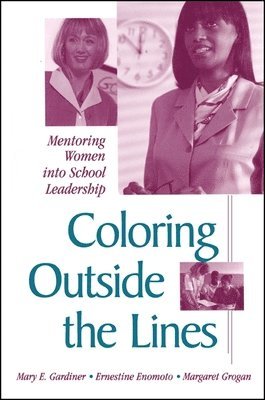
Presents new practices and ideas for mentoring women for school leadership positions.Coloring outside the Lines critically looks at mentoring from the perspective of women who have been historically marginalized in school leadership, and grounds itself in a variety of experiences, including those of women school leaders of color. Using a feminist poststructuralist framework, the authors deconstruct the mentoring of women within the culture of K-12 public school administration in which they work. Providing arguments that mentoring has been and can be discriminatory, the authors explore it as a vehicle for transformation and change in education leadership rather than abandoning it completely.
1 027 kr
Tillfälligt slut
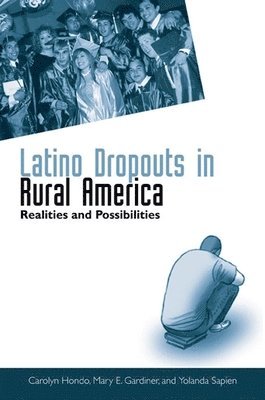
Latino high school students in rural communities talk about dropping out of school.This book affords Latino high school dropouts from rural communities in Idaho the opportunity to tell their stories in their own words. It candidly reveals students' school experiences, explores why students leave school, and looks at the impact of the No Child Left Behind Act (2001). Four of the nine students interviewed for the book passed NCLB-mandated state graduation tests, two others passed two of three sections, and all were capable of achieving success in school. The decision to leave school was connected with students' seeking personal satisfaction and to reduce the social-psychological pain of schooling. In certain cases principals and teachers blamed the Latino students for disadvantaging the school. Latino Dropouts in Rural America presents a systematic approach for addressing the main problem: a lack of cultural responsiveness in school curriculum, instruction, policies, and practices. The leadership plan recommended by the authors will help educators to understand the lives of rural Latino youth and to critique their own schools.
365 kr
Tillfälligt slut
Latino high school students in rural communities talk about dropping out of school.This book affords Latino high school dropouts from rural communities in Idaho the opportunity to tell their stories in their own words. It candidly reveals students' school experiences, explores why students leave school, and looks at the impact of the No Child Left Behind Act (2001). Four of the nine students interviewed for the book passed NCLB-mandated state graduation tests, two others passed two of three sections, and all were capable of achieving success in school. The decision to leave school was connected with students' seeking personal satisfaction and to reduce the social-psychological pain of schooling. In certain cases principals and teachers blamed the Latino students for disadvantaging the school. Latino Dropouts in Rural America presents a systematic approach for addressing the main problem: a lack of cultural responsiveness in school curriculum, instruction, policies, and practices. The leadership plan recommended by the authors will help educators to understand the lives of rural Latino youth and to critique their own schools.