Mary Poovey - Böcker
Visar alla böcker från författaren Mary Poovey. Handla med fri frakt och snabb leverans.
8 produkter
8 produkter
332 kr
Skickas inom 7-10 vardagar
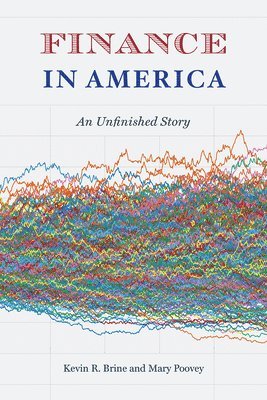
The economic crisis of 2008 led to an unprecedented focus on the world of high finance and revealed it to be far more arcane and influential than most people could ever have imagined. Any hope of avoiding future crises, it's clear, rest on understanding finance itself. To understand finance, however, we have to learn its history, and this book fills that need. Kevin R. Brine, an industry veteran, and Mary Poovey, an acclaimed historian, show that finance as we know it today emerged gradually in the late nineteenth century and only coalesced after World War II, becoming ever more complicated and ever more central to the American economy. The authors explain the models, regulations, and institutions at the heart of modern finance and uncover the complex and sometimes surprising origins of its critical features, such as corporate accounting standards, the Federal Reserve System, risk management practices, and American Keynesian and New Classic monetary economics. This book sees finance through its highs and lows, from pre-Depression to post-Recession, exploring the myriad ways in which the practices of finance and the realities of the economy influenced one another through the years.A masterwork of collaboration, Finance in America lays bare the theories and practices that constitute finance, opening up the discussion of its role and risks to a broad range of scholars and citizens.
711 kr
Tillfälligt slut
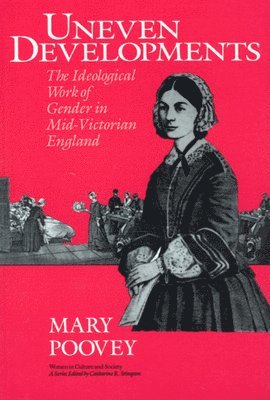
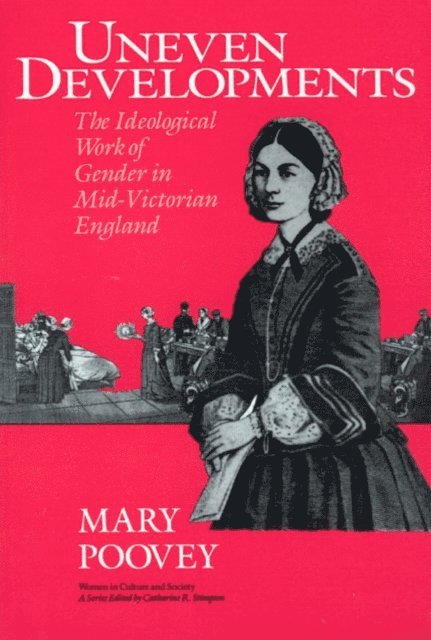
This study examines one of the conditions that made the development of a mass culture in Victorian Britain possible: the representation of the population as an aggregate - a social body. Drawing on both literature and social reform texts, the author analyzes the organization of knowledge during this period and explores its role in the emergence of the idea of the social body. The text illuminates the ways literary genres, such as the novel, and innovations in social thought, such as statistical thinking and anatomical realism, helped separate social concerns from the political and economic domains. The author then discusses the influence of the social body concept on Victorian ideas about the role of the state, examining writings by James Phillips Kay, Thomas Chalmers and Edwin Chadwick on regulating the poor. Analyzing the conflict between Kay's idea of the social body and Babbage's image of the social machine, she considers the implications of both models for the place of Victorian women.Poovey's readings of Disraeli's "Coningsby", Gaskell's "Mary Barton", and Dickens's "Our Mutual Friend" show that the novel as a genre exposed the role gender played in contemporary discussions of poverty and wealth. The study argues that gender, race and class should be considered in the context of broader concerns such as how social authority is distributed, how institutions formalize knowledge and how truth is defined.
275 kr
Skickas inom 7-10 vardagar
This study examines one of the conditions that made the development of a mass culture in Victorian Britain possible: the representation of the population as an aggregate - a social body. Drawing on both literature and social reform texts, the author analyzes the organization of knowledge during this period and explores its role in the emergence of the idea of the social body. The text illuminates the ways literary genres, such as the novel, and innovations in social thought, such as statistical thinking and anatomical realism, helped separate social concerns from the political and economic domains. The author then discusses the influence of the social body concept on Victorian ideas about the role of the state, examining writings by James Phillips Kay, Thomas Chalmers and Edwin Chadwick on regulating the poor. Analyzing the conflict between Kay's idea of the social body and Babbage's image of the social machine, she considers the implications of both models for the place of Victorian women.Poovey's readings of Disraeli's "Coningsby", Gaskell's "Mary Barton", and Dickens's "Our Mutual Friend" show that the novel as a genre exposed the role gender played in contemporary discussions of poverty and wealth. The study argues that gender, race and class should be considered in the context of broader concerns such as how social authority is distributed, how institutions formalize knowledge and how truth is defined.
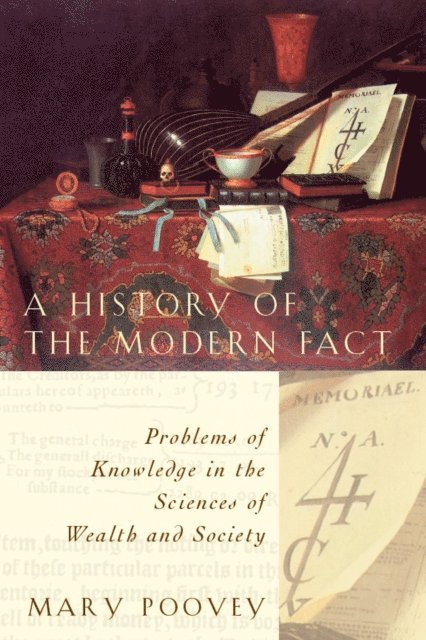
History of the Modern Fact
Problems of Knowledge in the Sciences of Wealth and Society
Inbunden, Engelska, 1998
645 kr
Skickas inom 7-10 vardagar
Exploring such questions as "how did fact become modernity's most favoured unit of knowledge?", this text contains ideas and texts from the publication of the first British manual on double-entry bookkeeping in 1588 to the institutionalization of statistics in the 1830s. It shows how the production of systematic knowledge from descriptions of observed particulars influenced government; how numerical representation became the privileged vehicle for generating useful facts; and how belief - whether figured as credit, credibility, or credulity - remained essential to the production of knowledge.
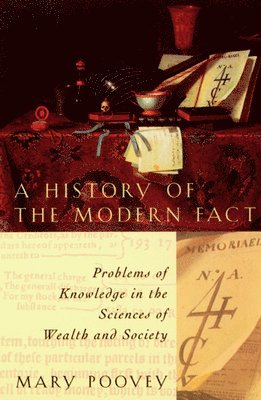
History of the Modern Fact
Problems of Knowledge in the Sciences of Wealth and Society
Häftad, Engelska, 1998
393 kr
Skickas inom 7-10 vardagar
Exploring such questions as "how did fact become modernity's most favoured unit of knowledge?", this text contains ideas and texts from the publication of the first British manual on double-entry bookkeeping in 1588 to the institutionalization of statistics in the 1830s. It shows how the production of systematic knowledge from descriptions of observed particulars influenced government; how numerical representation became the privileged vehicle for generating useful facts; and how belief - whether figured as credit, credibility, or credulity - remained essential to the production of knowledge.
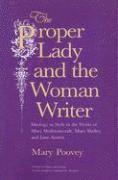
Proper Lady and the Woman Writer – Ideology as Style in the Works of Mary Wollstonecraft, Mary Shelley, and Jane Austen
Häftad, Engelska, 1985
343 kr
Skickas inom 7-10 vardagar
"A brilliant, original, and powerful book. . . . This is the most skillful integration of feminism and Marxist literary criticism that I know of." So writes critic Stephen Greenblatt about The Proper Lady and the Woman Writer, Mary Poovey's study of the struggle of three prominent writers to accommodate the artist's genius to the late eighteenth- and early nineteenth-century ideal of the modest, self-effacing "proper lady." Interpreting novels, letters, journals, and political tracts in the context of cultural strictures, Poovey makes an important contribution to English social and literary history and to feminist theory. "The proper lady was a handy concept for a developing bourgeois patriarchy, since it deprived women of worldly power, relegating them to a sanctified domestic sphere that, in complex ways, nourished and sustained the harsh 'real' world of men. With care and subtle intelligence, Poovey examines this 'guardian and nemesis of the female self' through the ways it is implicated in the style and strategies of three very different writers."—Rachel M. Brownstein, The Nation "The Proper Lady and the Woman Writer is a model of . . . creative discovery, providing a well-researched, illuminating history of women writers at the turn of the nineteenth century. [Poovey] creates sociologically and psychologically persuasive accounts of the writers: Wollstonecraft, who could never fully transcend the ideology of propriety she attacked; Shelley, who gradually assumed a mask of feminine propriety in her social and literary styles; and Austen, who was neither as critical of propriety as Wollstonecraft nor as accepting as Shelley ultimately became."—Deborah Kaplan, Novel
354 kr
Skickas inom 7-10 vardagar
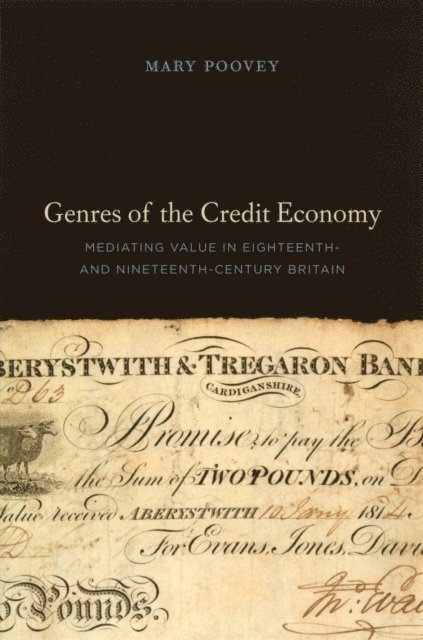
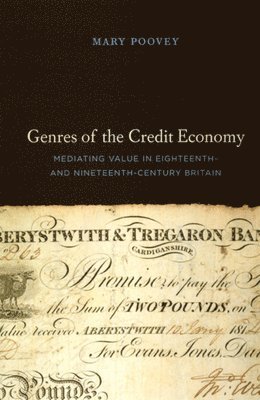
Genres of the Credit Economy
Mediating Value in Eighteenth- and Nineteenth-Century Britain
Häftad, Engelska, 2008
343 kr
Skickas inom 7-10 vardagar
How did banking, borrowing, investing, and even losing money - in other words, participating in the modern financial system - come to seem like routine activities of everyday life? "Genres of the Credit Economy" addresses this question by examining the history of financial instruments and representations of finance in eighteenth- and nineteenth-century Britain.Chronicling the process by which some of our most important conceptual categories were naturalized, Mary Poovey explores complex relationships among forms of writing that are not usually viewed together, from bills of exchange and bank checks, to realist novels and Romantic poems, to economic theory and financial journalism. Taking up all early forms of financial and monetary writing, Poovey argues that these genres mediated for early modern Britons the operations of a market system organized around credit and debt.By arguing that genre is a critical tool for historical and theoretical analysis and an agent in the events that formed the modern world, Poovey offers a new way to appreciate the character of the credit economy and demonstrates the contribution historians and literary scholars can make to understanding its operations.Much more than an exploration of writing on and around money, "Genres of the Credit Economy" offers startling insights about the evolution of disciplines and the separation of factual and fictional genres.