Maryann Cusimano Love – författare
Visar alla böcker från författaren Maryann Cusimano Love. Handla med fri frakt och snabb leverans.
8 produkter
8 produkter
94 kr
Skickas inom 7-10 vardagar
161 kr
Skickas inom 3-6 vardagar
174 kr
Skickas inom 3-6 vardagar
1 320 kr
Skickas inom 10-15 vardagar
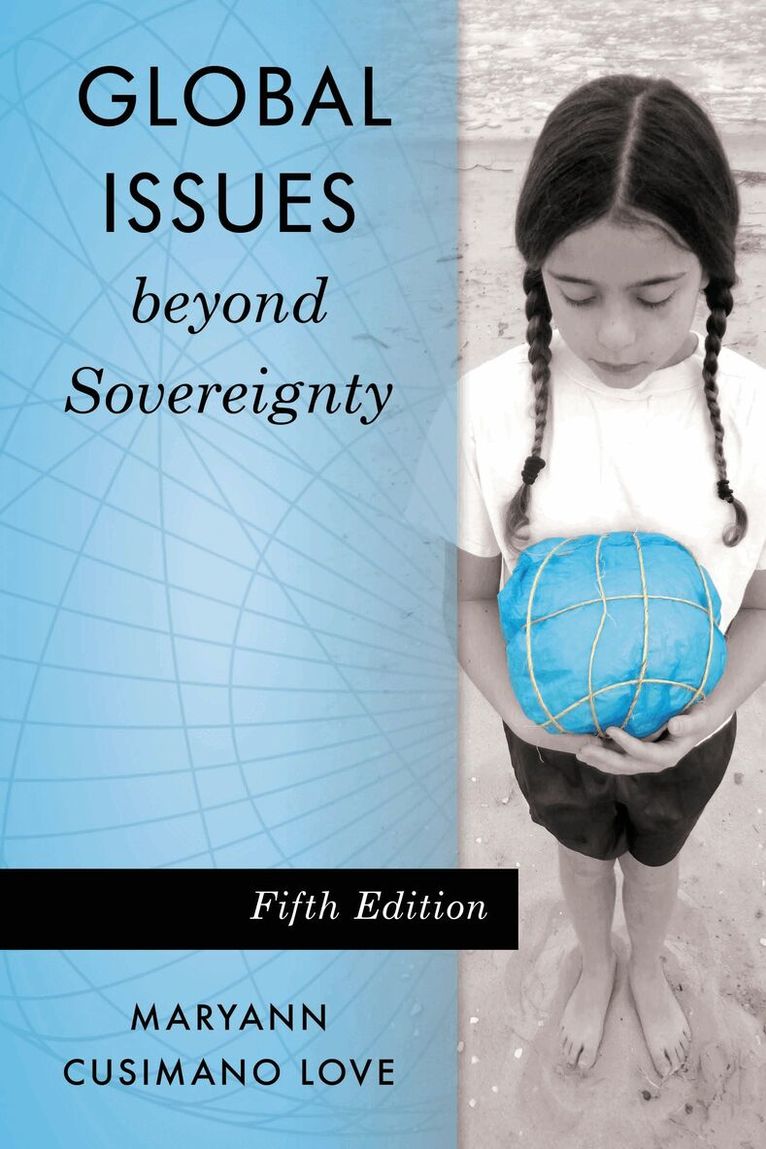
Other global issues books are a rather eclectic mash up of topics, headlines du jour, with an "and now this!" organizational scheme. The "hot" topics may have cooled by press time, and the presentation to students is disjointed, not clear. The approach is often a "scare 'em and leave 'em" presentation of a global horror show of problems, without clear arguments about the connections among the issues, or integrated discussions of solutions. In contrast, Global Issues Beyond Sovereignty provides a thesis and a common narrative throughout the "issue" chapters. The range of responses to manage global issues are compared and discussed throughout. Global problems move at internet speed; governments do not move so quickly. This creates gaps in what citizens expect the state to do, and what countries have the capacities to do. This paradox is a problem not only for weak or failing states; even the strongest states in the system struggle in how to effectively respond to global issues, from cybersecurity to environmental toxins. States cannot solve or manage trans-sovereign issues alone. The power of the private sector is growing (both legal and illegal, for profit and non-profit), while state power is flat or in some places declining. While private sector actors have means to impact transnational issues, they do not have a public mandate to do so. Countries increasingly must learn how to play well with others; this is easier said than done. Attempts to manage global issues flow through three channels: public sector responses, private sector responses, and mixed public-private partnerships. All three channels are explored throughout the book, uniting the issue chapters in a common discussion of challenges and responses. The conclusion presents lessons learned for theory and practice from managing global issues.
698 kr
Skickas inom 10-15 vardagar
Other global issues books are a rather eclectic mash up of topics, headlines du jour, with an "and now this!" organizational scheme. The "hot" topics may have cooled by press time, and the presentation to students is disjointed, not clear. The approach is often a "scare 'em and leave 'em" presentation of a global horror show of problems, without clear arguments about the connections among the issues, or integrated discussions of solutions. In contrast, Global Issues Beyond Sovereignty provides a thesis and a common narrative throughout the "issue" chapters. The range of responses to manage global issues are compared and discussed throughout. Global problems move at internet speed; governments do not move so quickly. This creates gaps in what citizens expect the state to do, and what countries have the capacities to do. This paradox is a problem not only for weak or failing states; even the strongest states in the system struggle in how to effectively respond to global issues, from cybersecurity to environmental toxins. States cannot solve or manage trans-sovereign issues alone. The power of the private sector is growing (both legal and illegal, for profit and non-profit), while state power is flat or in some places declining. While private sector actors have means to impact transnational issues, they do not have a public mandate to do so. Countries increasingly must learn how to play well with others; this is easier said than done. Attempts to manage global issues flow through three channels: public sector responses, private sector responses, and mixed public-private partnerships. All three channels are explored throughout the book, uniting the issue chapters in a common discussion of challenges and responses. The conclusion presents lessons learned for theory and practice from managing global issues.
886 kr
Kommande
Most U.S. Foreign Policy books cover the same terrain. They describe U.S. foreign policy actors (i.e., the President, Congress, media, interest groups, bureaucracies) and issues (economic policy, human rights, etc.). Foreign policy debates may be organized in an ad hoc fashion, geographically (what should U.S. foreign policy be toward Russia, China, Europe or the Middle East?), or chronologically (a diplomatic history approach). None of these approaches address the overarching challenge across foreign policy issue areas: how do U.S. foreign policy and U.S. foreign policy institutions adapt to the changes brought about by globalization? The oldest institutions of the U.S. government are foreign policy institutions: the Departments of State, Treasury, and War (today renamed Defense). Foreign policy was a central reason for the American Revolution, for changing institutions and creating the United States of America. Yet institutions born in 1776 or even 1946 struggle to meet 21st-century challenges. There is a disconnect between scholars and practitioners in thinking about the changes brought about by globalization; practitioners view these as more pressing and challenging than scholars, who are skeptical about whether they represent "real" or significant change. But, to take just one example, there is something new afoot in the privatization of U.S. foreign policy when non-state actors issue money (bitcoin). Our current foreign policy theories don't offer much guidance to policy makers charged with coming up with policy for virtual currencies. Maryann Cusimano Love discusses the history of change within U.S. foreign policy and its institutions, and provides antecedents to the current trends we are seeing.
483 kr
Kommande
Most U.S. Foreign Policy books cover the same terrain. They describe U.S. foreign policy actors (i.e., the President, Congress, media, interest groups, bureaucracies) and issues (economic policy, human rights, etc.). Foreign policy debates may be organized in an ad hoc fashion, geographically (what should U.S. foreign policy be toward Russia, China, Europe or the Middle East?), or chronologically (a diplomatic history approach). None of these approaches address the overarching challenge across foreign policy issue areas: how do U.S. foreign policy and U.S. foreign policy institutions adapt to the changes brought about by globalization? The oldest institutions of the U.S. government are foreign policy institutions: the Departments of State, Treasury, and War (today renamed Defense). Foreign policy was a central reason for the American Revolution, for changing institutions and creating the United States of America. Yet institutions born in 1776 or even 1946 struggle to meet 21st-century challenges. There is a disconnect between scholars and practitioners in thinking about the changes brought about by globalization; practitioners view these as more pressing and challenging than scholars, who are skeptical about whether they represent "real" or significant change. But, to take just one example, there is something new afoot in the privatization of U.S. foreign policy when non-state actors issue money (bitcoin). Our current foreign policy theories don't offer much guidance to policy makers charged with coming up with policy for virtual currencies. Maryann Cusimano Love discusses the history of change within U.S. foreign policy and its institutions, and provides antecedents to the current trends we are seeing.
104 kr
Skickas
I am your parent;you are my child.I am your quiet place;you are my wild.A day in the life of parent and child, full of smiles and giggles, messes and meals, boundless energy and well-earned rest - not to mention lots of love. Here, in simple, rhyming verse accompanied by colourful, playful illustrations by world-renowned artist Satomi Ichikawa, is one such day. Share it with others and treasure the memories.