Matteo Di Tullio - Böcker
Visar alla böcker från författaren Matteo Di Tullio. Handla med fri frakt och snabb leverans.
4 produkter
4 produkter
History of Environmental Resource Management in Europe
Sustainable Practices Through Time
Inbunden, Engelska, 2025
2 088 kr
Skickas inom 10-15 vardagar
Bringing together a broad range of case studies from across Europe, this book explores practices implemented to promote the sustainable use of environmental resources from the 16th century until the turn of the 21st century.How and with what results environmental resources were managed in the past is one of the main topics of debate in rural and environmental history and archaeology. This book explores the dialogue between these fields, drawing upon new studies and comparisons between ‘grammars’, concepts, and research practices from both fields to promote an interdisciplinary approach to the study of the environment. The book provides a comprehensive overview and comparison of the different practices of environmental resources management in Europe from the early modern period to contemporaneity, shedding light on a range of sustainability issues including land management, water supply, farming systems, and forestry. The interdisciplinary contributions in this volume provide original insight based on an analysis of written and material sources examining a range of different regions, including northern Italy, Slovenia, northern Spain, southern Spain, south-western France, and northern Romania.This book will be of interest to students and scholars of history and archaeology, as well as to those in research fields related to anthropology, sociology, environmental and agricultural sciences, and economics.
576 kr
Skickas inom 10-15 vardagar
The early decades of the sixteenth century were a turbulent time for the Italian peninsula as competing centres of power struggled for political control. Nowhere was this more true than the area contested by Milan and Venice, that was constantly crossed and occupied by rival armies. Investigating the impact of successive crises upon the inhabitants of the Po Valley, this book challenges many fundamental assumptions about the relationship between war and economic development and draws conclusion that have implications for early modern Europe as a whole. In traditional historiography, periods of war and general crisis have often been regarded as promoting a shift in resources from the communal towards a small number of individuals. However, through a close micro-study of a single region, this book offers a different perspective. Rather than promoting an aggressive individualism, it is argued that in times of general crisis, social networks aimed to reproduce themselves and the original status quo by developing creative solutions and institutions favouring co-operation. Furthermore the elites could not always exploit ’local’ wealth because of the need to protect their position of leadership within the community, which required the preservation of that very community. This thesis not only challenges the received wisdom, but also fuels a new debate about the ways in which economic growth occurred in Early Modern Italy and Europe.
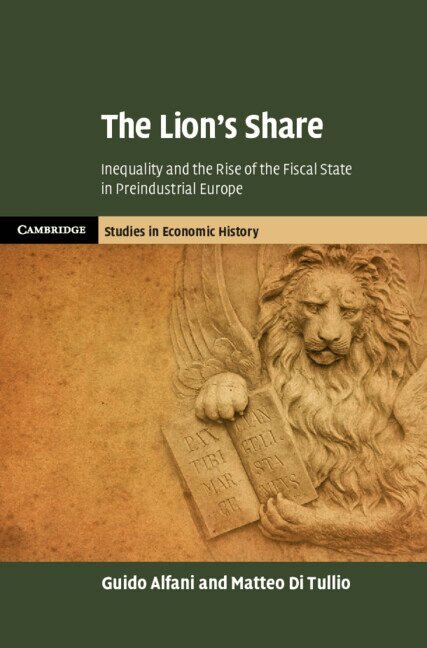
The Lion's Share
Inequality and the Rise of the Fiscal State in Preindustrial Europe
Inbunden, Engelska, 2019
552 kr
Skickas inom 7-10 vardagar
This is the most in-depth analysis of inequality and social polarization ever attempted for a preindustrial society. Using data from the archives of the Venetian Terraferma, and compared with information available for elsewhere in Europe, Guido Alfani and Matteo Di Tullio demonstrate that the rise of the fiscal-military state served to increase economic inequality in the early modern period. Preindustrial fiscal systems tended to be regressive in nature, and increased post-tax inequality compared to pre-tax - in contrast to what we would assume is the case in contemporary societies. This led to greater and greater disparities in wealth, which were made worse still as taxes were collected almost entirely to fund war and defence rather than social welfare. Though focused on Old Regime Europe, Alfani and Di Tullio's findings speak to contemporary debates about the roots of inequality and social stratification.
1 473 kr
Skickas inom 10-15 vardagar
The early decades of the sixteenth century were a turbulent time for the Italian peninsula as competing centres of power struggled for political control. Nowhere was this more true than the area contested by Milan and Venice, that was constantly crossed and occupied by rival armies. Investigating the impact of successive crises upon the inhabitants of the Po Valley, this book challenges many fundamental assumptions about the relationship between war and economic development and draws conclusion that have implications for early modern Europe as a whole. In traditional historiography, periods of war and general crisis have often been regarded as promoting a shift in resources from the communal towards a small number of individuals. However, through a close micro-study of a single region, this book offers a different perspective. Rather than promoting an aggressive individualism, it is argued that in times of general crisis, social networks aimed to reproduce themselves and the original status quo by developing creative solutions and institutions favouring co-operation. Furthermore the elites could not always exploit ’local’ wealth because of the need to protect their position of leadership within the community, which required the preservation of that very community. This thesis not only challenges the received wisdom, but also fuels a new debate about the ways in which economic growth occurred in Early Modern Italy and Europe.