Max Kistler - Böcker
Visar alla böcker från författaren Max Kistler. Handla med fri frakt och snabb leverans.
8 produkter
8 produkter
2 170 kr
Skickas inom 7-10 vardagar
This is the first English translation of Causalite´ et Lois de La Nature, and is an important contribution to the theory of causation. Max Kistler reconstructs a unified concept of causation that is general enough to adequately deal with both elementary physical processes, and the macroscopic level of phenomena we encounter in everyday life.This book will be of great interest to philosophers of science and metaphysics, and also to students and scholars of philosophy of mind where concepts of causation and law play a prominent role.
812 kr
Skickas inom 10-15 vardagar
This is the first English translation of Causalite´ et Lois de La Nature, and is an important contribution to the theory of causation. Max Kistler reconstructs a unified concept of causation that is general enough to adequately deal with both elementary physical processes, and the macroscopic level of phenomena we encounter in everyday life.This book will be of great interest to philosophers of science and metaphysics, and also to students and scholars of philosophy of mind where concepts of causation and law play a prominent role.
2 170 kr
Skickas inom 10-15 vardagar
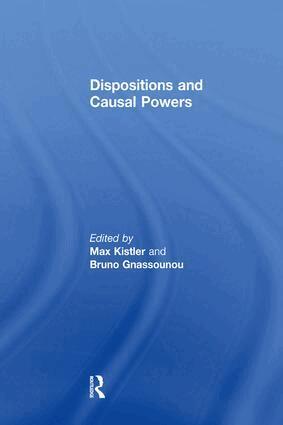
Dispositions are everywhere. We say that a wall is hard, that water quenches thirst and is transparent, that dogs can swim and oak trees can let their leaves fall, and that acid has the power to corrode metals. All these statements express attributions of dispositions, be they physical, physiological or psychological, yet there is much philosophical debate about how far, if at all, dispositional predicates can have complete meaning or figure in causal explanations. This collection of essays, by leading international researchers, examine the case for realism with respect to dispositions and causal powers in both metaphysics and science. Among the issues debated in this book is whether dispositions can be analyzed in terms of conditionals, whether all dispositions have a so-called categorical basis and, if they do, what is the relation between the disposition and its basis.
234 kr
Skickas inom 7-10 vardagar
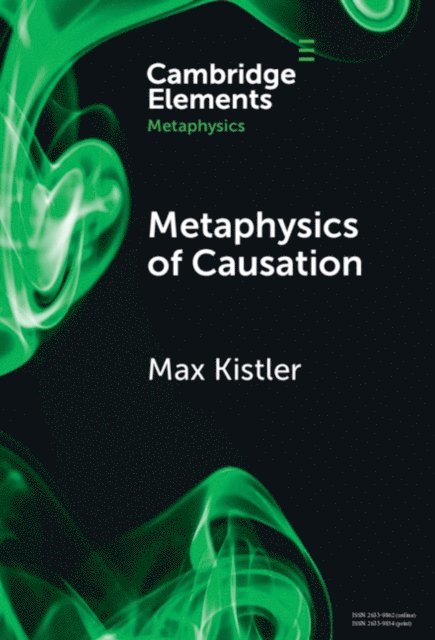
This Element presents the main attempts to account for causation as a metaphysical concept, in terms of 1) regularities and laws of nature, 2) conditional probabilities and Bayes nets, 3) necessitation between universals and causal powers, 4) counterfactual dependence, 5) interventions and causal models, and 6) processes and mechanisms. None of these accounts can provide a complete reductive analysis. However, some provide the means to distinguish several useful concepts of causation, such as total cause, contributing cause, direct and indirect cause, and actual cause. Moreover, some of these accounts can be construed so as to complement each other. The last part presents some contemporary debates: on the relation between grounding and causation, eliminativism with respect to causation in physics, the challenge against 'downward' causation from the Closure and Exclusion principles, robust and proportional causation, and degrees of causation. This title is also available as Open Access on Cambridge Core.
753 kr
Skickas inom 7-10 vardagar
This Element presents the main attempts to account for causation as a metaphysical concept, in terms of 1) regularities and laws of nature, 2) conditional probabilities and Bayes nets, 3) necessitation between universals and causal powers, 4) counterfactual dependence, 5) interventions and causal models, and 6) processes and mechanisms. None of these accounts can provide a complete reductive analysis. However, some provide the means to distinguish several useful concepts of causation, such as total cause, contributing cause, direct and indirect cause, and actual cause. Moreover, some of these accounts can be construed so as to complement each other. The last part presents some contemporary debates: on the relation between grounding and causation, eliminativism with respect to causation in physics, the challenge against 'downward' causation from the Closure and Exclusion principles, robust and proportional causation, and degrees of causation. This title is also available as Open Access on Cambridge Core.
635 kr
Skickas inom 10-15 vardagar
Dispositions are everywhere. We say that a wall is hard, that water quenches thirst and is transparent, that dogs can swim and oak trees can let their leaves fall, and that acid has the power to corrode metals. All these statements express attributions of dispositions, be they physical, physiological or psychological, yet there is much philosophical debate about how far, if at all, dispositional predicates can have complete meaning or figure in causal explanations. This collection of essays, by leading international researchers, examine the case for realism with respect to dispositions and causal powers in both metaphysics and science. Among the issues debated in this book is whether dispositions can be analyzed in terms of conditionals, whether all dispositions have a so-called categorical basis and, if they do, what is the relation between the disposition and its basis.
1 778 kr
Skickas inom 7-10 vardagar
The idea that persons or animals possess properties of two types, physical and mental, or psychological and cognitive, inevitably raises the question of how such cognitive properties can be causally efficacious, with respect to other cognitive, physiological, or physical properties, of the person herself or her environment. People, though composed exclusively of atoms like any other material object, have emergent properties that none of those components possess. Among them are cognitive properties. These properties give a person the power to cause both cognitive and physiological events and processes. The Material Mind defends a version of reductionist materialism. It modifies the conceptual framework of the debate by situating psychological and physiological properties of persons within a hierarchy of levels of reality. The Material Mind develops a concept of reduction that is compatible both with scientific change and with the possibility of multiple reduction bases. It shows that cognitive and other higher-level properties can be construed as causal powers, develops a concept of emergence compatible with reduction, and shows that the integration of the mind into a scientific conception of the world does not deprive mental properties and events of causal efficacy. The book defends the possibility of downward causation of physiological effects by cognitive causes, by questioning the justification of both the principle of the causal closure of the physical domain and the principle of causal-explanatory exclusion.
616 kr
Skickas inom 7-10 vardagar
The idea that persons or animals possess properties of two types, physical and mental, or psychological and cognitive, inevitably raises the question of how such cognitive properties can be causally efficacious, with respect to other cognitive, physiological, or physical properties, of the person herself or her environment. People, though composed exclusively of atoms like any other material object, have emergent properties that none of those components possess. Among them are cognitive properties. These properties give a person the power to cause both cognitive and physiological events and processes. The Material Mind defends a version of reductionist materialism. It modifies the conceptual framework of the debate by situating psychological and physiological properties of persons within a hierarchy of levels of reality. The Material Mind develops a concept of reduction that is compatible both with scientific change and with the possibility of multiple reduction bases. It shows that cognitive and other higher-level properties can be construed as causal powers, develops a concept of emergence compatible with reduction, and shows that the integration of the mind into a scientific conception of the world does not deprive mental properties and events of causal efficacy. The book defends the possibility of downward causation of physiological effects by cognitive causes, by questioning the justification of both the principle of the causal closure of the physical domain and the principle of causal-explanatory exclusion.