Mervyn Bennun - Böcker
Visar alla böcker från författaren Mervyn Bennun. Handla med fri frakt och snabb leverans.
2 produkter
2 produkter
218 kr
Skickas inom 5-8 vardagar
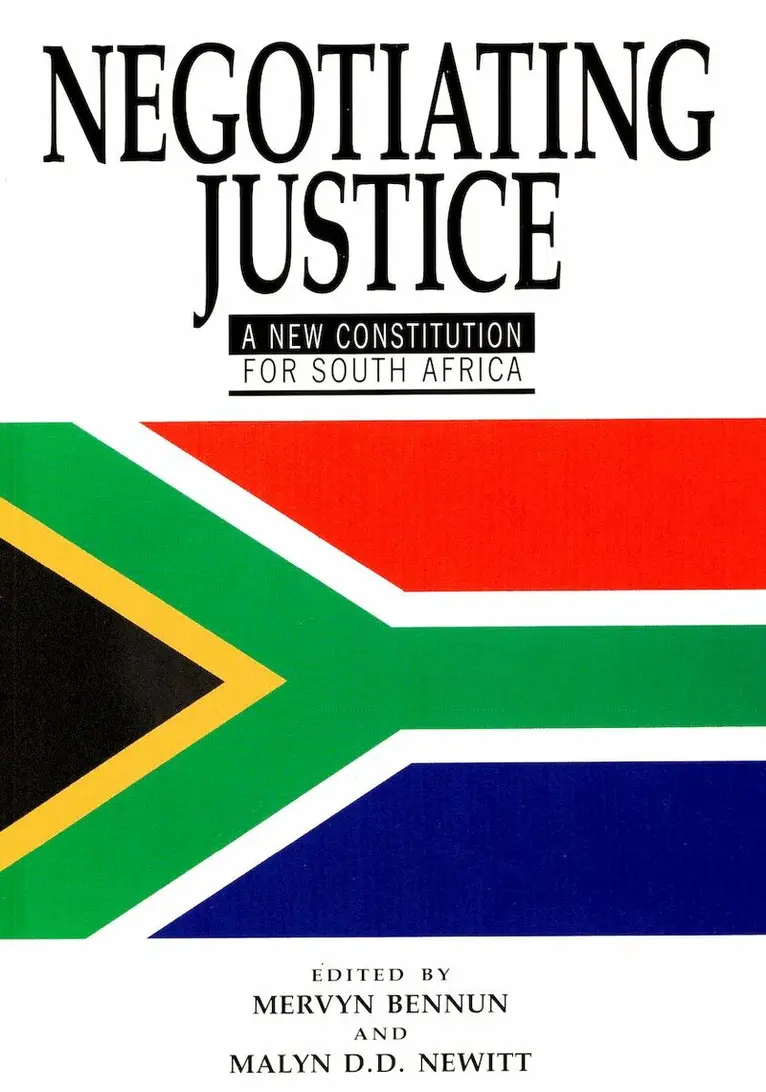
Between February 1990 when the South African president, F.W. De Klerk, released Nelson Mandela from prison and legalised the ANC, and April 1994 when the first democratic elections were held, South Africa experienced revolutionary changes. This book investigates some of the problems that came to the fore during this 'interregnum' and seeks to explain how a peaceful transition was eventually achieved.Ordinary South Africans as well as those entrusted with building the new state were forced to consider questions of profound importance —human rights and land reform, the future of the Homelands and the validity of the democratic process. The book focuses on these issues and on the interplay of forces of stability and instability in a period that saw the spread of communal violence on a horrific scale such that many prophesied the outbreak of civil war. It offers a way of understanding this violence by looking at the way it served the perceived interests of traditional apartheid and the objectives of the whites in the 'decolonisation' period. The book also explores the way in which De Klerk's National Party changed from support for Inkatha and the idea of Federalism to an alliance of convenience with the ANC which made the elections of April 1994 possible.The historical dimension of the new constitution is examined and the way in which the concept of democracy was negotiated. The book also focuses on the National Peace Accord and the attempt to create institu-tions to defuse the communal violence — the first time in the modern history of South Africa that an attempt was made to create institutions to serve the needs of the population as a whole. Other chapters examine the issue of a Bill of Rights and land reform. A close look at the experience of India since its independence throws light on what can and cannot be achieved through a formal Bill of Rights, and the options facing the new government in achieving stability in this area are realistically appraised.
264 kr
Tillfälligt slut
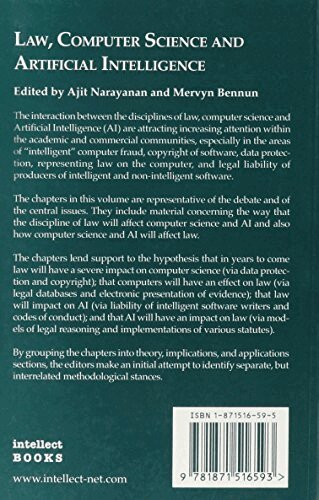
The interaction between the disciplines of law, computer science and artificial intelligence are attracting increasing attention within the academic and commercial communities, especially in the areas of "intelligent" computer fraud, copyright of software, data protection, representing law on the computer, and legal liability of producers of intelligent and nonintelligent software. The chapters in this volume are representative of the debate and of the central issues. They include material concerning the way that the discipline of law will affect computer science and AI and also how computer science and AI will affect law. The chapters lend support to the hypothesis that in years to come law will have a severe impact on computer science (via data protection and copyright); that computers will have an effect on law (via legal databases and electronic presentation of evidence); that law will impact on AI (via liability of intelligent software writers and codes of conduct); and that AI will have an impact on law (via models of legal reasoning and implementations of various statutes). By grouping the chapters into theory, implications, and applications sections, the authors make an initial attempt to identify separate, but interrelated methodological stances.