M.H. Alpar – författare
Visar alla böcker från författaren M.H. Alpar. Handla med fri frakt och snabb leverans.
4 produkter
4 produkter
Inbunden, Engelska, 1994
3 224 kr
Skickas inom 10-15 vardagar
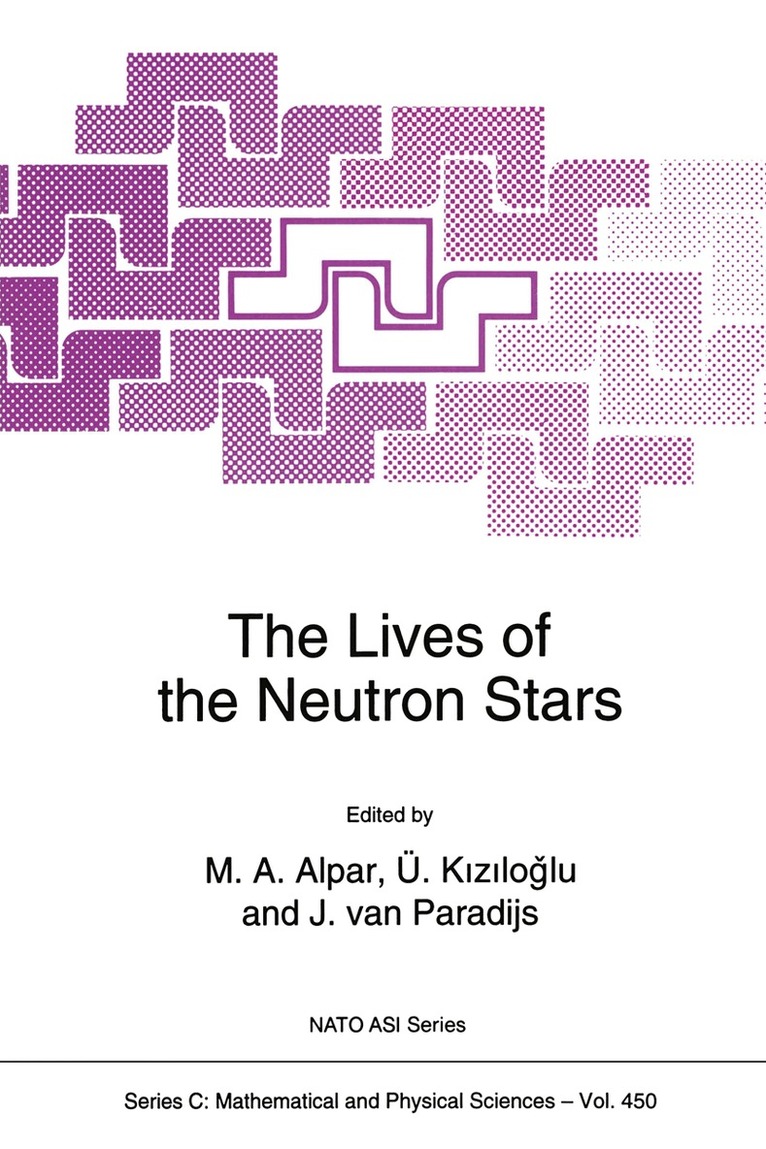
As the most compact known observable form of matter, neutron stars offer a fascinating range of problems to astrophysicists. This text offers a collection of reviews of current research on neutron stars, variously observed as radio pulsars, X-ray binaries, gamma-ray sources and sources of thermal X-ray emission. The reviews are meant for an audience of graduate students and scientists in the field, so they combine a tutorial approach with the objectives of a scientific review. The central theme of the book is evolution, stressing the changes of thermal, magnetic and dynamical properties throughout the lives of neutron stars.
Inbunden, Engelska, 1998
1 616 kr
Skickas inom 10-15 vardagar
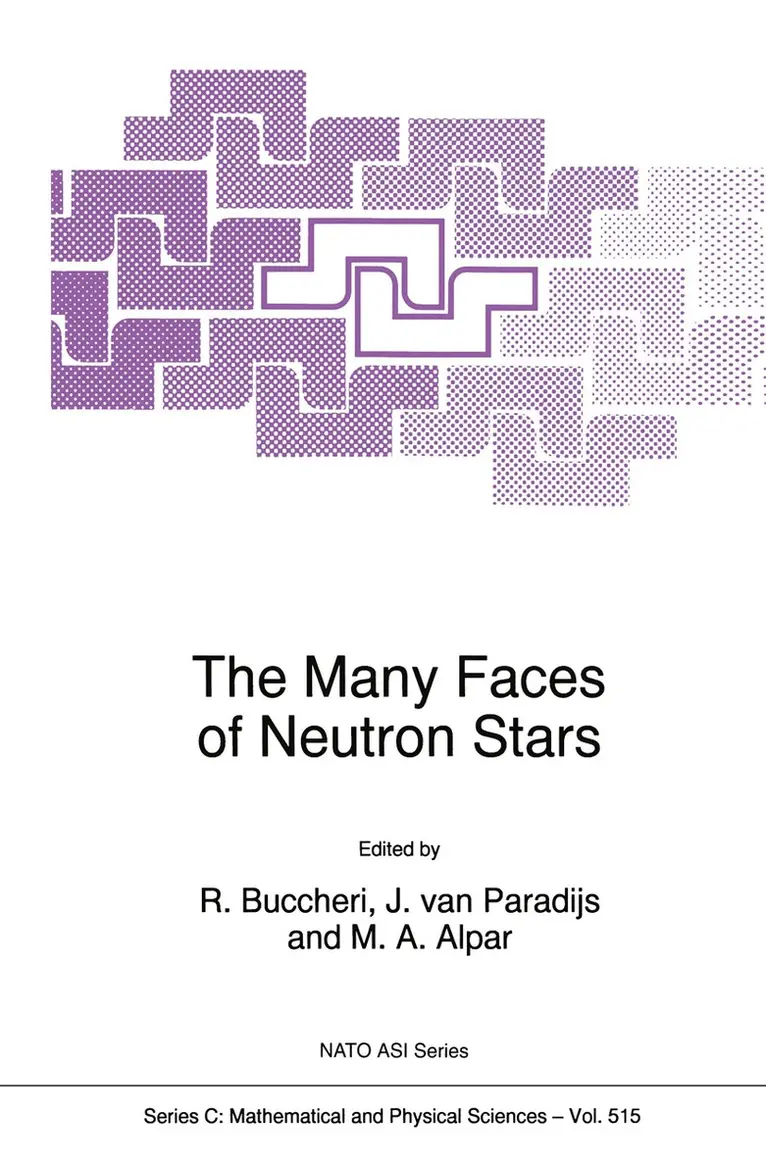
The NATO Advanced Study Institute 'The Many Faces of Neutron Stars' was the fourth in a series focusing on the astrophysics of neutron stars, which started with the ASI 'Timing Neutron Stars' (Qe§me, Turkey, April 1988), and ~as followed by 'Neutron Stars, and Interdisciplinary Field' (Agia Pelagia, Greece, September 1990), and 'The Lives ofthe Neutron Stars' (Kemer, Turkey, Septem ber 1993). The first ASI had as its theme the main types of observations from which we infer the properties of neutron stars, i.e., the timing of radio pulsars and accret ing neutron stars in X-ray binaries. The second ASI centered on the interplay between various areas of physics and their sometimes exotic applications to the extreme conditions encountered in neutron stars. In the third ASI the evolu tionary connections that exist between different types of neutron stars provided the theme of the lectures. During the last several years the number of neutron stars in their various disguises, e.g., millisecond radio pulsars, single neutron star X-ray sources, and soft gamma-ray repeaters has increased substantially, and new phenomena have been discovered in known populations of neutron star systems, e.g., the kHz QPO in low-mass X-ray binaries. For this reason we have selected 'The Many Faces of Neutron Stars' as the theme of this fourth Advanced Study Institute on neutron stars.
Häftad, Engelska, 2010
1 616 kr
Skickas inom 10-15 vardagar
The NATO Advanced Study Institute 'The Many Faces of Neutron Stars' was the fourth in a series focusing on the astrophysics of neutron stars, which started with the ASI 'Timing Neutron Stars' (Qe§me, Turkey, April 1988), and ~as followed by 'Neutron Stars, and Interdisciplinary Field' (Agia Pelagia, Greece, September 1990), and 'The Lives ofthe Neutron Stars' (Kemer, Turkey, Septem ber 1993). The first ASI had as its theme the main types of observations from which we infer the properties of neutron stars, i.e., the timing of radio pulsars and accret ing neutron stars in X-ray binaries. The second ASI centered on the interplay between various areas of physics and their sometimes exotic applications to the extreme conditions encountered in neutron stars. In the third ASI the evolu tionary connections that exist between different types of neutron stars provided the theme of the lectures. During the last several years the number of neutron stars in their various disguises, e.g., millisecond radio pulsars, single neutron star X-ray sources, and soft gamma-ray repeaters has increased substantially, and new phenomena have been discovered in known populations of neutron star systems, e.g., the kHz QPO in low-mass X-ray binaries. For this reason we have selected 'The Many Faces of Neutron Stars' as the theme of this fourth Advanced Study Institute on neutron stars.
Häftad, Engelska, 2012
3 224 kr
Skickas inom 10-15 vardagar
This NATO AS! was the third in the series of Advanced Study Institutes on neutron stars, which started with 'Timing Neutron Stars', held in Qe§me near izmir, Turkey (April 1988), followed by 'Neutron Stars, an Interdis ciplinary Subject', held in Agia Pelagia on the island of Crete (September 1990). The first school centered on our main observational access to neu tron stars, i. e. the timing of radio pulsars and accretion powered neutron stars, and on what timing of neutron stars teaches us of their structure and environment. The second school had as its theme the interplay between diverse areas of physics which find interesting, even exotic applications in the extreme conditions of neutron stars and their magnetospheres. As the field has developed, with the number of observed neutron stars rapidly in creasing, and our knowledge of many individual neutron stars getting deeper and more detailed, an evolutionary picture of neutron stars has started to emerge. This led us to choose 'The Lives of the Neutron Stars' as the uni fying theme of this third Advanced Study Institute on neutron stars. Different types of neutron star activity have been proposed to follow one another in stages during the lives of neutron stars in the same basic population; the evolutionary connection between low-mass X-ray binaries and millisecond radio pulsars is perhaps the prime example.