R. Buccheri – författare
Visar alla böcker från författaren R. Buccheri. Handla med fri frakt och snabb leverans.
15 produkter
15 produkter
Inbunden, Engelska, 1992
865 kr
Skickas inom 10-15 vardagar
Inbunden, Engelska, 2000
1 079 kr
Skickas inom 10-15 vardagar
Every human being is aware of the flow of time. This fact is embodied in the existence of such notions as the past and the future, the two domains being separated from each other by the single moment of the present. While the past is regarded as fixed and definite, the future is viewed as unknown, uncertain, and undetermined. The only perceivable moment is the present, the `now' - the ever-changing point moving from the past into the future. Physics tells us a different story: not only are the vast majority of physical laws time-reversible, but the concept of the `now' itself has no place at all in physics. In other words, the equations of physics do not distinguish between the past and the future and seem to be completely oblivious to the very idea of the present. This book discusses the biological and psychological aspects of perception of time, and the problems related to the determination of location arising from quantum physics, together with comments and opinions from philosophers and physicists.
Inbunden, Engelska, 1998
1 616 kr
Skickas inom 10-15 vardagar
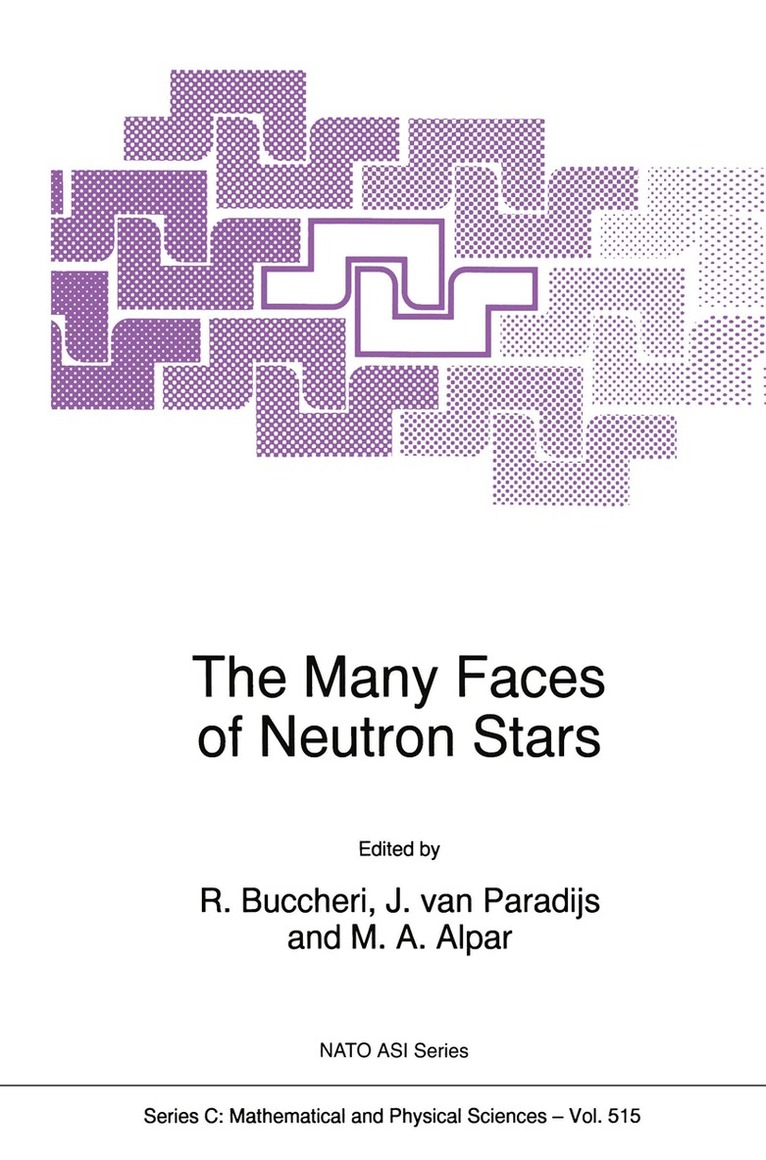
The NATO Advanced Study Institute 'The Many Faces of Neutron Stars' was the fourth in a series focusing on the astrophysics of neutron stars, which started with the ASI 'Timing Neutron Stars' (Qe§me, Turkey, April 1988), and ~as followed by 'Neutron Stars, and Interdisciplinary Field' (Agia Pelagia, Greece, September 1990), and 'The Lives ofthe Neutron Stars' (Kemer, Turkey, Septem ber 1993). The first ASI had as its theme the main types of observations from which we infer the properties of neutron stars, i.e., the timing of radio pulsars and accret ing neutron stars in X-ray binaries. The second ASI centered on the interplay between various areas of physics and their sometimes exotic applications to the extreme conditions encountered in neutron stars. In the third ASI the evolu tionary connections that exist between different types of neutron stars provided the theme of the lectures. During the last several years the number of neutron stars in their various disguises, e.g., millisecond radio pulsars, single neutron star X-ray sources, and soft gamma-ray repeaters has increased substantially, and new phenomena have been discovered in known populations of neutron star systems, e.g., the kHz QPO in low-mass X-ray binaries. For this reason we have selected 'The Many Faces of Neutron Stars' as the theme of this fourth Advanced Study Institute on neutron stars.
Inbunden, Engelska, 2003
2 366 kr
Skickas inom 10-15 vardagar
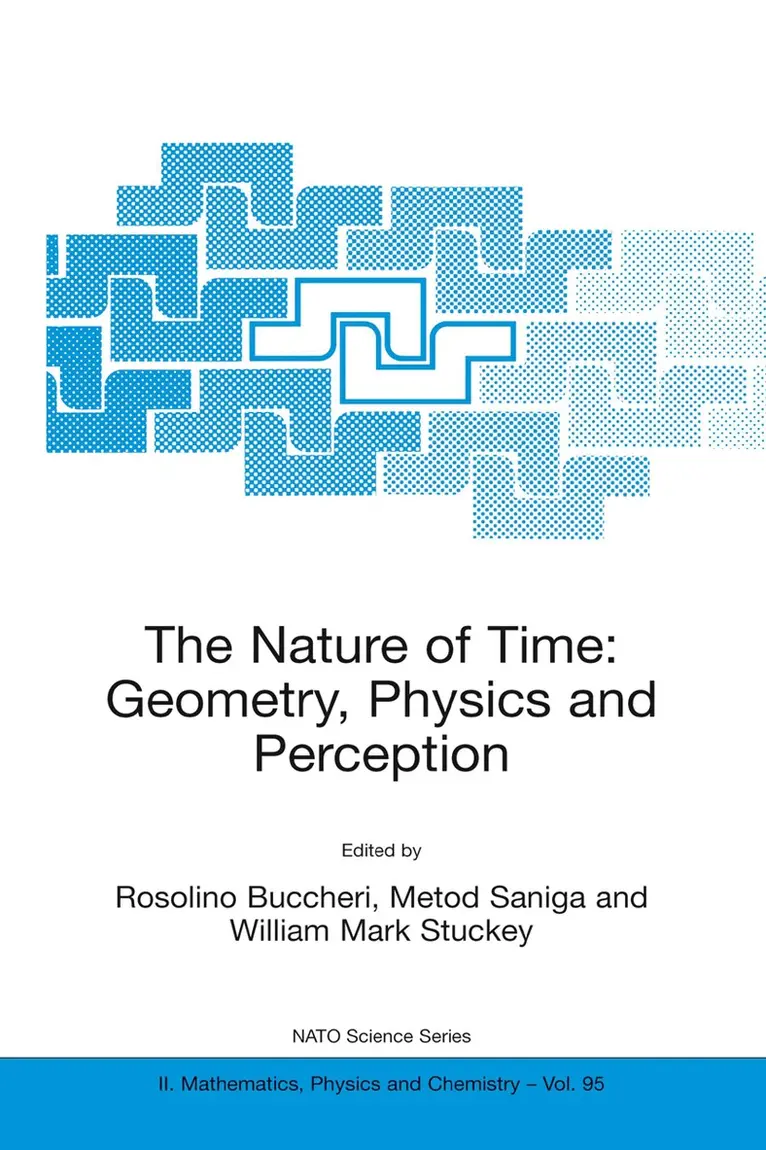
There are very few concepts that fascinate equally a theoretical physicist studying black holes and a patient undergoing seriolls mental psychosis. Time, undoubtedly, can well be ranked among them. For the measure of time inside a black hole is no less bizarre than the perception of time by a schizophrenic, who may perceive it as completely "suspended," "standing still," or even "reversing its direction. " The nature of time is certainly shrouded in profound mystery. This, perhaps, since the concept entails multifarious, and occasionally incongruous, facets. No wonder the subject attracts the serious attention of scholars on the one hand, and of the lay public on the other. Our Advanced Research Workshop is an excellent il lustration of this point, as the reader will soon discover. It turned out to be a unique professional forum for an unusually lively, effective and fruitful exchange of ideas and beliefs among 48 participants from 20 countries worldwide, selected out of more than a hundred applicants. The present book is based on the select talks presented at the meeting, and aims to provide the interested layperson and specialist alike with a multidisciplinary sampling of the most up-to-date scholarly research on the nature of time. It represents a coherent, state-of-the-art volume showing that research relevant to this topic is necessarily interdisciplinary and does not ignore such delicate issues as "altered" states of consciousness, religion and metaphysics.
Häftad, Engelska, 2003
2 366 kr
Skickas inom 10-15 vardagar
There are very few concepts that fascinate equally a theoretical physicist studying black holes and a patient undergoing seriolls mental psychosis. Time, undoubtedly, can well be ranked among them. For the measure of time inside a black hole is no less bizarre than the perception of time by a schizophrenic, who may perceive it as completely "suspended," "standing still," or even "reversing its direction. " The nature of time is certainly shrouded in profound mystery. This, perhaps, since the concept entails multifarious, and occasionally incongruous, facets. No wonder the subject attracts the serious attention of scholars on the one hand, and of the lay public on the other. Our Advanced Research Workshop is an excellent il lustration of this point, as the reader will soon discover. It turned out to be a unique professional forum for an unusually lively, effective and fruitful exchange of ideas and beliefs among 48 participants from 20 countries worldwide, selected out of more than a hundred applicants. The present book is based on the select talks presented at the meeting, and aims to provide the interested layperson and specialist alike with a multidisciplinary sampling of the most up-to-date scholarly research on the nature of time. It represents a coherent, state-of-the-art volume showing that research relevant to this topic is necessarily interdisciplinary and does not ignore such delicate issues as "altered" states of consciousness, religion and metaphysics.
Häftad, Engelska, 2012
543 kr
Skickas inom 10-15 vardagar
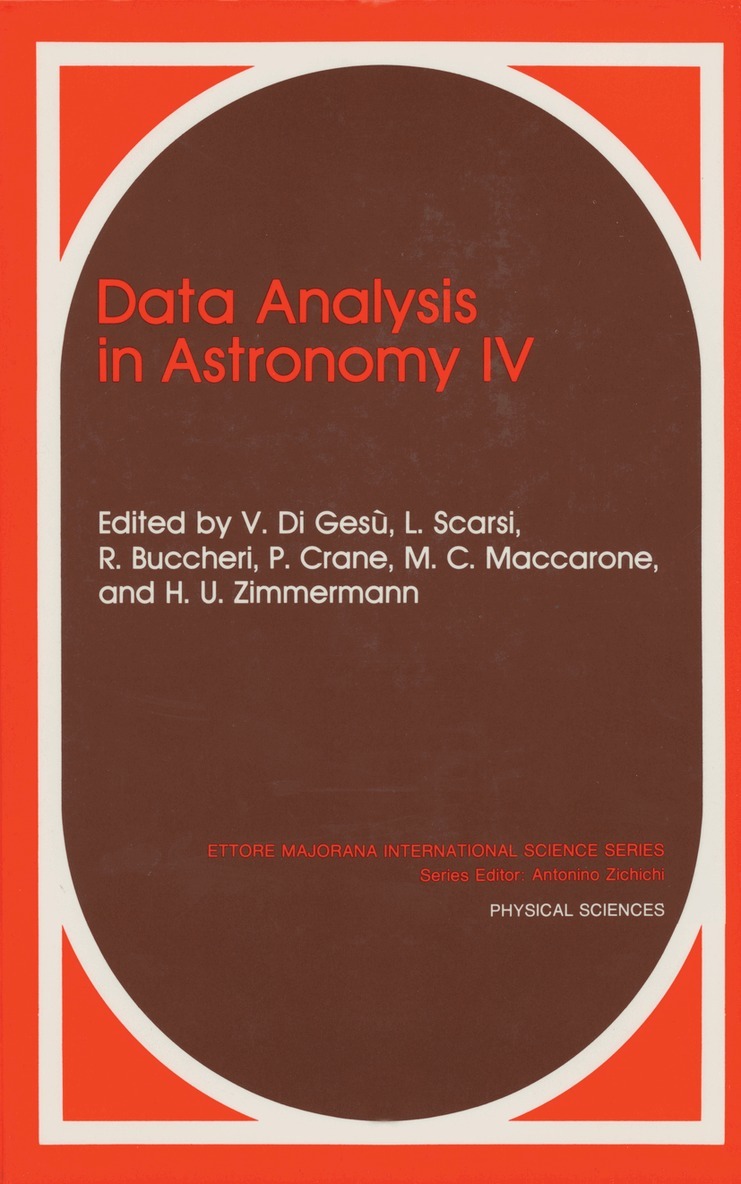
In this book are reported the main results presented at the "Fourth International Workshop on Data Analysis in Astronomy", held at the Ettore Majorana Center for Scientific Culture, Erice, Sicily, Italy, on April 12-19, 1991. The Workshop was preceded by three workshops on the same subject held in Erice in 1984, 1986 and 1988. The frrst workshop (Erice 1984) was dominated by presentations of "Systems for Data Analysis"; the main systems proposed were MIDAS, AlPS, RIAIP, and SAIA. Methodologies and image analysis topics were also presented with the emphasis on cluster analysis, multivariate analysis, bootstrap methods, time analysis, periodicity, 2D photometry, spectrometry, and data compression. A general presentation on "Parallel Processing" was made which encompassed new architectures, data structures and languages. The second workshop (Erice 1986) reviewed the "Data Handling Systems" planned for large major satellites and ground experiments (VLA, HST, ROSAT, COMPASS-COMPTEL). Data analysis methods applied to physical interpretation were mainly considered (cluster photometry, astronomical optical data compression, cluster analysis for pulsar light curves, coded aperture imaging). New parallel and vectorial machines were presented (cellular machines, PAPIA-machine, MPP-machine, vector computers in astronomy). Contributions in the field of artificial intelligence and planned applications to astronomy were also considered (expert systems, artificial intelligence in computer vision).
Häftad, Engelska, 2014
1 079 kr
Skickas inom 10-15 vardagar
Every human being is aware of the flow of time. This fact is embodied in the existence of such notions as the past and the future, the two domains being separated from each other by the single moment of the present. While the past is regarded as fixed and definite, the future is viewed as unknown, uncertain, and undetermined. The only perceivable moment is the present, the `now' - the ever-changing point moving from the past into the future. Physics tells us a different story: not only are the vast majority of physical laws time-reversible, but the concept of the `now' itself has no place at all in physics. In other words, the equations of physics do not distinguish between the past and the future and seem to be completely oblivious to the very idea of the present. This book discusses the biological and psychological aspects of perception of time, and the problems related to the determination of location arising from quantum physics, together with comments and opinions from philosophers and physicists.
E-bok
PDF, Engelska, 2012712 kr
Läs direkt efter köp
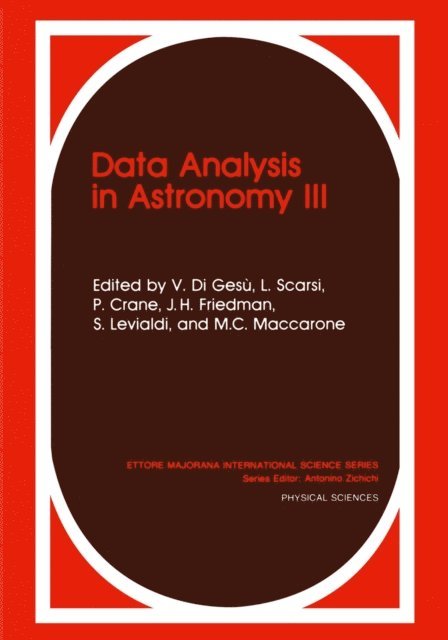
In this book are reported the main results presented at the "Fourth International Workshop on Data Analysis in Astronomy", held at the Ettore Majorana Center for Scientific Culture, Erice, Sicily, Italy, on April 12-19, 1991. The Workshop was preceded by three workshops on the same subject held in Erice in 1984, 1986 and 1988. The frrst workshop (Erice 1984) was dominated by presentations of "Systems for Data Analysis"; the main systems proposed were MIDAS, AlPS, RIAIP, and SAIA. Methodologies and image analysis topics were also presented with the emphasis on cluster analysis, multivariate analysis, bootstrap methods, time analysis, periodicity, 2D photometry, spectrometry, and data compression. A general presentation on "Parallel Processing" was made which encompassed new architectures, data structures and languages. The second workshop (Erice 1986) reviewed the "Data Handling Systems" planned for large major satellites and ground experiments (VLA, HST, ROSAT, COMPASS-COMPTEL). Data analysis methods applied to physical interpretation were mainly considered (cluster photometry, astronomical optical data compression, cluster analysis for pulsar light curves, coded aperture imaging). New parallel and vectorial machines were presented (cellular machines, PAPIA-machine, MPP-machine, vector computers in astronomy). Contributions in the field of artificial intelligence and planned applications to astronomy were also considered (expert systems, artificial intelligence in computer vision).
E-bok
PDF, Engelska, 20121 416 kr
Läs direkt efter köp
Every human being is aware of the flow of time. This fact is embodied in the existence of such notions as the past and the future, the two domains being separated from each other by the single moment of the present. While the past is regarded as fixed and definite, the future is viewed as unknown, uncertain, and undetermined. The only perceivable moment is the present, the `now'' - the ever-changing point moving from the past into the future. Physics tells us a different story: not only are the vast majority of physical laws time-reversible, but the concept of the `now'' itself has no place at all in physics. In other words, the equations of physics do not distinguish between the past and the future and seem to be completely oblivious to the very idea of the present. This book discusses the biological and psychological aspects of perception of time, and the problems related to the determination of location arising from quantum physics, together with comments and opinions from philosophers and physicists.
E-bok
PDF, Engelska, 2012712 kr
Läs direkt efter köp
In the book are reported the main results presented at the Third International Workshop on Data Analysis in Astronomy, held at the EUore Majorana Center for Scientific Culture, Erice, Sicily, Italy, on June 20-27,1988. The Workshop was the natural evolution of the two previous ones. The main goal of the first edition (Erice 1984) was to start a scientific interaction between Astronomers and Computer Scientists. Aim of the second (Erice 1986) was to look at the progress in data analysis methods and dedicated hardware technology. Data analysis problems become harder whenever the data are poor in statistics or the signal is weak and embedded in structured background. Experiments collecting data of such a nature require new and non-standard methodologies. Possibilistic approaches could be merged with the statistical ones, in order to formalize all the knowledge used by the scientists to reach conclusions. Moreover, the last decade has been characterized by very fast developments of Intelligent Systems for data analysis (knowledge based systems, ... ) that would be useful to support astronomers in complex decision making. For these reasons, the last edition of the workshop was intended to provide an overview on the state of the art in the data analysis methodologies and tools in the new frontieres of the astrophysics (y-astronomy, neutrino astronomy, gravitational waves, background radiation and extreme cosmic ray energy spectrum). The book is organized in two sections: - Data analysis methods and tools, - New frontieres in astronomy.
Häftad, Engelska, 2012
543 kr
Skickas inom 10-15 vardagar
In the book are reported the main results presented at the Third International Workshop on Data Analysis in Astronomy, held at the EUore Majorana Center for Scientific Culture, Erice, Sicily, Italy, on June 20-27,1988. The Workshop was the natural evolution of the two previous ones. The main goal of the first edition (Erice 1984) was to start a scientific interaction between Astronomers and Computer Scientists. Aim of the second (Erice 1986) was to look at the progress in data analysis methods and dedicated hardware technology. Data analysis problems become harder whenever the data are poor in statistics or the signal is weak and embedded in structured background. Experiments collecting data of such a nature require new and non-standard methodologies. Possibilistic approaches could be merged with the statistical ones, in order to formalize all the knowledge used by the scientists to reach conclusions. Moreover, the last decade has been characterized by very fast developments of Intelligent Systems for data analysis (knowledge based systems, ... ) that would be useful to support astronomers in complex decision making. For these reasons, the last edition of the workshop was intended to provide an overview on the state of the art in the data analysis methodologies and tools in the new frontieres of the astrophysics (y-astronomy, neutrino astronomy, gravitational waves, background radiation and extreme cosmic ray energy spectrum). The book is organized in two sections: - Data analysis methods and tools, - New frontieres in astronomy.
Häftad, Engelska, 2010
1 616 kr
Skickas inom 10-15 vardagar
The NATO Advanced Study Institute 'The Many Faces of Neutron Stars' was the fourth in a series focusing on the astrophysics of neutron stars, which started with the ASI 'Timing Neutron Stars' (Qe§me, Turkey, April 1988), and ~as followed by 'Neutron Stars, and Interdisciplinary Field' (Agia Pelagia, Greece, September 1990), and 'The Lives ofthe Neutron Stars' (Kemer, Turkey, Septem ber 1993). The first ASI had as its theme the main types of observations from which we infer the properties of neutron stars, i.e., the timing of radio pulsars and accret ing neutron stars in X-ray binaries. The second ASI centered on the interplay between various areas of physics and their sometimes exotic applications to the extreme conditions encountered in neutron stars. In the third ASI the evolu tionary connections that exist between different types of neutron stars provided the theme of the lectures. During the last several years the number of neutron stars in their various disguises, e.g., millisecond radio pulsars, single neutron star X-ray sources, and soft gamma-ray repeaters has increased substantially, and new phenomena have been discovered in known populations of neutron star systems, e.g., the kHz QPO in low-mass X-ray binaries. For this reason we have selected 'The Many Faces of Neutron Stars' as the theme of this fourth Advanced Study Institute on neutron stars.
E-bok
PDF, Engelska, 2012687 kr
Läs direkt efter köp
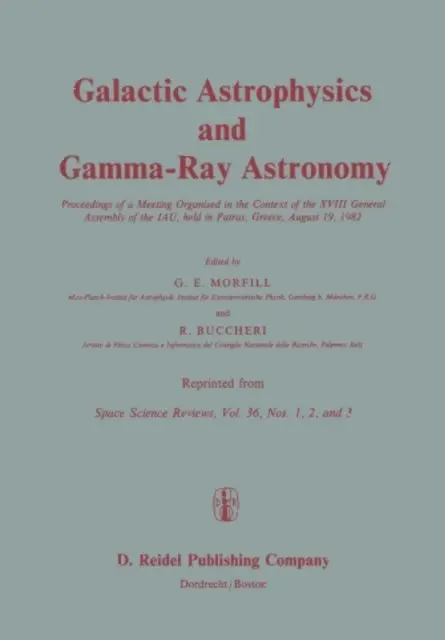
This book contains the invited and contributed lectures presented at a meeting organised in the context of the XVIII general assembly ofthe IAU, held in Patras, August 19, 1982. Roughly one hundred scientists attended this meeting, the discussions were livel- sometimes heated - and the original time span allocated to the meeting was as a result, comfortably exceeded by about 50 % . The aim of this meeting was to determine the role of galactic gamma-ray astronomy within the general concept of galactic astrophysics. The timing, at the end of the COS-B mission, was regarded as opportune, because it gives interested astrophysicists the possibility for interdisciplinary studies using the existing gamma-ray data base (e.g. comparison with infrared, radio, X-ray, etc. astronomies), as well as for theoretical studies. The next generation of gamma-ray detectors will probably not be in operation for another 5 to 10 years, and therefore it is hoped that the proceeding of this meeting can be used (in the intermediate time) as a basis for further studies, as a stimulation for more theoretical work and as an important contribution for defining the aims and operation of future gamma-ray missions. The interrelationship with other branches of astronomy, the astrophysical implications and the study of relevant physical processes using available measurements in the near-Earth environment were important results of the meeting. Many persons contributed to the success of the meeting, in particular all those who either presented a contribution and/or took part in the discussions.
Häftad, Engelska, 2011
543 kr
Skickas inom 10-15 vardagar
This book contains the invited and contributed lectures presented at a meeting organised in the context of the XVIII general assembly ofthe IAU, held in Patras, August 19, 1982. Roughly one hundred scientists attended this meeting, the discussions were livel- sometimes heated - and the original time span allocated to the meeting was as a result, comfortably exceeded by about 50 % . The aim of this meeting was to determine the role of galactic gamma-ray astronomy within the general concept of galactic astrophysics. The timing, at the end of the COS-B mission, was regarded as opportune, because it gives interested astrophysicists the possibility for interdisciplinary studies using the existing gamma-ray data base (e.g. comparison with infrared, radio, X-ray, etc. astronomies), as well as for theoretical studies. The next generation of gamma-ray detectors will probably not be in operation for another 5 to 10 years, and therefore it is hoped that the proceeding of this meeting can be used (in the intermediate time) as a basis for further studies, as a stimulation for more theoretical work and as an important contribution for defining the aims and operation of future gamma-ray missions. The interrelationship with other branches of astronomy, the astrophysical implications and the study of relevant physical processes using available measurements in the near-Earth environment were important results of the meeting. Many persons contributed to the success of the meeting, in particular all those who either presented a contribution and/or took part in the discussions.
E-bok
PDF, Engelska, 20123 046 kr
Läs direkt efter köp
There are very few concepts that fascinate equally a theoretical physicist studying black holes and a patient undergoing seriolls mental psychosis. Time, undoubtedly, can well be ranked among them. For the measure of time inside a black hole is no less bizarre than the perception of time by a schizophrenic, who may perceive it as completely "suspended," "standing still," or even "reversing its direction. " The nature of time is certainly shrouded in profound mystery. This, perhaps, since the concept entails multifarious, and occasionally incongruous, facets. No wonder the subject attracts the serious attention of scholars on the one hand, and of the lay public on the other. Our Advanced Research Workshop is an excellent il lustration of this point, as the reader will soon discover. It turned out to be a unique professional forum for an unusually lively, effective and fruitful exchange of ideas and beliefs among 48 participants from 20 countries worldwide, selected out of more than a hundred applicants. The present book is based on the select talks presented at the meeting, and aims to provide the interested layperson and specialist alike with a multidisciplinary sampling of the most up-to-date scholarly research on the nature of time. It represents a coherent, state-of-the-art volume showing that research relevant to this topic is necessarily interdisciplinary and does not ignore such delicate issues as "altered" states of consciousness, religion and metaphysics.